Fichera Mario, Nanetti Lorenzo, Monelli Alessia, Castaldo Anna, Marchini Gloria, Neri Marianna, Vukaj Xhuljano, Marzorati Mauro, Porcelli Simone, Mariotti Caterina
Unit of Medical Genetics and Neurogenetics, Fondazione IRCCS Istituto Neurologico Carlo Besta, Milan, Italy.
Department of Molecular Medicine, University of Pavia, Pavia, Italy.
Front Pharmacol. 2024 Mar 19;15:1342965. doi: 10.3389/fphar.2024.1342965. eCollection 2024.
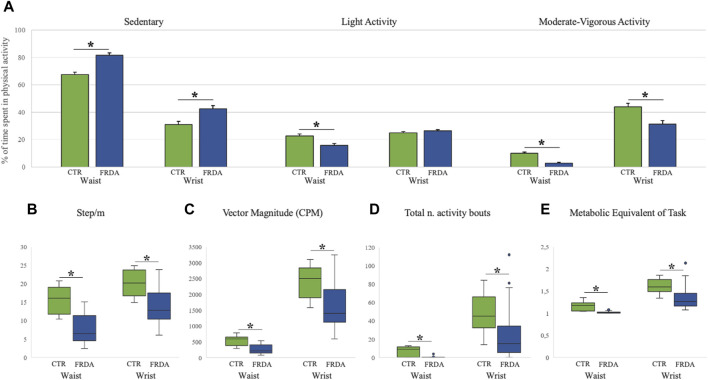
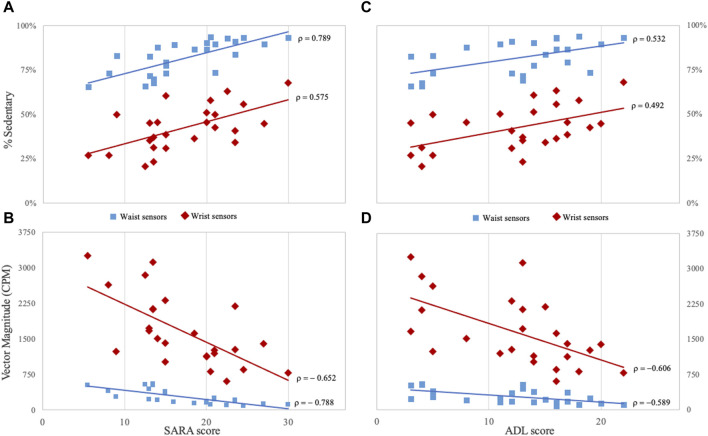
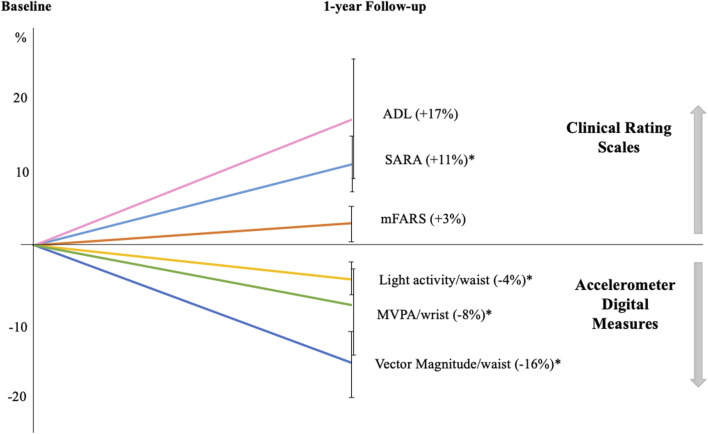
Quantitative measurement of physical activity may complement neurological evaluation and provide valuable information on patients' daily life. We evaluated longitudinal changes of physical activity in patients with Friedreich ataxia (FRDA) using remote monitoring with wearable sensors. We performed an observational study in 26 adult patients with FRDA and 13 age-sex matched healthy controls (CTR). Participants were asked to wear two wearable sensors, at non-dominant wrist and at waist, for 7 days during waking hours. Evaluations were performed at baseline and at 1-year follow-up. We analysed the percentage of time spent in sedentary or physical activities, the Vector Magnitude on the 3 axes (VM3), and average number of steps/min. Study participants were also evaluated with ataxia clinical scales and functional tests for upper limbs dexterity and walking capability. Baseline data showed that patients had an overall reduced level of physical activity as compared to CTR. Accelerometer-based measures were highly correlated with clinical scales and disease duration in FRDA. Significantly changes from baseline to l-year follow-up were observed in patients for the following measures: (i) VM3; (ii) percentage of sedentary and light activity, and (iii) percentage of Moderate-Vigorous Physical Activity (MVPA). Reduction in physical activity corresponded to worsening in gait score of the Scale for Assessment and Rating of Ataxia. Real-life activity monitoring is feasible and well tolerated by patients. Accelerometer-based measures can quantify disease progression in FRDA over 1 year, providing objective information about patient's motor activities and supporting the usefulness of these data as complementary outcome measure in interventional trials.
身体活动的定量测量可以补充神经学评估,并提供有关患者日常生活的有价值信息。我们使用可穿戴传感器进行远程监测,评估了弗里德赖希共济失调(FRDA)患者身体活动的纵向变化。我们对26名成年FRDA患者和13名年龄与性别匹配的健康对照者(CTR)进行了一项观察性研究。参与者被要求在清醒时间佩戴两个可穿戴传感器,一个戴在非优势手腕上,另一个戴在腰部,持续7天。在基线和1年随访时进行评估。我们分析了久坐或进行身体活动所花费的时间百分比、三个轴上的矢量大小(VM3)以及平均每分钟步数。还使用共济失调临床量表以及上肢灵活性和行走能力的功能测试对研究参与者进行了评估。基线数据显示,与CTR相比,患者的总体身体活动水平降低。基于加速度计的测量与FRDA的临床量表和疾病持续时间高度相关。在患者中观察到从基线到1年随访有以下显著变化:(i)VM3;(ii)久坐和轻度活动的百分比,以及(iii)中度至剧烈身体活动(MVPA)的百分比。身体活动的减少与共济失调评估和评分量表的步态评分恶化相对应。现实生活中的活动监测对患者来说是可行的且耐受性良好。基于加速度计的测量可以量化FRDA患者1年内的疾病进展,提供有关患者运动活动的客观信息,并支持这些数据作为干预试验中补充结局指标的有用性。