Roche Pharma Research and Early Development, pRED Informatics, Pharmaceutical Sciences, Clinical Pharmacology, and Neuroscience, Ophthalmology, and Rare Diseases Discovery and Translational Area, Roche Innovation Center Basel, F. Hoffmann-La Roche Ltd, Basel, Switzerland.
Huntington's Disease Centre, UCL Queen Square Institute of Neurology, University College London, London, United Kingdom.
J Med Internet Res. 2022 Jun 28;24(6):e32997. doi: 10.2196/32997.
Remote monitoring of Huntington disease (HD) signs and symptoms using digital technologies may enhance early clinical diagnosis and tracking of disease progression, guide treatment decisions, and monitor response to disease-modifying agents. Several recent studies in neurodegenerative diseases have demonstrated the feasibility of digital symptom monitoring.
The aim of this study was to evaluate a novel smartwatch- and smartphone-based digital monitoring platform to remotely monitor signs and symptoms of HD.
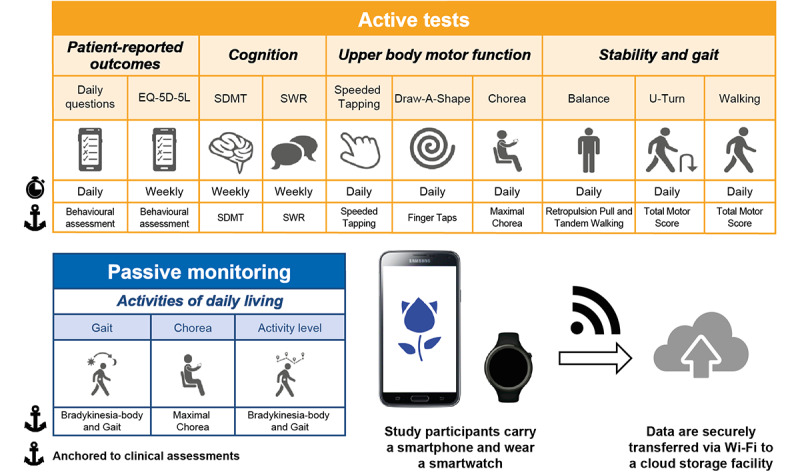
This analysis aimed to determine the feasibility and reliability of the Roche HD Digital Monitoring Platform over a 4-week period and cross-sectional validity over a 2-week interval. Key criteria assessed were feasibility, evaluated by adherence and quality control failure rates; test-retest reliability; known-groups validity; and convergent validity of sensor-based measures with existing clinical measures. Data from 3 studies were used: the predrug screening phase of an open-label extension study evaluating tominersen (NCT03342053) and 2 untreated cohorts-the HD Natural History Study (NCT03664804) and the Digital-HD study. Across these studies, controls (n=20) and individuals with premanifest (n=20) or manifest (n=179) HD completed 6 motor and 2 cognitive tests at home and in the clinic.
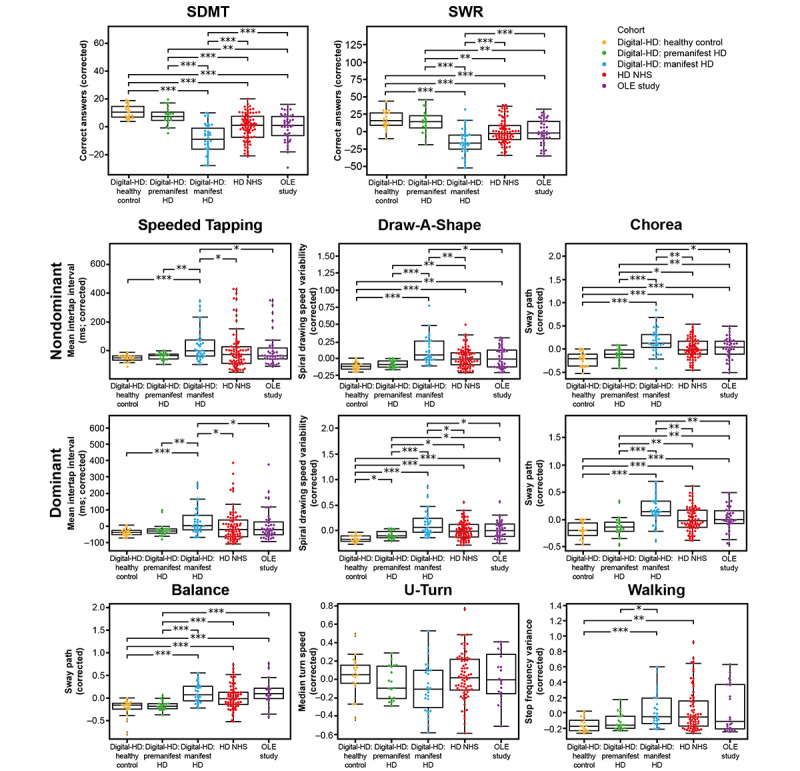
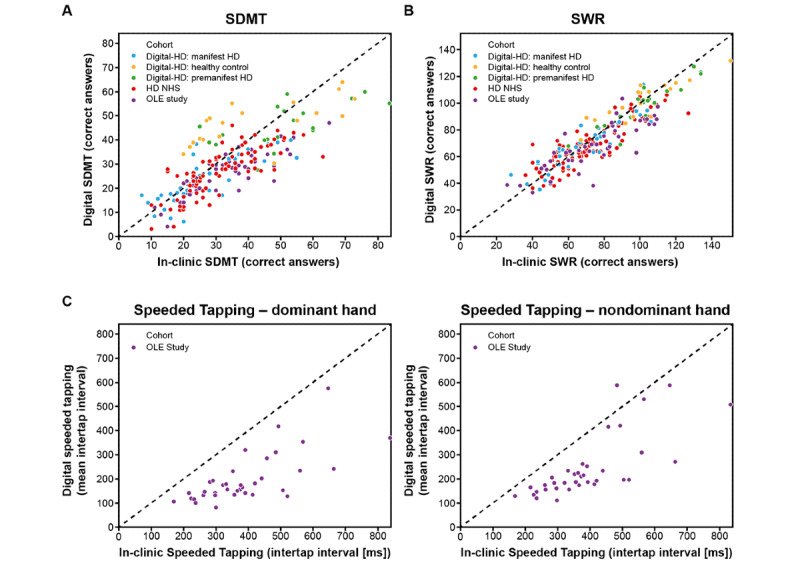
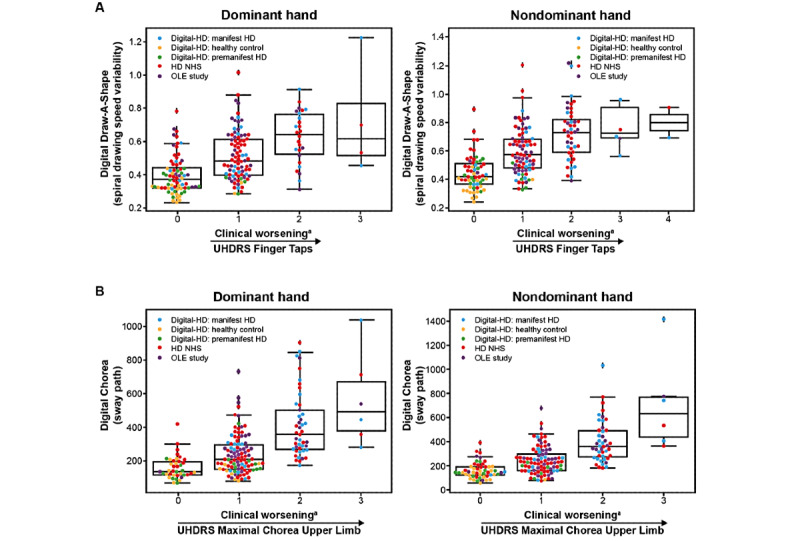
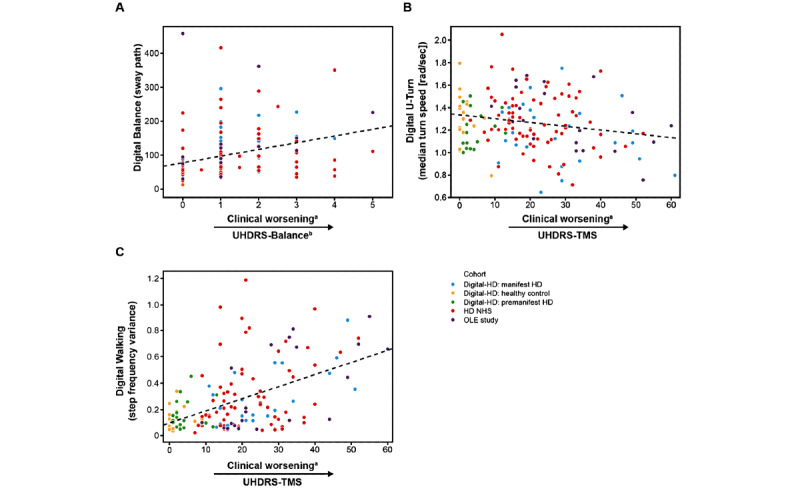
Participants in the open-label extension study, the HD Natural History Study, and the Digital-HD study completed 89.95% (1164/1294), 72.01% (2025/2812), and 68.98% (1454/2108) of the active tests, respectively. All sensor-based features showed good to excellent test-retest reliability (intraclass correlation coefficient 0.89-0.98) and generally low quality control failure rates. Good overall convergent validity of sensor-derived features to Unified HD Rating Scale outcomes and good overall known-groups validity among controls, premanifest, and manifest participants were observed. Among participants with manifest HD, the digital cognitive tests demonstrated the strongest correlations with analogous in-clinic tests (Pearson correlation coefficient 0.79-0.90).
These results show the potential of the HD Digital Monitoring Platform to provide reliable, valid, continuous remote monitoring of HD symptoms, facilitating the evaluation of novel treatments and enhanced clinical monitoring and care for individuals with HD.
使用数字技术远程监测亨廷顿病(HD)的体征和症状,可以提高早期临床诊断和疾病进展的跟踪能力,指导治疗决策,并监测疾病修饰剂的反应。最近几项神经退行性疾病的研究已经证明了数字症状监测的可行性。
本研究旨在评估一种新的基于智能手表和智能手机的数字监测平台,以远程监测 HD 的体征和症状。
本分析旨在确定罗氏 HD 数字监测平台在 4 周内的可行性和可靠性,并在 2 周间隔内进行横截面有效性评估。评估的关键标准包括:通过依从性和质量控制失败率评估的可行性;测试-再测试可靠性;已知组有效性;以及基于传感器的测量与现有临床测量的趋同有效性。使用了 3 项研究的数据:正在进行的托米那森(tominersen)开放标签扩展研究的预药物筛选阶段(NCT03342053)和 2 个未经治疗的队列——HD 自然史研究(NCT03664804)和数字-HD 研究。在这些研究中,对照组(n=20)和处于无症状前(n=20)或有症状(n=179)的 HD 患者在家中和诊所中完成了 6 项运动和 2 项认知测试。
开放标签扩展研究、HD 自然史研究和数字-HD 研究的参与者分别完成了 89.95%(1164/1294)、72.01%(2025/2812)和 68.98%(1454/2108)的主动测试。所有基于传感器的特征均表现出良好至极好的测试-再测试可靠性(组内相关系数 0.89-0.98)和通常较低的质量控制失败率。观察到基于传感器的特征与统一 HD 评分量表结果之间的总体良好趋同有效性以及对照组、无症状前和有症状参与者之间的总体已知组有效性。在有症状的 HD 参与者中,数字认知测试与类似的诊所测试相关性最强(Pearson 相关系数 0.79-0.90)。
这些结果表明,HD 数字监测平台具有提供可靠、有效、连续的 HD 症状远程监测的潜力,有助于评估新型治疗方法,并增强对 HD 患者的临床监测和护理。