Department of Molecular Neurobiology, Max Planck Institute for Multidisciplinary Sciences, Göttingen 37075, Germany.
Laboratory of Membrane Biophysics, Max Planck Institute for Multidisciplinary Sciences, Göttingen 37077, Germany.
Proc Natl Acad Sci U S A. 2024 Apr 9;121(15):e2320505121. doi: 10.1073/pnas.2320505121. Epub 2024 Apr 3.
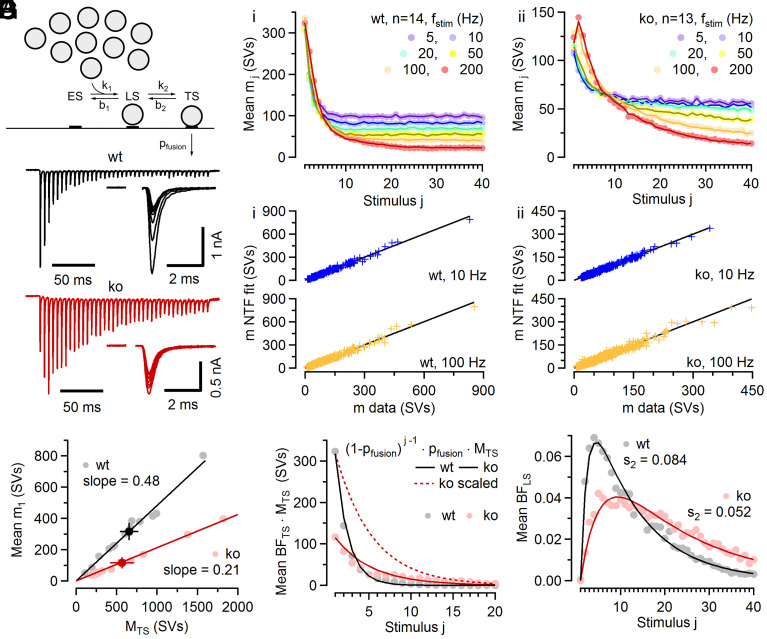
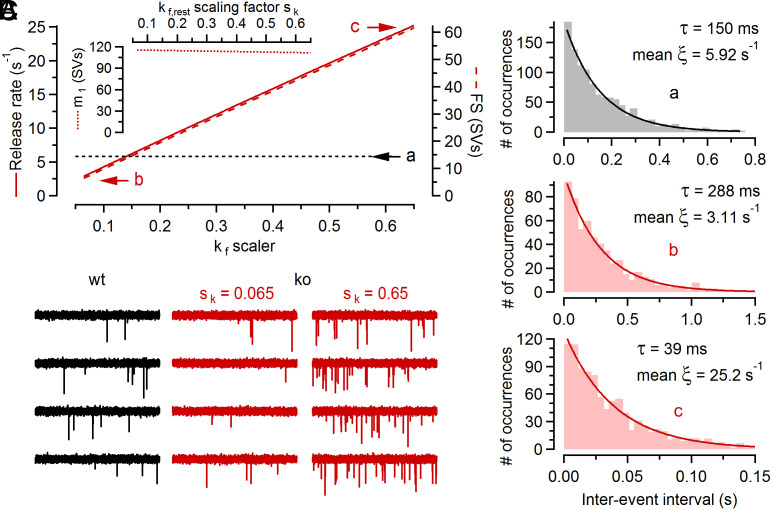
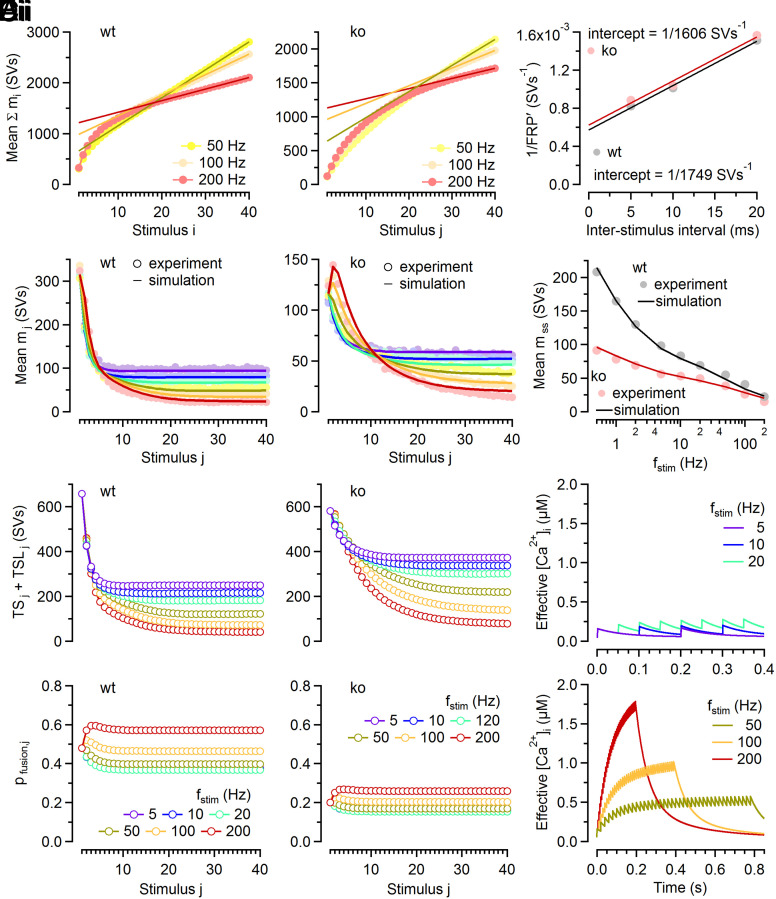
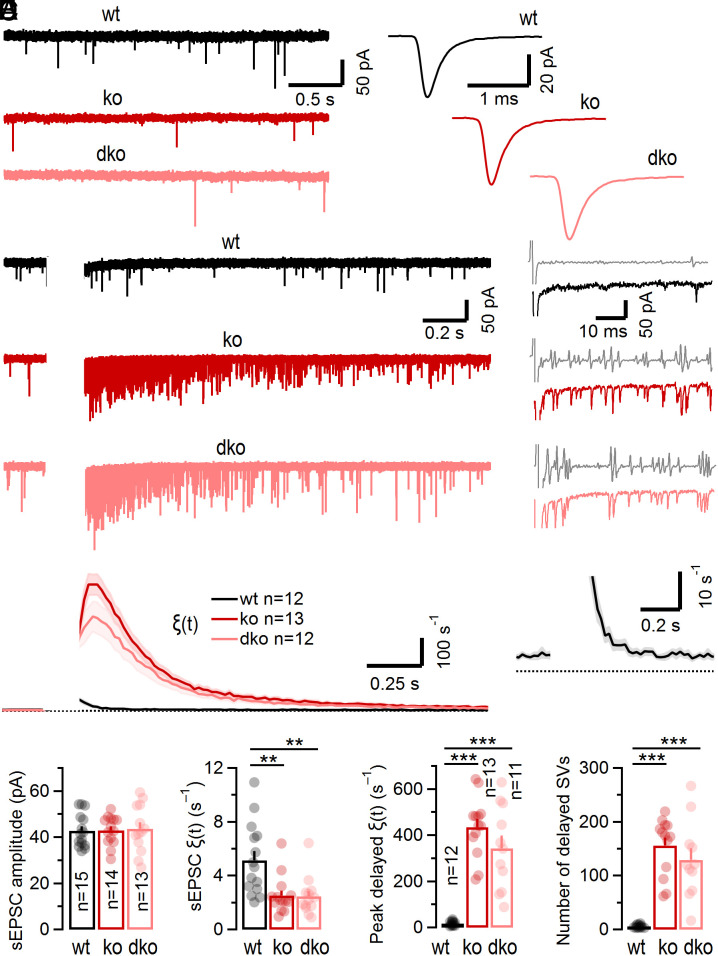
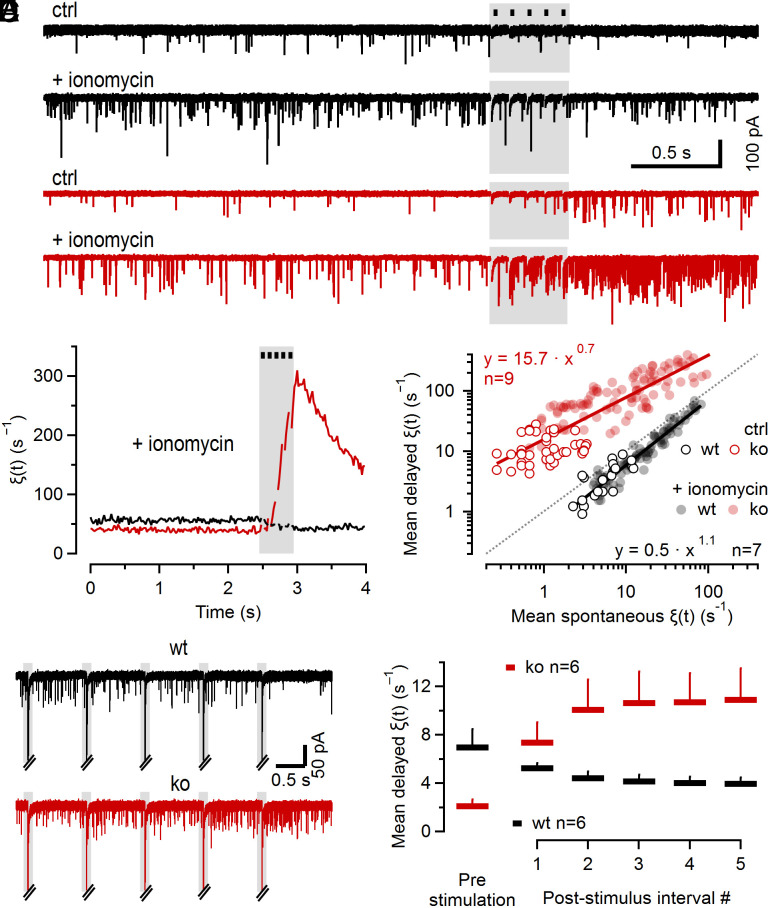
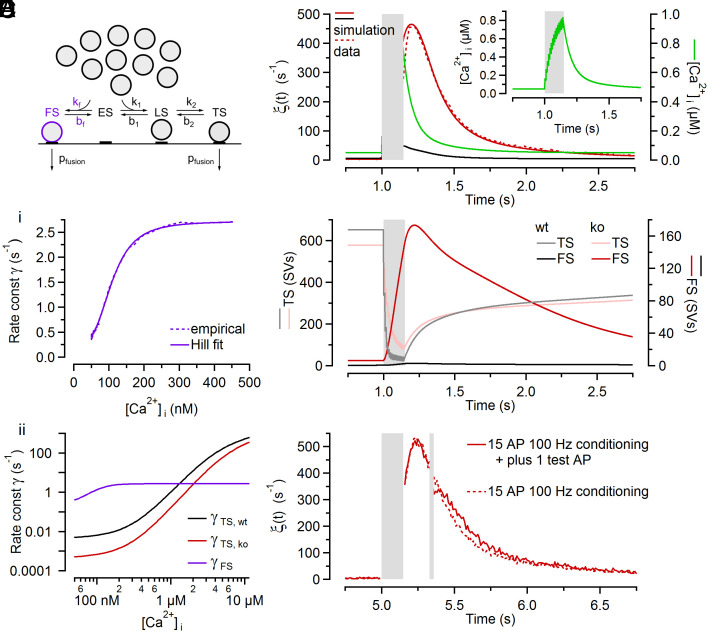
The presynaptic SNARE-complex regulator complexin (Cplx) enhances the fusogenicity of primed synaptic vesicles (SVs). Consequently, Cplx deletion impairs action potential-evoked transmitter release. Conversely, though, Cplx loss enhances spontaneous and delayed asynchronous release at certain synapse types. Using electrophysiology and kinetic modeling, we show that such seemingly contradictory transmitter release phenotypes seen upon Cplx deletion can be explained by an additional of Cplx in the control of SV priming, where its ablation facilitates the generation of a "faulty" SV fusion apparatus. Supporting this notion, a sequential two-step priming scheme, featuring reduced vesicle fusogenicity and increased transition rates into the faulty primed state, reproduces all aberrations of transmitter release modes and short-term synaptic plasticity seen upon Cplx loss. Accordingly, we propose a dual presynaptic function for the SNARE-complex interactor Cplx, one as a "checkpoint" protein that guarantees the proper assembly of the fusion machinery during vesicle priming, and one in boosting vesicle fusogenicity.
突触前 SNARE 复合物调节复合物素(Cplx)增强了成熟突触小泡(SV)的融合性。因此,Cplx 的缺失会损害动作电位诱发的递质释放。然而,相反的是,Cplx 的缺失会增强某些突触类型的自发性和延迟异步释放。通过电生理学和动力学建模,我们表明,在 Cplx 缺失时观察到的这种看似矛盾的递质释放表型,可以用 Cplx 在 SV 引发中的额外控制来解释,其中它的消融促进了“有缺陷”的 SV 融合装置的产生。支持这一观点,一个顺序的两步引发方案,其特征是降低了囊泡的融合性,增加了进入有缺陷的引发状态的转变率,再现了 Cplx 缺失时所有递质释放模式和短期突触可塑性的异常。因此,我们提出了 SNARE 复合物相互作用蛋白 Cplx 的双重突触前功能,一种是作为“检查点”蛋白,在囊泡引发过程中保证融合机制的正确组装,另一种是增强囊泡的融合性。