Heidelberg Institute of Global Health, Heidelberg University, Heidelberg, Baden-Württemberg, Germany
Heidelberg Institute of Global Health, Heidelberg University, Heidelberg, Baden-Württemberg, Germany.
BMJ Paediatr Open. 2024 Apr 2;8(1):e002455. doi: 10.1136/bmjpo-2023-002455.
Legislation in the European Union (EU) and the USA promoting the development of paediatric medicines has contributed to new treatments for children. This study explores how such legislation responds to paediatric health needs in different country settings and globally, and whether it should be considered for wider implementation.
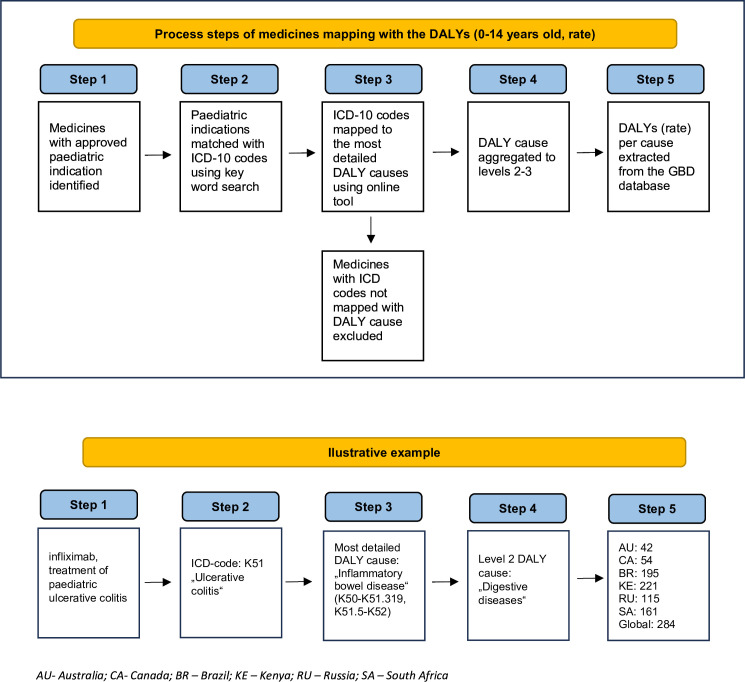
We searched EU and US regulatory databases for medicines with approved indications resulting from completed paediatric development between 2007 and 2018. Of 195 medicines identified, 187 could be systematically mapped to the burden of the target disease for six study countries (Australia, Brazil, Canada, Kenya, Russia, South Africa) and globally, using disability-adjusted life years (DALYs). All medicines were also screened for inclusion on the WHO Model List of Essential Medicines (EML) and the EML for children under 13 years (EMLc).
The studied medicines were disproportionately focused on non-communicable diseases, which represented 68% of medicines and 21% of global paediatric DALYs. On the other hand, we found 28% of medicines for communicable, maternal, neonatal and nutritional disorders, representing 73% of global paediatric DALYs. Neonatal disorders and malaria were mapped with two medicines, tuberculosis and neglected tropical diseases with none. The gap between medicines and paediatric DALYs was greater in countries with lower income. Still, 34% of medicines are included in the EMLc and 48% in the EML.
Paediatric policies in the EU and the USA are only partially responsive to paediatric health needs. To be considered for wider implementation, paediatric incentives and obligations should be more targeted towards paediatric health needs. International harmonisation of legislation and alignment with global research priorities could further strengthen its impact on child health and support ongoing efforts to improve access to medicines. Furthermore, efforts should be made to ensure global access to authorised paediatric medicines.
欧盟(EU)和美国的立法促进了儿科药物的发展,为儿童带来了新的治疗方法。本研究探讨了这种立法如何应对不同国家和全球的儿科健康需求,以及是否应该考虑更广泛的实施。
我们在欧盟和美国的监管数据库中搜索了 2007 年至 2018 年间完成儿科开发并获得批准适应症的药物。在确定的 195 种药物中,有 187 种可以使用残疾调整生命年(DALYs)系统地映射到六个研究国家(澳大利亚、巴西、加拿大、肯尼亚、俄罗斯和南非)和全球的目标疾病负担上。所有药物还被筛选是否纳入世界卫生组织基本药物标准清单(EML)和 13 岁以下儿童 EML(EMLc)。
所研究的药物在很大程度上侧重于非传染性疾病,占药物的 68%和全球儿科 DALYs 的 21%。另一方面,我们发现用于传染病、孕产妇、新生儿和营养障碍的药物占 28%,占全球儿科 DALYs 的 73%。新生儿疾病和疟疾分别有两种药物进行了映射,而结核病和被忽视的热带病则没有。收入较低国家的药物与儿科 DALYs 之间的差距更大。尽管如此,34%的药物被纳入 EMLc,48%的药物被纳入 EML。
欧盟和美国的儿科政策仅部分响应儿科健康需求。为了考虑更广泛的实施,儿科激励措施和义务应该更针对儿科健康需求。立法的国际协调和与全球研究重点的一致可能会进一步加强其对儿童健康的影响,并支持正在努力改善药物获取的工作。此外,应努力确保全球获得授权的儿科药物。