Department of Anesthesiology and Perioperative Medicine, the First Affiliated Hospital of Nanjing Medical University, Nanjing, 210029, China.
J Cardiothorac Surg. 2024 Apr 3;19(1):172. doi: 10.1186/s13019-024-02737-4.
To review and analyze the airway and anesthesia management methods for patients who underwent endoscopic closure of tracheoesophageal fistula (TEF) and to summarize the experience of intraoperative airway management.
We searched the anesthesia information system of the First Affiliated Hospital of Nanjing Medical University for anesthesia cases of TEF from July 2020 to July 2023 and obtained a total of 34 anesthesia records for endoscopic TEF occlusion. The intraoperative airway management methods and vital signs were recorded, and the patients' disease course and follow-up records were analyzed and summarized.
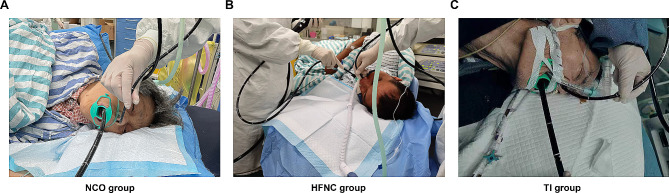
The airway management strategies used for TEF occlusion patients included nasal catheter oxygen (NCO, n = 5), high-flow nasal cannula oxygen therapy (HFNC, n = 4) and tracheal intubation (TI, n = 25). The patients who underwent tracheal intubation with an inner diameter of 5.5 mm had stable hemodynamics and oxygenation status during surgery, while intravenous anesthesia without intubation could not effectively inhibit the stress response caused by occluder implantation, which could easily cause hemodynamic fluctuations, hypoxemia, and carbon dioxide accumulation. Compared with those in the TI group, the NCO group and the HFNC group had significantly longer surgical times, and the satisfaction score of the endoscopists was significantly lower. In addition, two patients in the NCO group experienced postoperative hypoxemia.
During the anesthesia process for TEF occlusions, a tracheal catheter with an inner diameter of 5.5 mm can provide a safe and effective airway management method.
回顾和分析经内镜治疗气管食管瘘(TEF)患者的气道和麻醉管理方法,总结术中气道管理经验。
检索南京医科大学第一附属医院麻醉信息系统 2020 年 7 月至 2023 年 7 月行内镜 TEF 封堵术的麻醉病例,共获得 34 例经内镜 TEF 封堵术的麻醉记录,记录术中气道管理方法及生命体征,分析并总结患者的病程及随访资料。
TEF 封堵患者的气道管理策略包括鼻导管吸氧(NCO,n=5)、高流量鼻导管吸氧(HFNC,n=4)和气管插管(TI,n=25)。内径为 5.5mm 的气管导管插管患者术中血流动力学和氧合状态稳定,而无插管的静脉麻醉不能有效抑制封堵器植入引起的应激反应,容易引起血流动力学波动、低氧血症和二氧化碳蓄积。与 TI 组相比,NCO 组和 HFNC 组的手术时间明显延长,内镜医师的满意度评分明显降低。此外,NCO 组有 2 例患者术后出现低氧血症。
在 TEF 封堵的麻醉过程中,内径为 5.5mm 的气管导管可为气道管理提供一种安全有效的方法。