Australian Institute of Marine Science, Indian Ocean Marine Research Centre, Crawley, Australia.
UWA Oceans Institute, The University of Western Australia, Crawley, Australia.
Commun Biol. 2024 Apr 4;7(1):410. doi: 10.1038/s42003-024-06100-0.
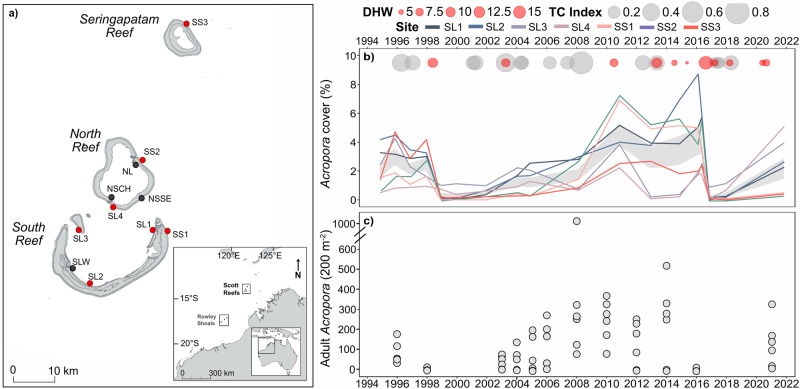
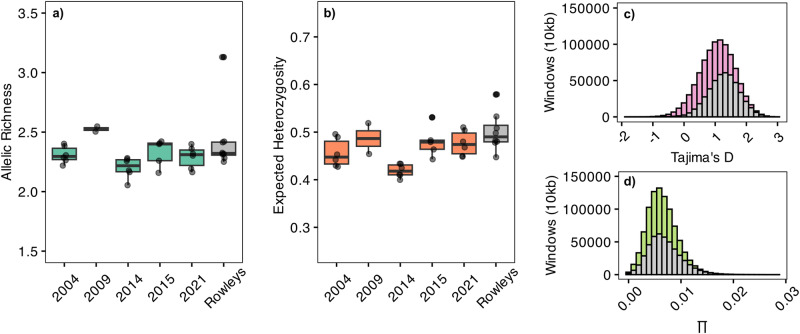
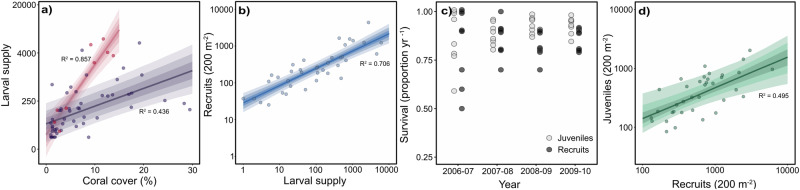
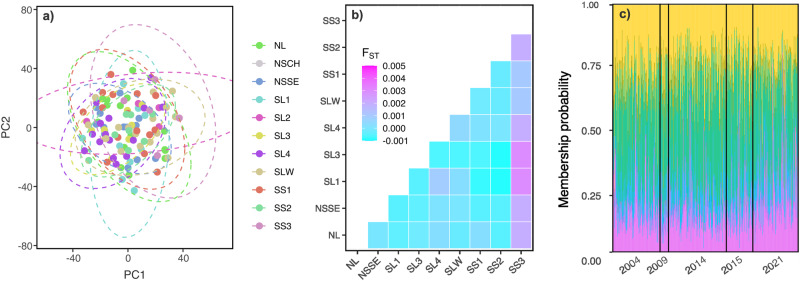
Climate change is restructuring natural ecosystems. The direct impacts of these events on biodiversity and community structure are widely documented, but the impacts on the genetic variation of populations remains largely unknown. We monitored populations of Acropora coral on a remote coral reef system in northwest Australia for two decades and through multiple cycles of impact and recovery. We combined these demographic data with a temporal genetic dataset of a common broadcast spawning corymbose Acropora to explore the spatial and temporal patterns of connectivity underlying recovery. Our data show that broad-scale dispersal and post-recruitment survival drive recovery from recurrent disturbances, including mass bleaching and mortality. Consequently, genetic diversity and associated patterns of connectivity are maintained through time in the broader metapopulation. The results highlight an inherent resilience in these globally threatened species of coral and showcase their ability to cope with multiple disturbances, given enough time to recover is permitted.
气候变化正在重塑自然生态系统。这些事件对生物多样性和群落结构的直接影响已被广泛记录,但对种群遗传变异的影响在很大程度上仍未知。我们在澳大利亚西北部偏远的珊瑚礁系统上对 Acropora 珊瑚进行了长达二十年的监测,经历了多次冲击和恢复的周期。我们将这些人口统计数据与一个常见的广泛繁殖珊瑚属 Acropora 的时间遗传数据集相结合,以探索恢复背后的连通性的时空模式。我们的数据表明,广泛的扩散和补充后生存能力驱动了从反复干扰(包括大规模白化和死亡)中恢复。因此,遗传多样性和相关的连通性模式在更广泛的复合种群中随时间得以维持。这些结果突出了这些在全球范围内受到威胁的珊瑚物种的内在弹性,并展示了它们在有足够的恢复时间的情况下应对多种干扰的能力。