Ighalo Joshua, Kirby Eric D, Song Xiaowei, Fickling Shaun D, Pawlowski Gabriela, Hajra Sujoy Ghosh, Liu Careesa C, Menon Carlo, Shah Sudhin A, Knoefel Frank, D'Arcy Ryan C N
Simon Fraser University, Faculty of Sciences and Applied Sciences, Metro-Vancouver, Canada.
Health and Technology District, BrainNET, Metro-Vancouver, Canada.
Heliyon. 2024 Mar 29;10(7):e28982. doi: 10.1016/j.heliyon.2024.e28982. eCollection 2024 Apr 15.
Managing cognitive function in care homes is a significant challenge. Individuals in care have a variety of scores across standard clinical assessments, such as the Mini-Mental Status Exam (MMSE), and many of them have scores that fall within the range associated with dementia. A recent methodological advance, brain vital sign monitoring through auditory event-related potentials, provides an objective and sensitive physiological measurement to track abnormalities, differences, or changes in cognitive function. Taking advantage of point-of-care accessibility, the current study evaluated the methodological feasibility, the assessment of whether a particular research method can be successfully implemented, of quantitatively measuring cognition of care home residents using brain vital signs. Secondarily, the current study examined the relationship between brain vital signs, specifically the cognitive processing associated N400 component, and MMSE scores in care home residents.
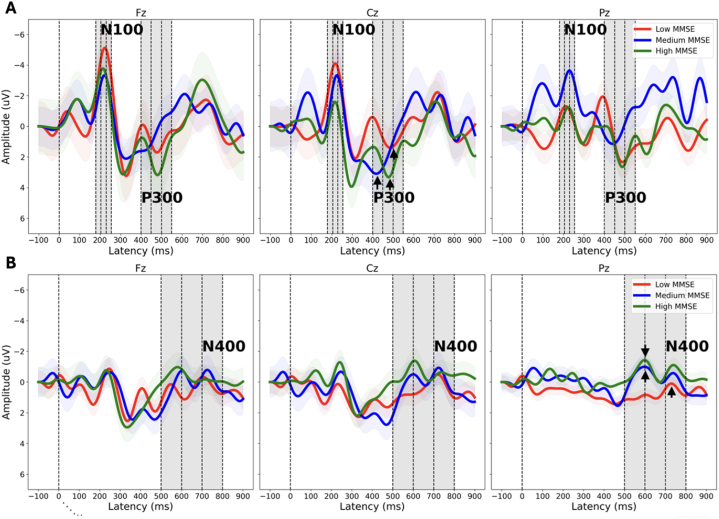
Brain vital signs used the established N100 (auditory sensation), P300 (basic attention), and N400 (cognitive processing) event-related potential (ERP) components. A total of 52 residents were enrolled, with all participants evaluated using the MMSE. Participants were assigned into homogeneous groups based on their MMSE scores, and were categorized into low (n = 14), medium (n = 17), and high (n = 13) MMSE groups. Both brain vital sign measures and underlying ERP waveforms were examined. Statistical analyses used partial least squares correlation (PLS) analyses in which both MMSE and age were included as factors, as well as jackknife approaches, to test for significant brain vital sign changes.
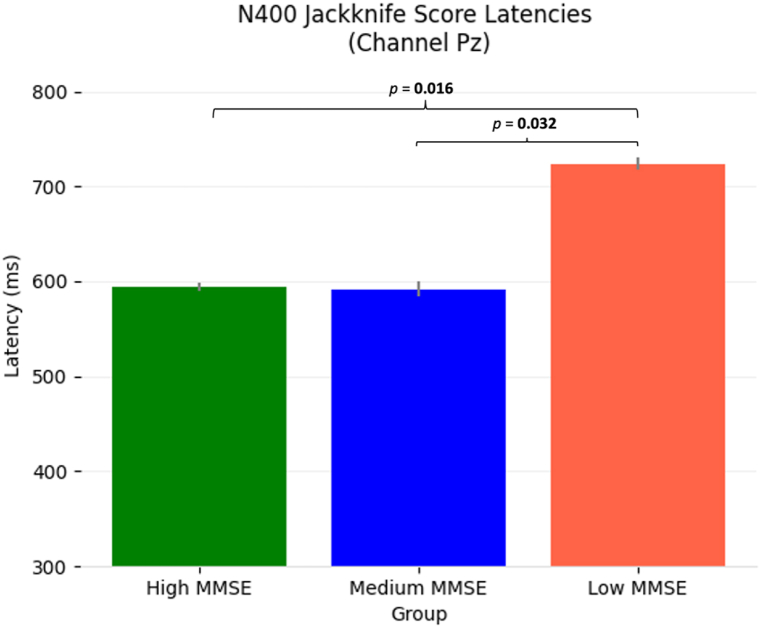
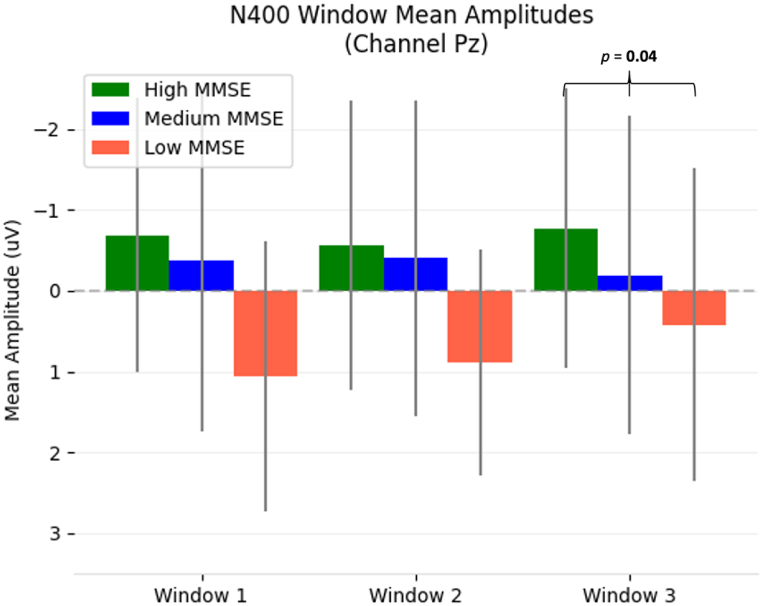
The current study successfully measured and analyzed standardized, quantifiable brain vital signs in a care home setting. ERP waveform data showed specific N400 changes between MMSE groups as a function of MMSE score. PLS analyses confirmed significant MMSE-related and age-related differences in the N400 amplitude ( < 0.05, corrected). Similarly, the jackknife approach emphasized the N400 latency difference between the low and high MMSE groups.
It was possible to acquire brain vital signs measures in care home residents. Additionally, the current study evaluated brain vital signs relative to MMSE in this group. The comparison revealed significant decreasing in N400 response amplitude (cognitive processing) as a function of both MMSE score and age, as well as a slowing of N400 latency. The findings indicate that objective neurophysiological measures of impairment are detectable in care home residents across the span of MMSE scores. Direct comparison to MMSE- and age-related variables represents a critical initial step ahead of future studies that will investigate relative improvements in sensitivity, validity, reliability and related advantages of brain vital sign monitoring.
在养老院管理认知功能是一项重大挑战。接受护理的个体在标准临床评估(如简易精神状态检查表(MMSE))中有各种得分,其中许多人的得分落在与痴呆相关的范围内。最近的一项方法学进展,即通过听觉事件相关电位进行脑生命体征监测,提供了一种客观且灵敏的生理测量方法,以追踪认知功能的异常、差异或变化。利用即时护理的可及性,本研究评估了使用脑生命体征定量测量养老院居民认知的方法学可行性,即评估一种特定研究方法能否成功实施。其次,本研究考察了脑生命体征,特别是与认知加工相关的N400成分,与养老院居民MMSE得分之间的关系。
脑生命体征采用已确立的N100(听觉感觉)、P300(基本注意力)和N400(认知加工)事件相关电位(ERP)成分。共招募了52名居民,所有参与者均接受MMSE评估。参与者根据其MMSE得分被分为同质组,并被分为低(n = 14)、中(n = 17)和高(n = 13)MMSE组。对脑生命体征测量值和潜在的ERP波形均进行了检查。统计分析采用偏最小二乘相关(PLS)分析,其中MMSE和年龄均作为因素纳入,以及采用留一法,以测试脑生命体征的显著变化。
本研究在养老院环境中成功测量并分析了标准化、可量化的脑生命体征。ERP波形数据显示,MMSE组之间的N400有特定变化,是MMSE得分的函数。PLS分析证实了N400波幅在MMSE相关和年龄相关方面存在显著差异(<0.05,校正后)。同样,留一法强调了低MMSE组和高MMSE组之间N400潜伏期的差异。
在养老院居民中获取脑生命体征测量值是可行的。此外,本研究评估了该组中与MMSE相关的脑生命体征。比较显示,N400反应波幅(认知加工)随MMSE得分和年龄均显著降低,以及N400潜伏期延长。研究结果表明,在MMSE得分范围内,养老院居民中可检测到客观的神经生理学损伤测量值。与MMSE和年龄相关变量的直接比较是未来研究的关键初始步骤,未来研究将调查脑生命体征监测在敏感性、有效性、可靠性及相关优势方面的相对改善情况。