Fickling Shaun D, Smith Aynsley M, Stuart Michael J, Dodick David W, Farrell Kyle, Pender Sara C, D'Arcy Ryan C N
Faculty of Science and Applied Sciences, Simon Fraser University, Metro Vancouver, BC V5A1S6, Canada.
Center for Neurology Studies, HealthTech Connex, Metro Vancouver, BC V3V0C6, Canada.
Brain Commun. 2021 Apr 6;3(2):fcab019. doi: 10.1093/braincomms/fcab019. eCollection 2021.
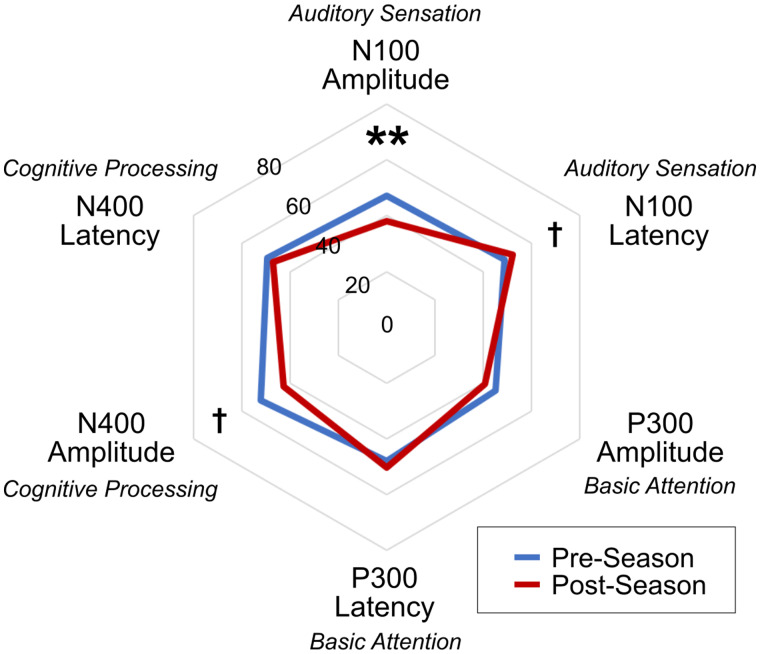
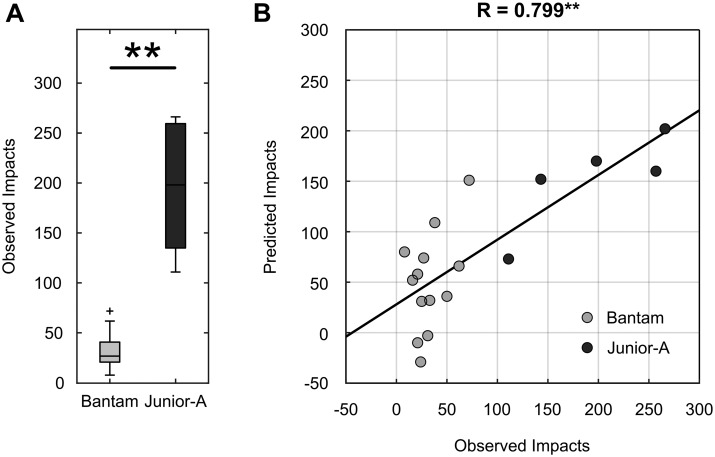
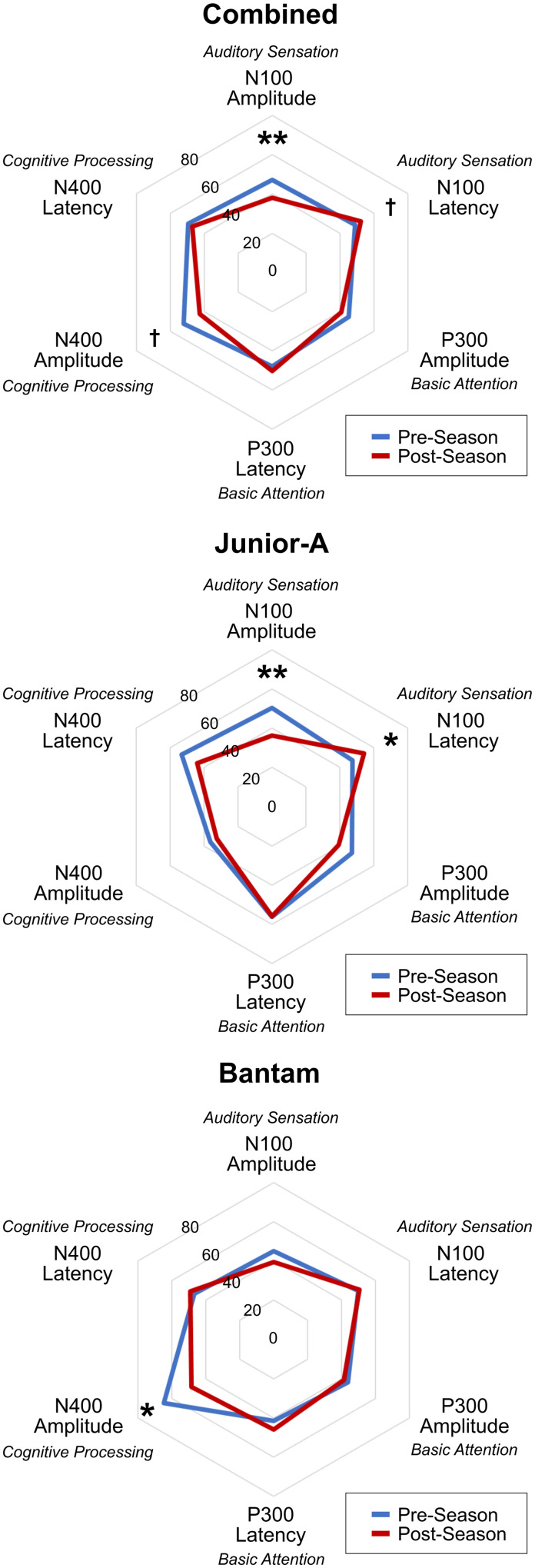
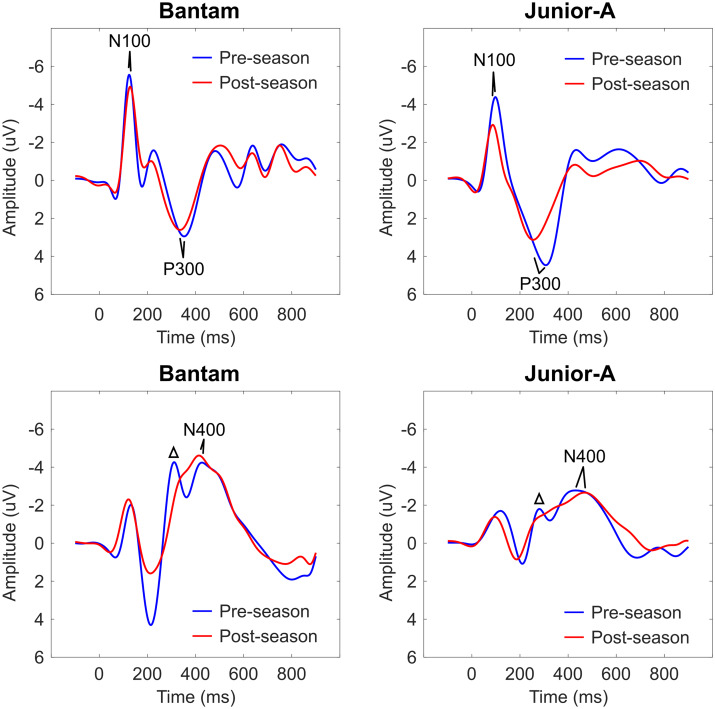
The brain vital signs framework is a portable, objective, neurophysiological evaluation of brain function at point-of-care. We investigated brain vital signs at pre- and post-season for age 14 or under (Bantam) and age 16-20 (Junior-A) male ice hockey players to (i) further investigate previously published brain vital sign results showing subconcussive cognitive deficits and (ii) validate these findings through comparison with head-impact data obtained from instrumented accelerometers. With a longitudinal study design, 23 male ice hockey players in Bantam ( = 13; age 13.63 ± 0.62) and Tier II Junior-A ( = 10; age 18.62 ± 0.86) divisions were assessed at pre- and post-season. None were diagnosed with a concussion during the season. Cognitive evoked potential measures of Auditory sensation (N100), Basic attention (P300) and Cognitive processing (N400) were analysed as changes in peak amplitudes and latencies (six standard scores total). A regression analysis examined the relationship between brain vital signs and the number of head impacts received during the study season. Significant pre/post differences in brain vital signs were detected for both groups. Bantam and Junior-A players also differed in number of head impacts (Bantam: 32.92 ± 17.68; Junior-A: 195.00 ± 61.08; < 0.001). Importantly, the regression model demonstrated a significant linear relationship between changes in brain vital signs and total head impacts received ( = 0.799, = 0.007), with clear differences between the Bantam and Junior-A groups. In the absence of a clinically diagnosed concussion, the brain vital sign changes appear to have demonstrated the compounding effects of repetitive subconcussive impacts. The findings underscored the importance of an objective physiological measure of brain function along the spectrum of concussive impacts.
脑生命体征框架是一种在医疗现场对脑功能进行的便携式、客观的神经生理学评估。我们调查了14岁及以下(儿童组)和16 - 20岁(青年甲组)男性冰球运动员在赛季前和赛季后的脑生命体征,目的是:(i) 进一步研究先前发表的显示亚脑震荡认知缺陷的脑生命体征结果;(ii) 通过与从仪器化加速度计获得的头部撞击数据进行比较来验证这些发现。采用纵向研究设计,对23名儿童组(n = 13;年龄13.63 ± 0.62)和乙级青年甲组(n = 10;年龄18.62 ± 0.86)的男性冰球运动员在赛季前和赛季后进行了评估。赛季期间无人被诊断为脑震荡。分析了听觉感觉(N100)、基本注意力(P300)和认知处理(N400)的认知诱发电位测量值,以观察峰值幅度和潜伏期的变化(总共六个标准分数)。回归分析研究了脑生命体征与研究赛季期间接受的头部撞击次数之间的关系。两组均检测到脑生命体征存在显著的赛季前/后差异。儿童组和青年甲组运动员在头部撞击次数上也存在差异(儿童组:32.92 ± 17.68;青年甲组:195.00 ± 61.08;p < 0.001)。重要的是,回归模型显示脑生命体征变化与接受的总头部撞击次数之间存在显著的线性关系(r = 0.799,p = 0.007),儿童组和青年甲组之间存在明显差异。在没有临床诊断脑震荡的情况下,脑生命体征变化似乎已经显示出重复性亚脑震荡撞击的复合效应。这些发现强调了在脑震荡撞击范围内对脑功能进行客观生理测量的重要性。