Research Institute, Princess Margaret Cancer Centre, Toronto, Ontario, Canada; Department of Cell and Systems Biology, University of Toronto, Toronto, Ontario, Canada.
Research Institute, Princess Margaret Cancer Centre, Toronto, Ontario, Canada; Radiation Medicine Program, Princess Margaret Cancer Centre, Toronto, Ontario, Canada; Department of Radiation Oncology, University of Toronto, Toronto, Ontario, Canada; Institute of Medical Science, University of Toronto, Toronto, Ontario, Canada.
EBioMedicine. 2024 May;103:105089. doi: 10.1016/j.ebiom.2024.105089. Epub 2024 Apr 5.
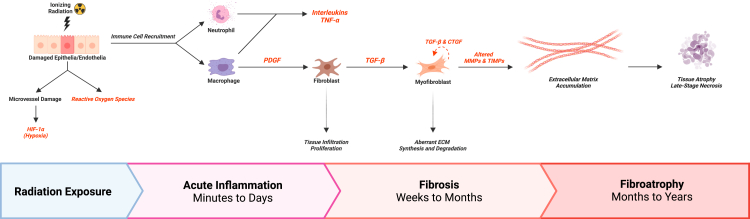
Advances in radiation techniques have enabled the precise delivery of higher doses of radiotherapy to tumours, while sparing surrounding healthy tissues. Consequently, the incidence of radiation toxicities has declined, and will likely continue to improve as radiotherapy further evolves. Nonetheless, ionizing radiation elicits tissue-specific toxicities that gradually develop into radiation-induced fibrosis, a common long-term side-effect of radiotherapy. Radiation fibrosis is characterized by an aberrant wound repair process, which promotes the deposition of extensive scar tissue, clinically manifesting as a loss of elasticity, tissue thickening, and organ-specific functional consequences. In addition to improving the existing technologies and guidelines directing the administration of radiotherapy, understanding the pathogenesis underlying radiation fibrosis is essential for the success of cancer treatments. This review integrates the principles for radiotherapy dosimetry to minimize off-target effects, the tissue-specific clinical manifestations, the key cellular and molecular drivers of radiation fibrosis, and emerging therapeutic opportunities for both prevention and treatment.
放射技术的进步使我们能够更精确地将高剂量的放射疗法施用于肿瘤,同时保护周围的健康组织。因此,放射毒性的发生率已经下降,并且随着放射疗法的进一步发展,这种情况可能会继续改善。尽管如此,电离辐射会引发组织特异性毒性,逐渐发展为放射诱导纤维化,这是放射疗法的一种常见长期副作用。放射纤维化的特征是异常的伤口修复过程,促进广泛的疤痕组织沉积,临床上表现为弹性丧失、组织增厚和特定器官的功能后果。除了改进指导放射疗法实施的现有技术和指南外,了解放射纤维化的发病机制对于癌症治疗的成功至关重要。本综述整合了放射疗法剂量学的原则,以最大限度地减少靶外效应,以及组织特异性临床表现、放射纤维化的关键细胞和分子驱动因素,以及预防和治疗的新兴治疗机会。