Department of Psychology, Faculty of Education and Psychology, University of Isfahan, Isfahan, Iran.
Center for Affective Neuroscience, Development, Learning and Education, University of Southern California (USC), Los Angeles, USA.
Sci Rep. 2024 Apr 5;14(1):8035. doi: 10.1038/s41598-024-57715-6.
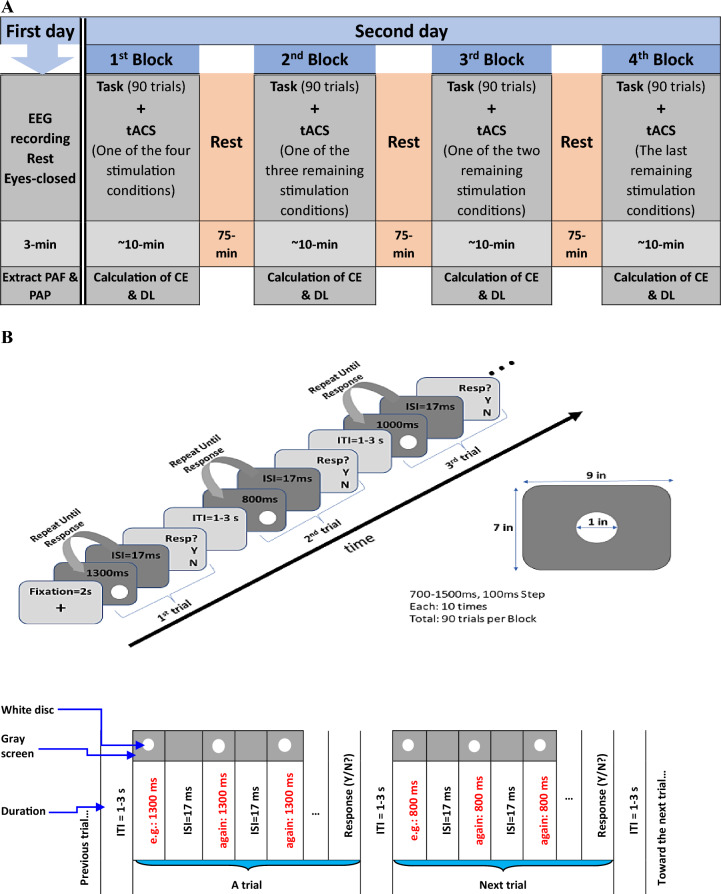
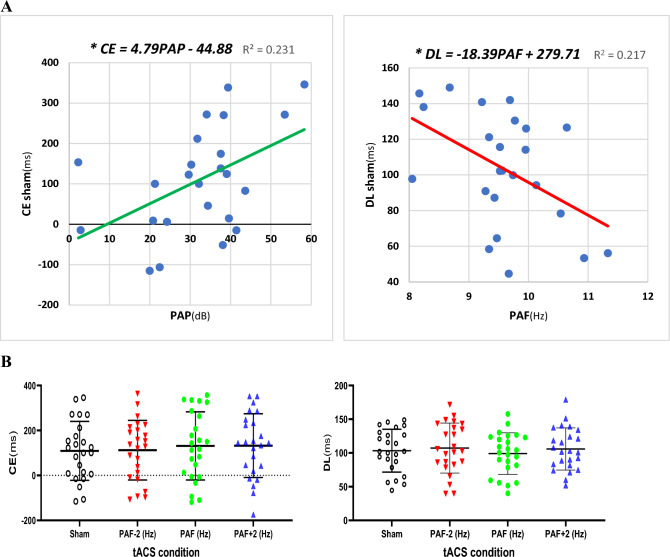
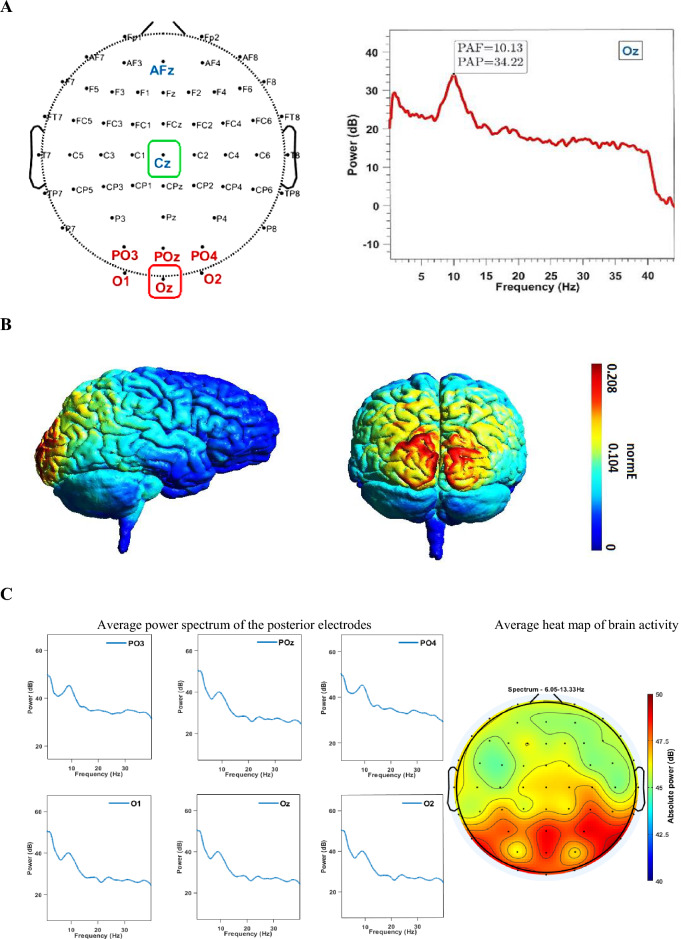
Alpha oscillations have been implicated in time perception, yet a consensus on their precise role remains elusive. This study directly investigates this relationship by examining the impact of alpha oscillations on time perception. Resting-state EEG recordings were used to extract peak alpha frequency (PAF) and peak alpha power (PAP) characteristics. Participants then performed a time generalization task under transcranial alternating current stimulation (tACS) at frequencies of PAF-2, PAF, and PAF+2, as well as a sham condition. Results revealed a significant correlation between PAP and accuracy, and between PAF and precision of one-second time perception in the sham condition. This suggests that alpha oscillations may influence one-second time perception by modulating their frequency and power. Interestingly, these correlations weakened with real tACS stimulations, particularly at higher frequencies. A second analysis aimed to establish a causal relationship between alpha peak modulation by tACS and time perception using repeated measures ANOVAs, but no significant effect was observed. Results were interpreted according to the state-dependent networks and internal clock model.
阿尔法振荡被认为与时间感知有关,但它们的确切作用仍未达成共识。本研究通过考察阿尔法振荡对时间感知的影响,直接研究了这种关系。使用静息态 EEG 记录提取了峰值阿尔法频率 (PAF) 和峰值阿尔法功率 (PAP) 特征。然后,参与者在 PAF-2、PAF 和 PAF+2 以及假刺激条件下进行了经颅交流电刺激 (tACS) 的时间泛化任务。结果表明,在假刺激条件下,PAP 与准确性之间以及 PAF 与一秒钟时间感知的精度之间存在显著相关性。这表明阿尔法振荡可能通过调节其频率和功率来影响一秒钟的时间感知。有趣的是,这些相关性随着真实 tACS 刺激的减弱而减弱,特别是在更高的频率下。第二个分析旨在使用重复测量方差分析建立 tACS 对阿尔法峰值调制和时间感知之间的因果关系,但没有观察到显著影响。结果根据状态相关网络和内部时钟模型进行了解释。