The First School of Clinical Medical, Lanzhou University, Lanzhou, 730000, Gansu, People's Republic of China.
Department of General Surgery, The First Hospital of Lanzhou University, Lanzhou, 730000, Gansu, People's Republic of China.
Sci Rep. 2024 Apr 5;14(1):8023. doi: 10.1038/s41598-024-58607-5.
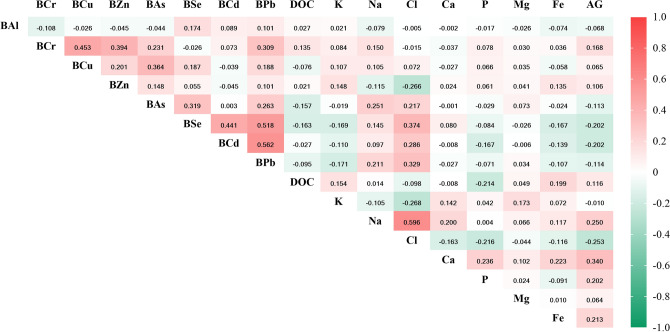
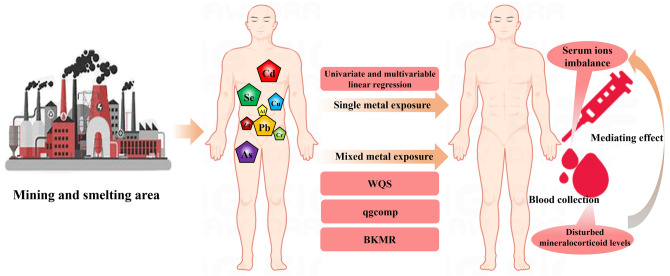
Toxic metals are vital risk factors affecting serum ion balance; however, the effect of their co-exposure on serum ions and the underlying mechanism remain unclear. We assessed the correlations of single metal and mixed metals with serum ion levels, and the mediating effects of mineralocorticoids by investigating toxic metal concentrations in the blood, as well as the levels of representative mineralocorticoids, such as deoxycorticosterone (DOC), and serum ions in 471 participants from the Dongdagou-Xinglong cohort. In the single-exposure model, sodium and chloride levels were positively correlated with arsenic, selenium, cadmium, and lead levels and negatively correlated with zinc levels, whereas potassium and iron levels and the anion gap were positively correlated with zinc levels and negatively correlated with selenium, cadmium and lead levels (all P < 0.05). Similar results were obtained in the mixed exposure models considering all metals, and the major contributions of cadmium, lead, arsenic, and selenium were highlighted. Significant dose-response relationships were detected between levels of serum DOC and toxic metals and serum ions. Mediation analysis showed that serum DOC partially mediated the relationship of metals (especially mixed metals) with serum iron and anion gap by 8.3% and 8.6%, respectively. These findings suggest that single and mixed metal exposure interferes with the homeostasis of serum mineralocorticoids, which is also related to altered serum ion levels. Furthermore, serum DOC may remarkably affect toxic metal-related serum ion disturbances, providing clues for further study of health risks associated with these toxic metals.
有毒金属是影响血清离子平衡的重要危险因素,但它们的共同暴露对血清离子的影响及其潜在机制尚不清楚。我们评估了单一金属和混合金属与血清离子水平的相关性,以及通过调查血液中毒金属浓度以及代表性盐皮质激素(如脱氧皮质酮(DOC))和 471 名来自 Dongdagou-Xinglong 队列的参与者的血清离子水平,来评估矿物质皮质激素的中介作用。在单暴露模型中,钠和氯离子水平与砷、硒、镉和铅水平呈正相关,与锌水平呈负相关,而钾和铁水平以及阴离子间隙与锌水平呈正相关,与硒、镉和铅水平呈负相关(均 P<0.05)。在考虑所有金属的混合暴露模型中也得到了类似的结果,突出了镉、铅、砷和硒的主要贡献。在血清 DOC 和有毒金属与血清离子之间检测到显著的剂量-反应关系。中介分析表明,血清 DOC 部分介导了金属(尤其是混合金属)与血清铁和阴离子间隙的关系,分别为 8.3%和 8.6%。这些发现表明,单一和混合金属暴露会干扰血清矿物质皮质激素的内稳态,这也与血清离子水平的改变有关。此外,血清 DOC 可能显著影响与有毒金属相关的血清离子紊乱,为进一步研究这些有毒金属相关的健康风险提供了线索。