Kim Lee Joon, Shin David, Leite Wellington C, O'Neill Hugh, Ruebel Oliver, Tritt Andrew, Hura Greg L
Molecular Biophysics and Integrated Bioimaging Division, Lawrence Berkeley National Laboratory, Berkeley, CA, United States.
David Shin Consulting, Berkeley, CA, United States.
Front Mol Biosci. 2024 Mar 22;11:1321364. doi: 10.3389/fmolb.2024.1321364. eCollection 2024.
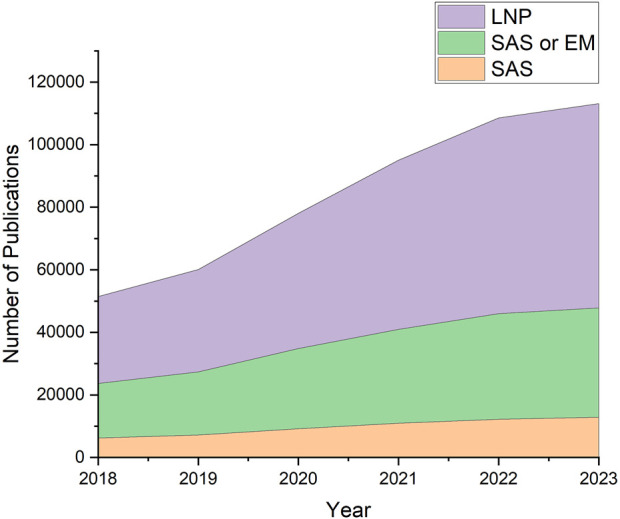
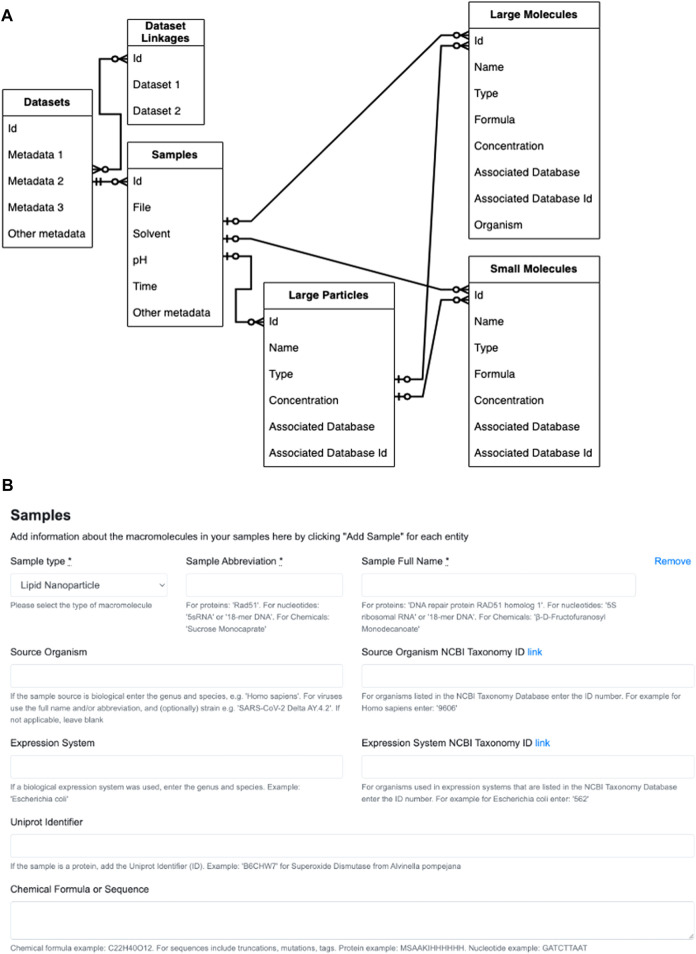
Lipid nanoparticles (LNPs) are being intensively researched and developed to leverage their ability to safely and effectively deliver therapeutics. To achieve optimal therapeutic delivery, a comprehensive understanding of the relationship between formulation, structure, and efficacy is critical. However, the vast chemical space involved in the production of LNPs and the resulting structural complexity make the structure to function relationship challenging to assess and predict. New components and formulation procedures, which provide new opportunities for the use of LNPs, would be best identified and optimized using high-throughput characterization methods. Recently, a high-throughput workflow, consisting of automated mixing, small-angle X-ray scattering (SAXS), and cellular assays, demonstrated a link between formulation, internal structure, and efficacy for a library of LNPs. As SAXS data can be rapidly collected, the stage is set for the collection of thousands of SAXS profiles from a myriad of LNP formulations. In addition, correlated LNP small-angle neutron scattering (SANS) datasets, where components are systematically deuterated for additional contrast inside, provide complementary structural information. The centralization of SAXS and SANS datasets from LNPs, with appropriate, standardized metadata describing formulation parameters, into a data repository will provide valuable guidance for the formulation of LNPs with desired properties. To this end, we introduce Simple Scattering, an easy-to-use, open data repository for storing and sharing groups of correlated scattering profiles obtained from LNP screening experiments. Here, we discuss the current state of the repository, including limitations and upcoming changes, and our vision towards future usage in developing our collective knowledge base of LNPs.
脂质纳米颗粒(LNPs)正在被深入研究和开发,以利用其安全有效地递送治疗药物的能力。为了实现最佳的治疗递送效果,全面了解制剂、结构和疗效之间的关系至关重要。然而,LNPs生产过程中涉及的巨大化学空间以及由此产生的结构复杂性使得结构与功能的关系难以评估和预测。使用高通量表征方法能够最好地识别和优化可为LNPs应用带来新机遇的新成分和制剂程序。最近,一种由自动混合、小角X射线散射(SAXS)和细胞分析组成的高通量工作流程,展示了一组LNPs的制剂、内部结构和疗效之间的联系。由于SAXS数据可以快速收集,因此为从大量LNP制剂中收集数千个SAXS图谱奠定了基础。此外,相关的LNP小角中子散射(SANS)数据集,其中各成分被系统地氘代以增加内部对比度,提供了互补的结构信息。将来自LNPs的SAXS和SANS数据集集中到一个数据存储库中,并配以描述制剂参数的适当标准化元数据,将为制备具有所需特性LNPs提供有价值的指导。为此,我们引入了Simple Scattering,这是一个易于使用的开放数据存储库,用于存储和共享从LNP筛选实验中获得的相关散射图谱组。在这里,我们讨论了该存储库的当前状态,包括局限性和即将发生的变化,以及我们对其未来在发展我们的LNPs集体知识库中的应用愿景。