Wilhelmy Christoph, Keil Isabell Sofia, Uebbing Lukas, Schroer Martin A, Franke Daniel, Nawroth Thomas, Barz Matthias, Sahin Ugur, Haas Heinrich, Diken Mustafa, Langguth Peter
Department of Biopharmaceutics and Pharmaceutical Technology, Johannes Gutenberg University Mainz, 55128 Mainz, Germany.
TRON-Translational Oncology at the University Medical Center of Johannes Gutenberg University gGmbH, 55131 Mainz, Germany.
Pharmaceutics. 2023 Aug 1;15(8):2068. doi: 10.3390/pharmaceutics15082068.
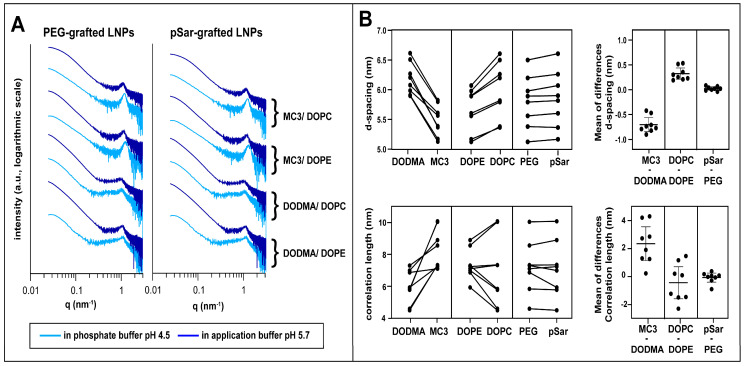
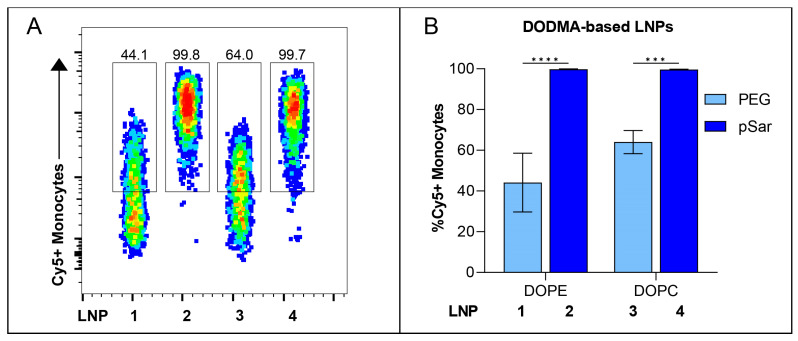
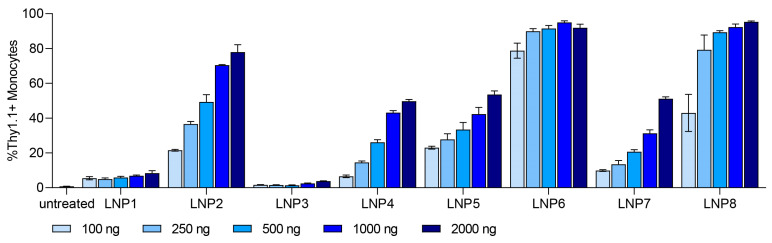
Lipid nanoparticles (LNPs) have gained great attention as carriers for mRNA-based therapeutics, finding applications in various indications, extending beyond their recent use in vaccines for infectious diseases. However, many aspects of LNP structure and their effects on efficacy are not well characterized. To further exploit the potential of mRNA therapeutics, better control of the relationship between LNP formulation composition with internal structure and transfection efficiency in vitro is necessary. We compared two well-established ionizable lipids, namely DODMA and MC3, in combination with two helper lipids, DOPE and DOPC, and two polymer-grafted lipids, either with polysarcosine (pSar) or polyethylene glycol (PEG). In addition to standard physicochemical characterization (size, zeta potential, RNA accessibility), small-angle X-ray scattering (SAXS) was used to analyze the structure of the LNPs. To assess biological activity, we performed transfection and cell-binding assays in human peripheral blood mononuclear cells (hPBMCs) using Thy1.1 reporter mRNA and Cy5-labeled mRNA, respectively. With the SAXS measurements, we were able to clearly reveal the effects of substituting the ionizable and helper lipid on the internal structure of the LNPs. In contrast, pSar as stealth moieties affected the LNPs in a different manner, by changing the surface morphology towards higher roughness. pSar LNPs were generally more active, where the highest transfection efficiency was achieved with the LNP formulation composition of MC3/DOPE/pSar. Our study highlights the utility of pSar for improved mRNA LNP products and the importance of pSar as a novel stealth moiety enhancing efficiency in future LNP formulation development. SAXS can provide valuable information for the rational development of such novel formulations by elucidating structural features in different LNP compositions.
脂质纳米颗粒(LNPs)作为基于mRNA的治疗药物载体已引起广泛关注,其应用于各种适应症,已超越了近期在传染病疫苗中的应用。然而,LNP结构的许多方面及其对疗效的影响尚未得到充分表征。为了进一步挖掘mRNA治疗药物的潜力,有必要更好地控制LNP制剂组成与内部结构之间的关系以及体外转染效率。我们比较了两种成熟的可电离脂质,即DODMA和MC3,与两种辅助脂质DOPE和DOPC,以及两种聚合物接枝脂质,分别是聚肌氨酸(pSar)或聚乙二醇(PEG)。除了标准的物理化学表征(尺寸、zeta电位、RNA可及性)外,还使用小角X射线散射(SAXS)来分析LNPs的结构。为了评估生物活性,我们分别使用Thy1.1报告基因mRNA和Cy5标记的mRNA在人外周血单核细胞(hPBMCs)中进行了转染和细胞结合试验。通过SAXS测量,我们能够清楚地揭示可电离脂质和辅助脂质替代对LNPs内部结构的影响。相比之下,pSar作为隐形部分以不同方式影响LNPs,通过使表面形态向更高粗糙度变化。pSar LNPs通常更具活性,其中MC3/DOPE/pSar的LNP制剂组成实现了最高的转染效率。我们的研究强调了pSar在改进mRNA LNP产品方面的实用性,以及pSar作为一种新型隐形部分在未来LNP制剂开发中提高效率的重要性。SAXS可以通过阐明不同LNP组成中的结构特征,为合理开发此类新型制剂提供有价值的信息。