Stagkourakis Stefanos, Williams Paul, Spigolon Giada, Khanal Shreya, Ziegler Katharina, Heikkinen Laura, Fisone Gilberto, Broberger Christian
Department of Neuroscience, Biomedicum B:4, Karolinska Institutet, Solnavägen 9, 171 65 Stockholm, Sweden.
Department of Biochemistry and Biophysics, Stockholm University, Svante Arrhenius väg 16C, 104 05 Stockholm, Sweden.
bioRxiv. 2024 Mar 31:2023.02.02.526862. doi: 10.1101/2023.02.02.526862.
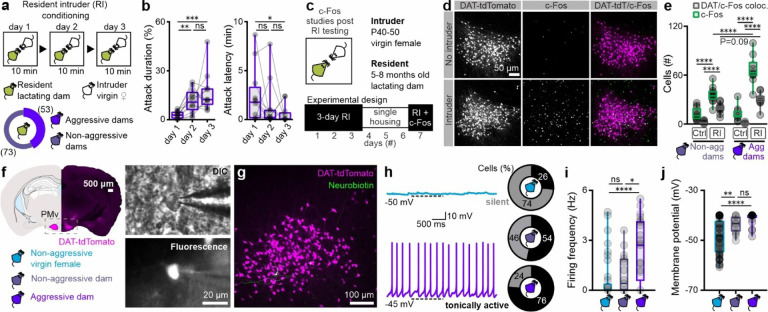
Aggression, a sexually dimorphic behaviour, is prevalent in males and typically absent in virgin females. Following parturition, however, the transient expression of aggression in adult female mice protects pups from predators and infanticide by male conspecifics. While maternal hormones are known to elicit nursing, their potential role in maternal aggression remains elusive. Here, we show in mice that a molecularly defined subset of ventral premammillary (PMv) neurons, instrumental for intermale aggression, switch from quiescence to a hyperexcitable state during lactation. We identify that the maternal hormones prolactin and oxytocin excite these cells through actions that include T-type Ca channels. Optogenetic manipulation or genetic ablation of PMv neurons profoundly affects maternal aggression, while activation of these neurons impairs the expression of non-aggression-related maternal behaviours. This work identifies a monomorphic neural substrate that can incorporate hormonal cues to enable the transient expression of a dormant behavioural program in lactating females.
攻击行为是一种具有性别差异的行为,在雄性中普遍存在,而未生育的雌性通常没有。然而,分娩后,成年雌性小鼠中攻击行为的短暂表达可保护幼崽免受捕食者和雄性同类的杀婴行为。虽然已知母体激素会引发哺乳行为,但其在母体攻击行为中的潜在作用仍不清楚。在这里,我们在小鼠中发现,腹侧乳头前核(PMv)中一个分子定义明确的神经元子集,对雄性间攻击行为起作用,在哺乳期从静止状态转变为超兴奋状态。我们确定母体激素催乳素和催产素通过包括T型钙通道在内的作用来兴奋这些细胞。对PMv神经元进行光遗传学操作或基因消融会深刻影响母体攻击行为,而激活这些神经元则会损害与非攻击相关的母体行为的表达。这项工作确定了一种单态性神经基质,它可以整合激素信号,使哺乳期雌性中休眠行为程序得以短暂表达。