Umhang Gérald, Frantz Alain C, Ferté Hubert, Fournier Chambrillon Christine, Gautrelet Manon, Gritti Thibault, Thenon Nathan, Le Loc'h Guillaume, Isère-Laoué Estelle, Egal Fabien, Caillot Christophe, Lippert Stéphanie, Heddergott Mike, Fournier Pascal, Richomme Céline
ANSES Nancy Laboratory for Rabies and Wildlife, National Reference Laboratory for Echinococcus spp., Malzeville, France.
Musée National d'Histoire Naturelle, Luxembourg, Luxembourg.
Int J Parasitol Parasites Wildl. 2024 Mar 21;23:100928. doi: 10.1016/j.ijppaw.2024.100928. eCollection 2024 Apr.
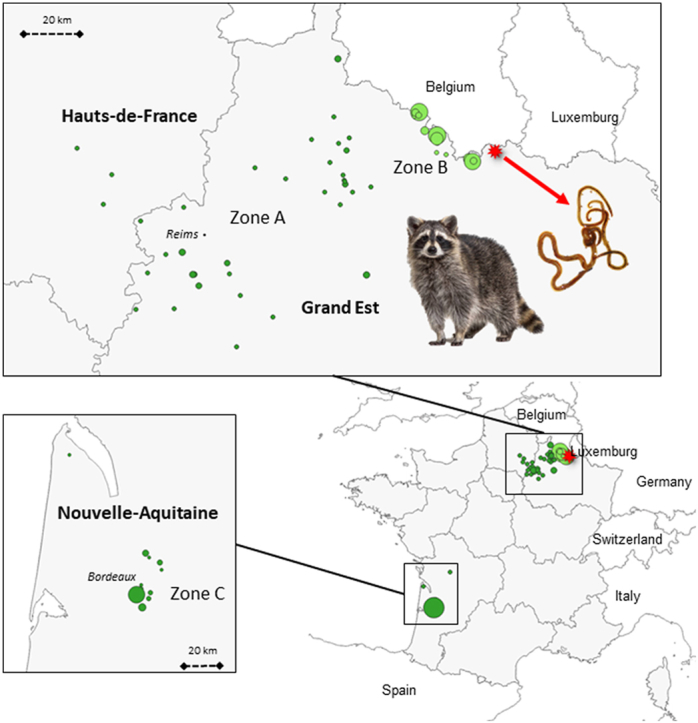
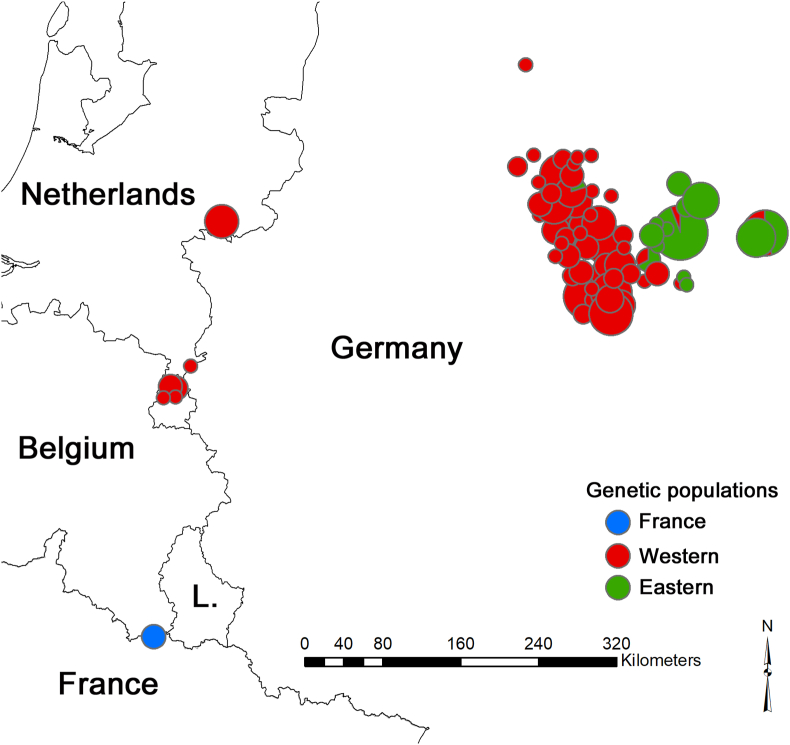
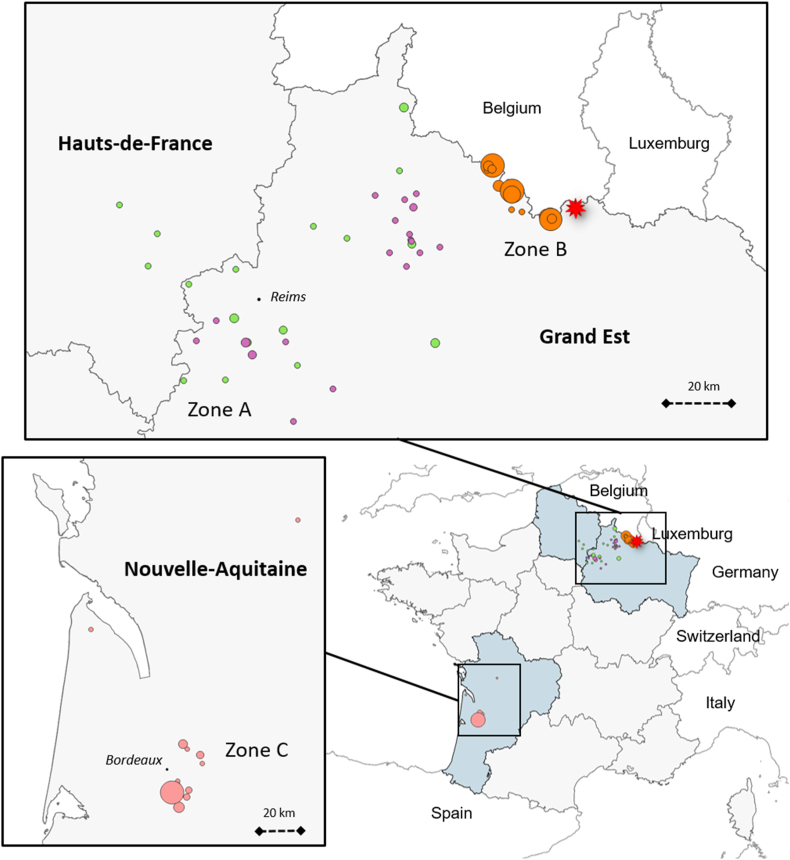
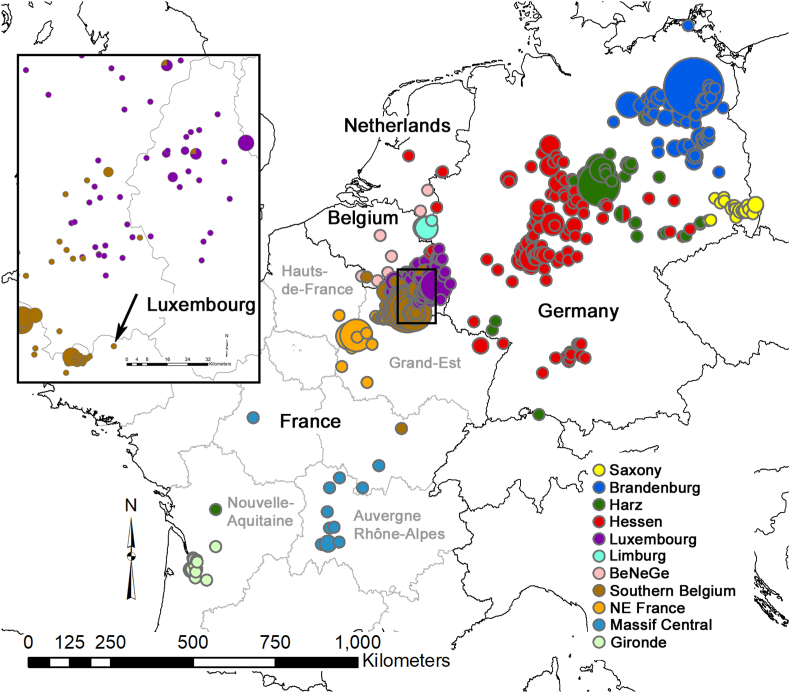
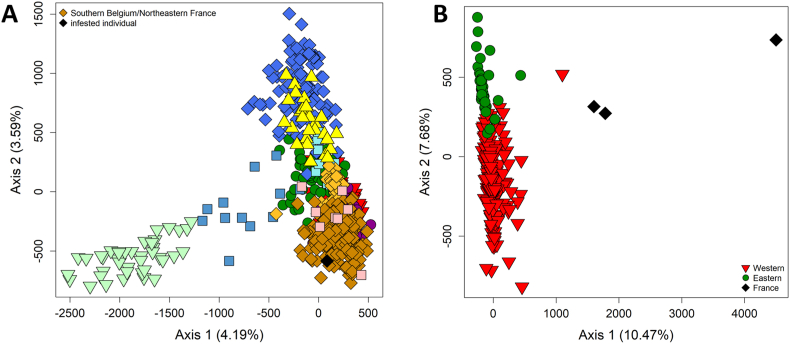
Human infection by can result in larva migrans syndromes, which can cause severe neurological sequelae and fatal cases. The raccoon serves as the definitive host of the nematode, harboring adult worms in its intestine and excreting millions of eggs into the environment via its feces. Transmission to paratenic hosts (such as rodents, birds and rabbits) or to humans occurs by accidental ingestion of eggs. The occurrence of in wild raccoons has been reported in several Western European countries. In France, raccoons have currently established three separate and expanding populations as a result of at least three independent introductions. Until now the presence of in these French raccoon populations has not been investigated. Between 2011 and 2021, 300 raccoons were collected from both the south-western and north-eastern populations. The core parts of the south-western and north-eastern French raccoon populations were free of . However, three worms (molecularly confirmed) were detected in a young raccoon found at the edge of the north-eastern French raccoon population, close to the Belgian and Luxemburg borders. Population genetic structure analysis, genetic exclusion tests and factorial correspondence analysis all confirmed that the infected raccoon originated from the local genetic population, while the same three approaches showed that the worms were genetically distinct from the two nearest known populations in Germany and the Netherlands. The detection of an infected raccoon sampled east of the northeastern population raises strong questions about the routes of introduction of the roundworms. Further studies are required to test wild raccoons for the presence of in the area of the index case and further east towards the border with Germany.
人类感染[具体寄生虫名称未给出]可导致幼虫移行症综合征,这可能会引起严重的神经后遗症和致命病例。浣熊是这种线虫的终末宿主,其肠道内寄生着成虫,并通过粪便向环境中排泄数百万枚虫卵。通过意外摄入虫卵,可传播至转续宿主(如啮齿动物、鸟类和兔子)或人类。在几个西欧国家都报告了野生浣熊感染[具体寄生虫名称未给出]的情况。在法国,由于至少三次独立引入,浣熊目前已形成三个独立且不断扩大的种群。到目前为止,尚未对这些法国浣熊种群中[具体寄生虫名称未给出]的存在情况进行调查。在2011年至2021年期间,从西南部和东北部种群中收集了300只浣熊。法国西南部和东北部浣熊种群的核心区域没有[具体寄生虫名称未给出]。然而,在法国东北部浣熊种群边缘、靠近比利时和卢森堡边境发现的一只幼年浣熊体内检测到了三条线虫(经分子确认)。种群遗传结构分析、遗传排除测试和因子对应分析均证实,受感染的浣熊源自当地遗传种群,而同样的三种方法表明,这些线虫在基因上与德国和荷兰最近的两个已知种群不同。在东北部种群以东采集到一只受感染浣熊,这引发了关于蛔虫引入途径的强烈疑问。需要进一步开展研究,以检测索引病例所在地区及更往东直至与德国接壤地区的野生浣熊是否存在[具体寄生虫名称未给出]。