Department of Neurosurgery, The Johns Hopkins University School of Medicine, Baltimore, MD, USA.
Department of Neurosurgery, Stanford School of Medicine, Palo Alto, CA, USA.
Oncoimmunology. 2024 Apr 4;13(1):2338965. doi: 10.1080/2162402X.2024.2338965. eCollection 2024.
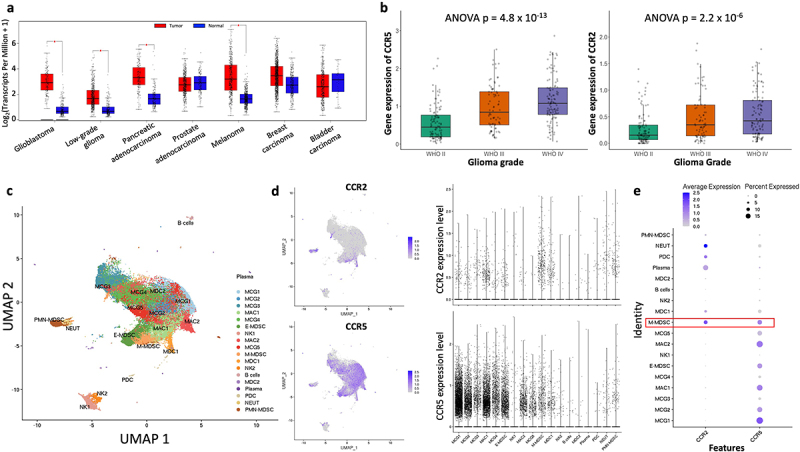
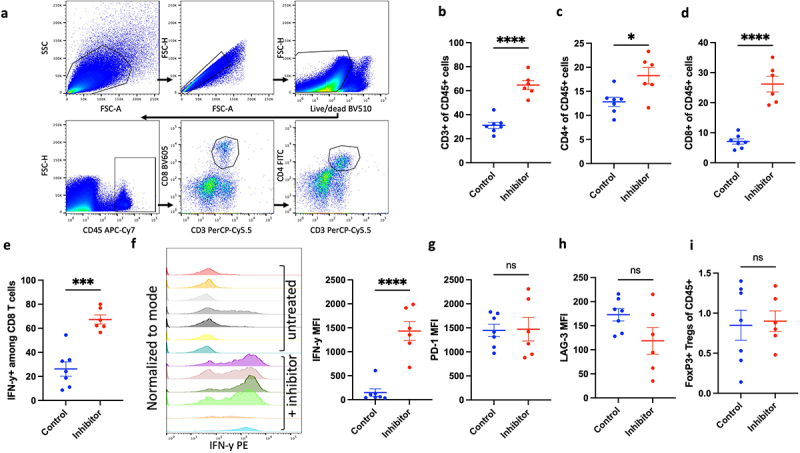
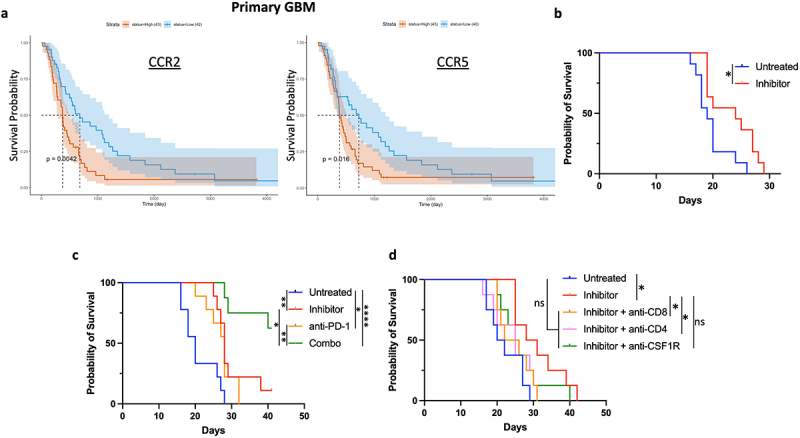
Immunotherapy has revolutionized the treatment of cancers. Reinvigorating lymphocytes with checkpoint blockade has become a cornerstone of immunotherapy for multiple tumor types, but the treatment of glioblastoma has not yet shown clinical efficacy. A major hurdle to treat GBM with checkpoint blockade is the high degree of myeloid-mediated immunosuppression in brain tumors that limits CD8 T-cell activity. A potential strategy to improve anti-tumor efficacy against glioma is to use myeloid-modulating agents to target immunosuppressive cells, such as myeloid-derived suppressor cells (MDSCs) in the tumor microenvironment. We found that the co-inhibition of the chemokine receptors CCR2 and CCR5 in murine model of glioma improves the survival and synergizes robustly with anti-PD-1 therapy. Moreover, the treatment specifically reduced the infiltration of monocytic-MDSCs (M-MDSCs) into brain tumors and increased lymphocyte abundance and cytokine secretion by tumor-infiltrating CD8 T cells. The depletion of T-cell subsets and myeloid cells abrogated the effects of CCR2 and CCR5 blockade, indicating that while broad depletion of myeloid cells does not improve survival, specific reduction in the infiltration of immunosuppressive myeloid cells, such as M-MDSCs, can boost the anti-tumor immune response of lymphocytes. Our study highlights the potential of CCR2/CCR5 co-inhibition in reducing myeloid-mediated immunosuppression in GBM patients.
免疫疗法已经彻底改变了癌症的治疗方式。通过检查点阻断来激活淋巴细胞已成为多种肿瘤类型免疫治疗的基石,但胶质母细胞瘤的治疗尚未显示出临床疗效。用检查点阻断治疗 GBM 的一个主要障碍是脑肿瘤中高度髓系介导的免疫抑制,限制了 CD8 T 细胞的活性。一种提高针对神经胶质瘤的抗肿瘤疗效的潜在策略是使用髓样调节药物来靶向抑制肿瘤微环境中的免疫抑制细胞,如髓系来源的抑制细胞 (MDSCs)。我们发现,在胶质母细胞瘤的小鼠模型中,共同抑制趋化因子受体 CCR2 和 CCR5 可提高生存率,并与抗 PD-1 治疗协同作用。此外,该治疗方法特异性地减少单核细胞-MDSCs (M-MDSCs) 浸润脑肿瘤,并增加肿瘤浸润 CD8 T 细胞的淋巴细胞丰度和细胞因子分泌。T 细胞亚群和髓样细胞的耗竭消除了 CCR2 和 CCR5 阻断的作用,表明虽然广泛耗尽髓样细胞不能提高生存率,但特异性减少浸润性免疫抑制性髓样细胞(如 M-MDSCs)可以增强淋巴细胞的抗肿瘤免疫反应。我们的研究强调了 CCR2/CCR5 共抑制在减少 GBM 患者髓样介导的免疫抑制方面的潜力。