Advanced Public Health Laboratory, Institute Gonçalo Moniz, Foundation Oswaldo Cruz (FIOCRUZ-BA), Salvador, Brazil.
Salvador University (UNIFACS), Salvador, Brazil.
Am J Trop Med Hyg. 2024 Apr 9;110(6):1237-1244. doi: 10.4269/ajtmh.23-0238. Print 2024 Jun 5.
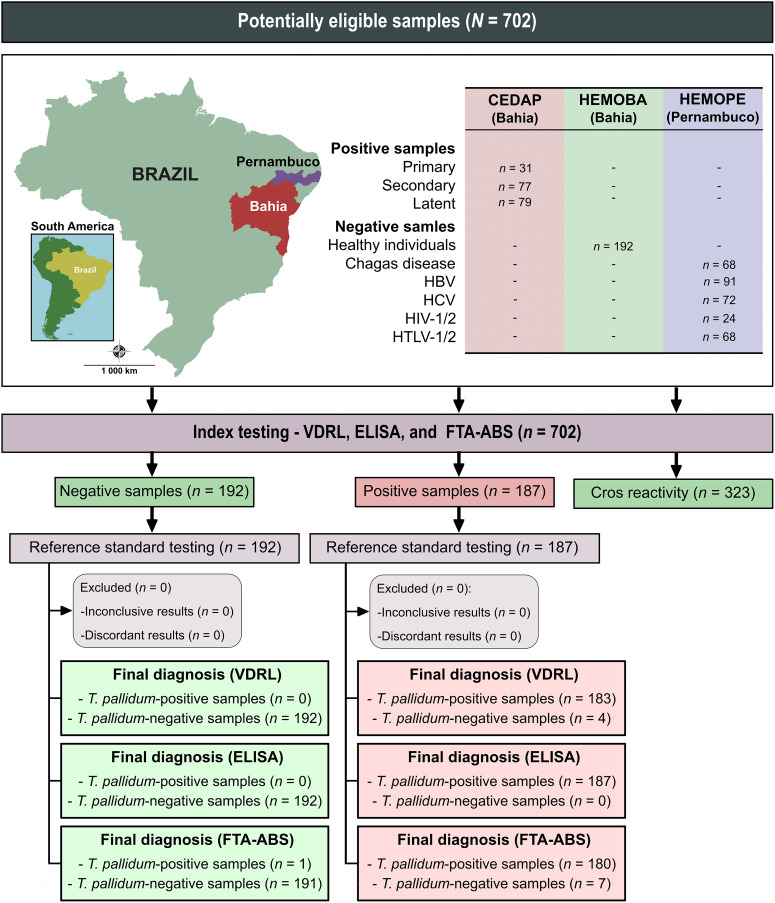
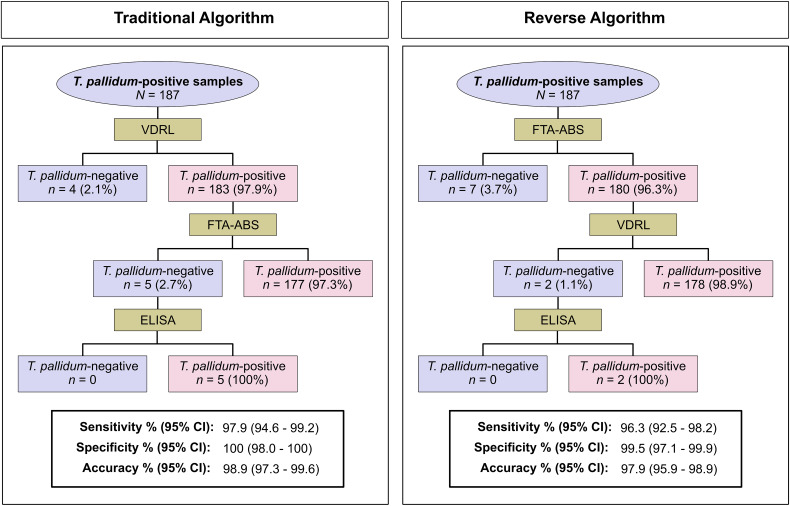
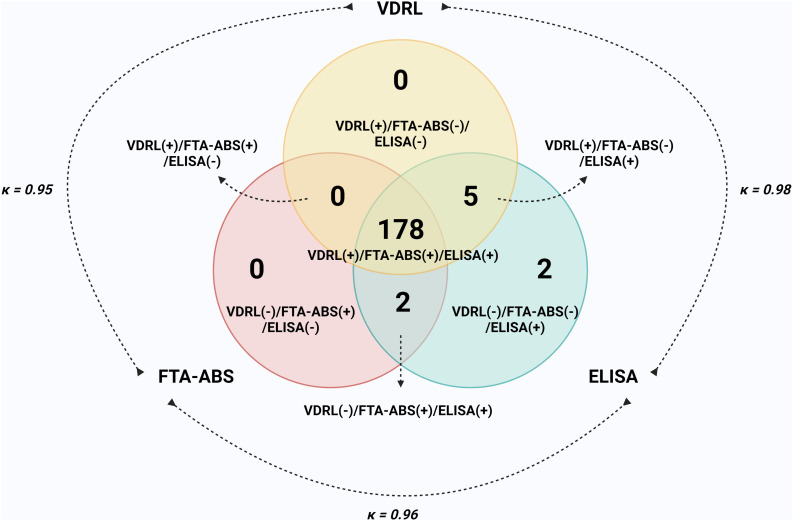
There are a variety of nontreponemal test (NTT) and treponemal test (TT) kits for the serologic diagnosis of syphilis. Because of the complexity of the infection (multiple clinical stages) and the different antigens used in these kits, a systematic evaluation of the accuracy of the currently available commercial tests is warranted. Our objective was to evaluate the performance of commercially available tests for the diagnosis of syphilis infection. In this study, we analyzed one NTT (Venereal Disease Research Laboratory [VDRL] test, Wiener Laboratories, Rosario, Argentina) and two TTs (fluorescent treponemal antibody absorption [FTA-ABS] test, Euroimmun, Lübeck, Germany, and syphilis recombinant ELISA v. 4.0 test [ELISA], Wiener Laboratories, Rosario, Argentina) using a panel of 187 samples, including serum samples from 31 individuals with primary syphilis, 77 with secondary syphilis, and 79 with latent syphilis. An additional 192 samples from uninfected individuals and 323 serum samples from individuals with other diseases were included. The sensitivities of the VDRL, ELISA, and FTA-ABS tests were 97.9%, 100%, and 96.3%, respectively. The VDRL and ELISA tests showed a specificity of 100%, and the FTA-ABS test showed a specificity of 99.5%. Accuracy was 98.9% for the VDRL test, 100% for the ELISA, and 97.9% for the FTA-ABS test. For primary, secondary, and latent syphilis, the ELISA achieved a diagnostic performance of 100%, whereas the sensitivity for the VDRL and FTA-ABS tests ranged from 96.8% to 98.7% and 93.7% to 98.7%, respectively. No difference was observed when the tests were used as traditional or reverse algorithms. In general, all three tests are able to discriminate positive and negative samples for syphilis, regardless of the diagnostic algorithm.
有多种非梅毒螺旋体试验(NTT)和梅毒螺旋体试验(TT)试剂盒可用于梅毒的血清学诊断。由于感染的复杂性(多个临床阶段)和这些试剂盒中使用的不同抗原,有必要对当前可用的商业检测方法的准确性进行系统评估。我们的目的是评估商业上可用于诊断梅毒感染的检测方法的性能。在这项研究中,我们分析了一种 NTT(性病研究实验室[VDRL]试验,Wiener Laboratories,罗萨里奥,阿根廷)和两种 TT(荧光密螺旋体抗体吸收[FTA-ABS]试验,Euroimmun,吕贝克,德国,和梅毒重组 ELISA v. 4.0 试验[ELISA],Wiener Laboratories,罗萨里奥,阿根廷),使用了包括 31 例原发性梅毒、77 例二期梅毒和 79 例潜伏梅毒血清样本在内的 187 个样本的面板。还包括 192 个未感染个体的样本和 323 个患有其他疾病个体的血清样本。VDRL、ELISA 和 FTA-ABS 试验的敏感性分别为 97.9%、100%和 96.3%。VDRL 和 ELISA 试验的特异性为 100%,FTA-ABS 试验的特异性为 99.5%。VDRL 试验的准确性为 98.9%,ELISA 为 100%,FTA-ABS 为 97.9%。对于原发性、二期和潜伏性梅毒,ELISA 达到了 100%的诊断性能,而 VDRL 和 FTA-ABS 试验的敏感性范围分别为 96.8%至 98.7%和 93.7%至 98.7%。使用传统或反向算法时,没有观察到差异。一般来说,无论使用何种诊断算法,这三种检测方法都能够区分梅毒的阳性和阴性样本。