Morais Leonardo Mario Siqueira, Queiroz Arnaldo Fabrício Dos Santos, Brito Bárbara Kellry Fagundes de, Fenzl Norbert, Soares Marcelo de Oliveira, Giarrizzo Tommaso, Martinelli Filho José Eduardo
Centro de Estudos Avançados da Biodiversidade, Universidade Federal do Pará, Av. Perimetral, km 01, Guamá, Belém, PA, 66075-750, Brazil.
Laboratório de Oceanografia Biológica, Instituto de Geociências, Universidade Federal do Pará. Av. Augusto Corrêa s/n, Guamá, Belém, PA, 66075-110, Brazil.
Heliyon. 2024 Mar 30;10(7):e28851. doi: 10.1016/j.heliyon.2024.e28851. eCollection 2024 Apr 15.
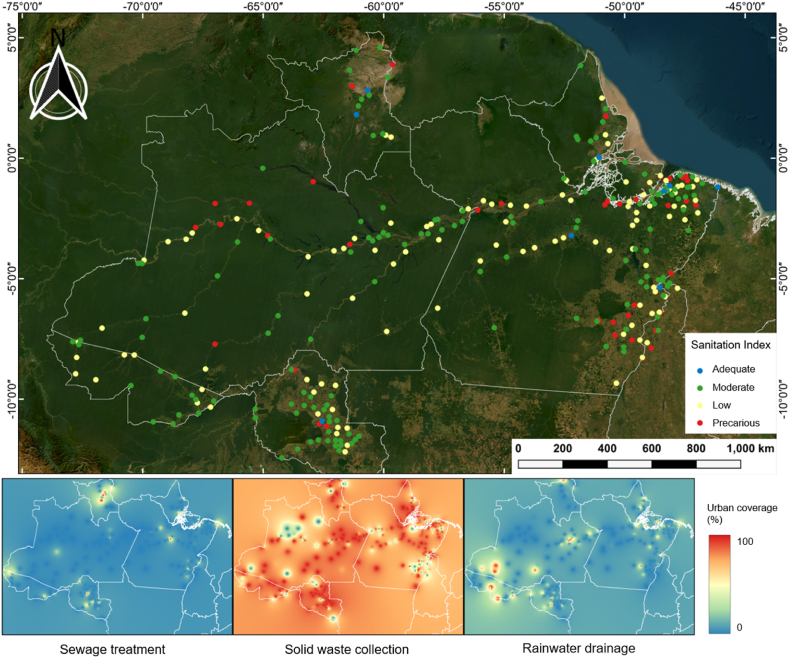
Microplastics (MPs) have been identified as a major potential threat to the biota and human health. Despite the exponential increase in MP research worldwide, few studies have focused on the extensive Amazon biome. To assess research priorities, the present study reviewed and summarized the available scientific knowledge on MPs in the Amazon, in addition to analyzing population and waste-management data, to evaluate potential sources of MPs in the hydrographic system. Poor sanitation conditions are a main source of MPs for the vast hydrographic basin, and, consequently, for the adjacent ocean. Secondary MPs predominated, mostly fibers (96% of debris), composed of polyamide (32%). Mean MP concentrations ranged from 0.34 to 38.3 particles.individual in biota, 5 to 476,000 particles.m in water, and 492.5 to 1.30848 × 10 particles.m in sediment, values in close comparison with those found in areas profoundly affected by anthropogenic pollution. MPs were widespread in a range of Amazonian environments and species, and negative effects are probably occurring at various ecological levels. However, limited research, methodological constraints, flaws and the lack of standardization, combined with the continental dimensions of the Amazon, hampers the collection of the fundamental knowledge needed to reliably evaluate the impacts and implement effective mitigation measures. There is an urgent need to expand scientific data available for the region, improving local research infrastructure, and training and deploying local researchers.
微塑料(MPs)已被确认为对生物群和人类健康的主要潜在威胁。尽管全球范围内MP研究呈指数级增长,但很少有研究关注广袤的亚马逊生物群落。为评估研究重点,本研究回顾并总结了关于亚马逊地区MPs的现有科学知识,此外还分析了人口和废物管理数据,以评估水文系统中MPs的潜在来源。卫生条件差是广大水文盆地,进而也是邻近海洋中MPs的主要来源。次生微塑料占主导,主要是纤维(占碎片的96%),由聚酰胺组成(32%)。生物群中MPs的平均浓度范围为每个体0.34至38.3个颗粒,水中为每立方米5至476,000个颗粒,沉积物中为每立方米492.5至1.30848×10个颗粒,这些值与受人为污染严重影响地区的值相近。MPs在一系列亚马逊环境和物种中广泛存在,可能在各个生态层面产生负面影响。然而,研究有限、方法上的限制、缺陷以及缺乏标准化,再加上亚马逊地区的广袤面积,阻碍了收集可靠评估影响和实施有效缓解措施所需的基础知识。迫切需要扩大该地区可用的科学数据,改善当地研究基础设施,并培训和部署当地研究人员。