
一项结合智能手机应用程序的戒烟心理治疗的有效性和可接受性评估:一项试点研究。
Evaluation of effectiveness and acceptability of a psychological treatment for smoking cessation combined with a smartphone App: A pilot study.
作者信息
Barroso-Hurtado María, López-Durán Ana, Martínez-Vispo Carmela, Suárez-Castro Daniel, Becoña Elisardo
机构信息
Smoking and Addictive Disorders Unit, Department of Clinical Psychology and Psychobiology University of Santiago de Compostela, Campus Vida, 15782, Spain.
出版信息
Internet Interv. 2024 Mar 30;36:100737. doi: 10.1016/j.invent.2024.100737. eCollection 2024 Jun.
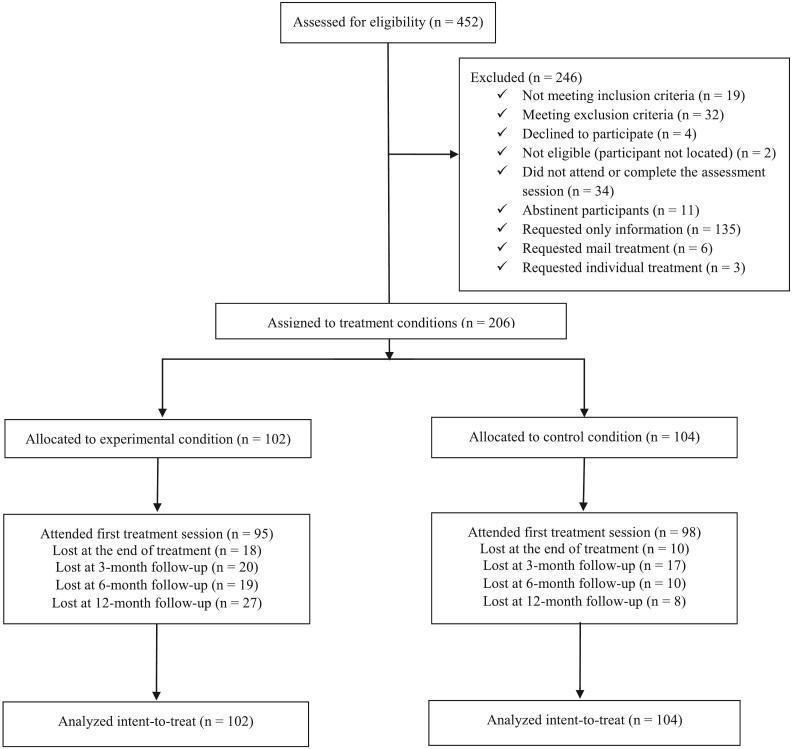
Despite the increasing number of mobile-based interventions to quit smoking over the last years, few studies have investigated the efficacy of smoking cessation interventions blended with smartphone Apps. The present pilot study aims to examine the preliminary effectiveness and acceptability of a cognitive-behavioral treatment combined with a smartphone App, compared to the same psychological treatment without the App. The sample comprised 206 treatment-seeking smokers, who were assigned to: 1) an experimental group receiving a cognitive-behavioral intervention combined with the "Non Fumo" App ( = 102), and 2) a control group receiving only the cognitive-behavioral intervention to quit smoking ( = 104). Results concerning the primary outcomes showed no significant differences between conditions in point-prevalence abstinence rates at 12-month follow-up (35.30 % in the experimental group vs. 31.70 % in the control group) and in treatment acceptability. Regarding the secondary outcomes, both groups obtained similar point-prevalence abstinence rates at the end of treatment (61.80 % vs. 65.40 %), at 3-month (42.20 % vs. 45.20 %, respectively) and 6-month follow-ups (37.30 % vs. 37.50 %). No significant differences were found between conditions in prolonged abstinence rates at 6-month (35.3 % vs. 35.6 %) and 12-month follow-ups (30.4 % vs. 26.9 %). Overall, good abstinence rates and treatment acceptability were obtained, although there were no significant differences between conditions. More research is needed to establish clear conclusions about the efficacy of psychological smoking cessation treatments blended with smartphone Apps.
尽管在过去几年中,基于移动设备的戒烟干预措施数量不断增加,但很少有研究调查与智能手机应用程序相结合的戒烟干预措施的效果。本试点研究旨在检验与不使用该应用程序的相同心理治疗相比,认知行为疗法与智能手机应用程序相结合的初步有效性和可接受性。样本包括206名寻求治疗的吸烟者,他们被分为:1)实验组,接受认知行为干预并结合“Non Fumo”应用程序(n = 102);2)对照组,仅接受戒烟的认知行为干预(n = 104)。关于主要结果的结果显示,在12个月随访时的点患病率戒烟率(实验组为35.30%,对照组为31.70%)和治疗可接受性方面,两组之间没有显著差异。关于次要结果,两组在治疗结束时(分别为61.80%和65.40%)、3个月随访时(分别为42.20%和45.20%)以及6个月随访时(分别为37.30%和37.50%)的点患病率戒烟率相似。在6个月(35.3%对35.6%)和12个月随访时(30.4%对26.9%)的长期戒烟率方面,两组之间没有发现显著差异。总体而言,尽管两组之间没有显著差异,但获得了良好的戒烟率和治疗可接受性。需要更多的研究来明确关于与智能手机应用程序相结合的心理戒烟治疗效果的结论。
 Zotero 插件