CEMAD Digestive Disease Center, Fondazione Policlinico Universitario "A. Gemelli" IRCCS, Catholic University of Rome, Rome 00168, Italy.
Fondazione Policlinico Universitario Agostino Gemelli IRCCS, Fondazione Policlinico Universitario Agostino Gemelli IRCCS - Università Cattolica del Sacro Cuore, Rome 00168, Italy.
World J Gastroenterol. 2024 Mar 14;30(10):1450-1460. doi: 10.3748/wjg.v30.i10.1450.
Direct-acting antiviral agents (DAAs) are highly effective treatment for chronic hepatitis C (CHC) with a significant rate of sustained virologic response (SVR). The achievement of SVR is crucial to prevent additional liver damage and slow down fibrosis progression. The assessment of fibrosis degree can be performed with transient elastography, magnetic resonance elastography or shear-wave elastography (SWE). Liver elastography could function as a predictor for hepatocellular carcinoma (HCC) in CHC patients treated with DAAs.
To explore the predictive value of SWE for HCC development after complete clearance of hepatitis C virus (HCV).
A comprehensive literature search of clinical studies was performed to identify the ability of SWE to predict HCC occurrence after HCV clearance. In accordance with the study protocol, a qualitative and quantitative analysis of the evidence was planned.
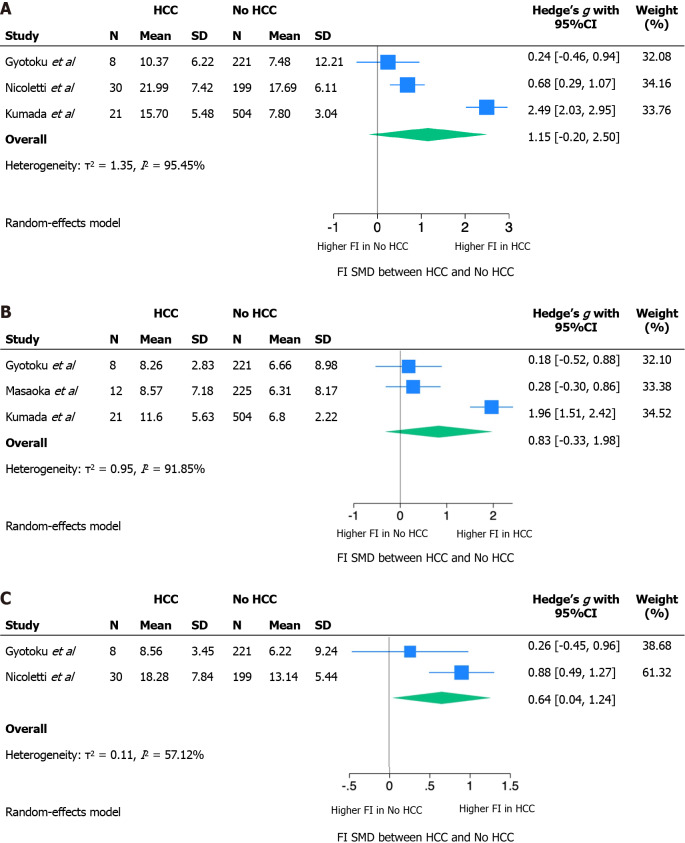
At baseline and after 12 wk of follow-up, a trend was shown towards greater liver stiffness (LS) in those who go on to develop HCC compared to those who do not [baseline LS standardized mean difference (SMD): 1.15, 95% confidence interval (95%CI): 020-2.50; LS SMD after 12 wk: 0.83, 95%CI: 0.33-1.98]. The absence of a statistically significant difference between the mean LS in those who developed HCC or not may be related to the inability to correct for confounding factors and the absence of raw source data. There was a statistically significant LS SMD at 24 wk of follow-up between patients who developed HCC not (0.64; 95%CI: 0.04-1.24).
SWE could be a promising tool for prediction of HCC occurrence in patients treated with DAAs. Further studies with larger cohorts and standardized timing of elastographic evaluation are needed to confirm these data.
直接作用抗病毒药物(DAAs)对慢性丙型肝炎(CHC)的治疗效果非常显著,其持续病毒学应答(SVR)率较高。实现 SVR 对于预防进一步的肝损伤和减缓纤维化进展至关重要。纤维化程度的评估可以通过瞬时弹性成像、磁共振弹性成像或剪切波弹性成像(SWE)来完成。肝弹性成像可以作为 DAA 治疗的 CHC 患者发生肝细胞癌(HCC)的预测指标。
探索 SWE 在 HCV 完全清除后预测 HCC 发展的价值。
对临床研究进行全面的文献检索,以确定 SWE 预测 HCV 清除后 HCC 发生的能力。根据研究方案,计划对证据进行定性和定量分析。
在基线和随访 12 周时,与未发生 HCC 的患者相比,发生 HCC 的患者的肝脏硬度(LS)呈升高趋势[基线 LS 标准化均数差值(SMD):1.15,95%置信区间(95%CI):020-2.50;随访 12 周 LS SMD:0.83,95%CI:0.33-1.98]。未发生 HCC 和发生 HCC 的患者之间 LS 的平均值之间没有统计学差异,这可能与无法校正混杂因素以及缺乏原始数据源有关。在随访 24 周时,发生 HCC 的患者和未发生 HCC 的患者之间的 LS SMD 具有统计学意义(0.64;95%CI:0.04-1.24)。
SWE 可能是预测 DAA 治疗患者 HCC 发生的一种有前途的工具。需要进一步开展具有更大队列和标准化弹性评估时间的研究,以验证这些数据。