Haiphong International Hospital, Haiphong, Vietnam.
Hai Phong University of Medicine and Pharmacy, Hai Phong, Vietnam.
PLoS One. 2023 Sep 1;18(9):e0290235. doi: 10.1371/journal.pone.0290235. eCollection 2023.
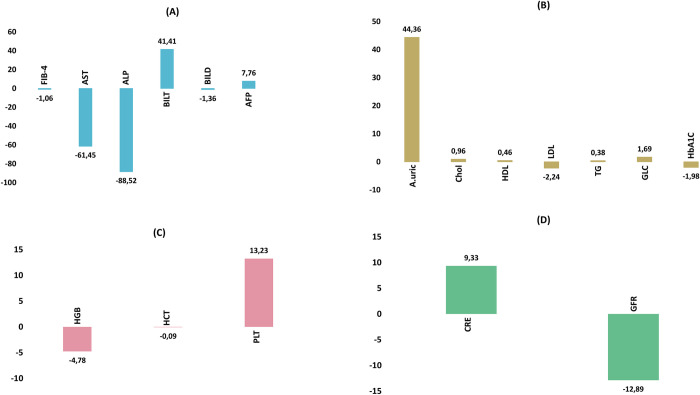
The impact of direct-acting antivirals (DAA) therapy on lipid and glucose metabolism and kidney function in patients with hepatitis C virus (HCV) infection, along with its side effects on blood cells, remains controversial. Therefore, we conducted a study that enrolled 280 patients with HCV infection who achieved sustained virologic response after treatment with DAA therapy without ribavirin to evaluate the metabolic changes, renal function, and anemia risk based on real-world data. This study was an observational prospective study with a follow-up period of 12 weeks after the initiation of DAA therapy. Data on biochemical tests, renal function, blood counts, viral load, and host genomics were recorded before treatment and after 12 weeks of treatment with DAAs. DAA therapy reduced fibrosis-4 scores and improved liver function, with significant reductions in aspartate transaminase, alanine aminotransferase, and total bilirubin levels. However, DAA therapy slightly increased uric acid, cholesterol, and low-density lipoprotein cholesterol levels. It significantly reduced fasting blood glucose levels and hemoglobin A1C index (HbA1C) in the study group, while hemoglobin (Hb) and hematocrit (HCT) concentrations decreased significantly (4.78 ± 21.79 g/L and 0.09% ± 0.11%, respectively). The estimated glomerular filtration rate (eGFR) decreased by 12.89 ± 39.04 mL/min/1.73m2. Most variations were not related to the genotype, except for Hb, HCT, and HbA1C. Anemia incidence increased from 23.58% before treatment to 30.72% after treatment. Patients with HCV-1 genotype had a higher rate of anemia than did patients with genotype 6 (36.23% vs. 24.62%). Multivariate analysis showed that the risk of anemia was related to female sex, cirrhosis status, fibrosis-4 score, pretreatment eGFR, and pretreatment Hb level. The results of our study can provide helpful information to clinicians for the prognosis and treatment of HCV infection.
直接作用抗病毒药物(DAA)治疗对丙型肝炎病毒(HCV)感染患者的脂质和葡萄糖代谢及肾功能的影响及其对血细胞的副作用仍存在争议。因此,我们进行了一项研究,纳入了 280 例接受 DAA 治疗且无利巴韦林治疗后获得持续病毒学应答的 HCV 感染患者,以基于真实世界数据评估代谢变化、肾功能和贫血风险。这项研究是一项观察性前瞻性研究,在 DAA 治疗开始后 12 周进行随访。在治疗前和 DAA 治疗 12 周后记录了生化检查、肾功能、血细胞计数、病毒载量和宿主基因组学的数据。DAA 治疗降低了纤维化-4 评分并改善了肝功能,天冬氨酸转氨酶、丙氨酸转氨酶和总胆红素水平显著降低。然而,DAA 治疗略微增加了尿酸、胆固醇和低密度脂蛋白胆固醇水平。它显著降低了研究组的空腹血糖水平和糖化血红蛋白指数(HbA1C),而血红蛋白(Hb)和红细胞压积(HCT)浓度显著降低(分别为 4.78 ± 21.79 g/L 和 0.09% ± 0.11%)。估算肾小球滤过率(eGFR)下降了 12.89 ± 39.04 mL/min/1.73m2。大多数变化与基因型无关,除了 Hb、HCT 和 HbA1C。贫血发生率从治疗前的 23.58%增加到治疗后的 30.72%。HCV-1 基因型患者的贫血发生率高于基因型 6 患者(36.23%比 24.62%)。多变量分析显示,贫血的风险与女性、肝硬化状态、纤维化-4 评分、治疗前 eGFR 和治疗前 Hb 水平有关。我们研究的结果可以为临床医生提供有关 HCV 感染预后和治疗的有用信息。