
脑外排建模:脑表面的约束。
Modeling of brain efflux: Constraints of brain surfaces.
机构信息
Center for Translational Neuromedicine, Faculty of Health and Medical Sciences, University of Copenhagen, Copenhagen 2200 Denmark.
Department of Cellular and Molecular Medicine, Faculty of Health and Medical Sciences, University of Copenhagen, Copenhagen 2200 Denmark.
出版信息
Proc Natl Acad Sci U S A. 2024 Apr 16;121(16):e2318444121. doi: 10.1073/pnas.2318444121. Epub 2024 Apr 10.
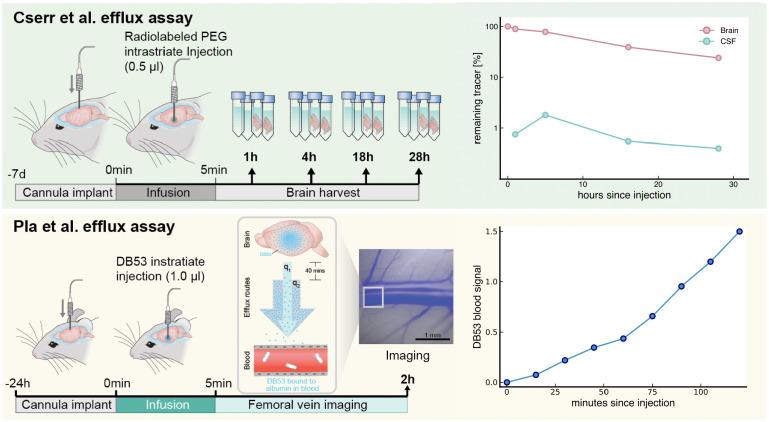
Fluid efflux from the brain plays an important role in solute waste clearance. Current experimental approaches provide little spatial information, and data collection is limited due to short duration or low frequency of sampling. One approach shows tracer efflux to be independent of molecular size, indicating bulk flow, yet also decelerating like simple membrane diffusion. In an apparent contradiction to this report, other studies point to tracer efflux acceleration. We here develop a one-dimensional advection-diffusion model to gain insight into brain efflux principles. The model is characterized by nine physiological constants and three efflux parameters for which we quantify prior uncertainty. Using Bayes' rule and the two efflux studies, we validate the model and calculate data-informed parameter distributions. The apparent contradictions in the efflux studies are resolved by brain surface boundaries being bottlenecks for efflux. To critically test the model, a custom MRI efflux assay measuring solute dispersion in tissue and release to cerebrospinal fluid was employed. The model passed the test with tissue bulk flow velocities in the range 60 to 190 [Formula: see text]m/h. Dimensional analysis identified three principal determinants of efflux, highlighting brain surfaces as a restricting factor for metabolite solute clearance.
脑内液流对于溶质废物清除具有重要作用。目前的实验方法提供的空间信息较少,并且由于采样持续时间短或频率低,数据收集受到限制。一种方法表明示踪剂流出与分子大小无关,表明是体流,但也像简单的膜扩散一样减速。与这一报告明显矛盾的是,其他研究表明示踪剂流出加速。我们在这里开发了一个一维平流-扩散模型,以深入了解脑内流出原理。该模型的特点是有九个生理常数和三个流出参数,我们对其先验不确定性进行了量化。使用贝叶斯规则和两项流出研究,我们验证了模型并计算了数据驱动的参数分布。通过将脑表面边界作为流出的瓶颈,解决了流出研究中的明显矛盾。为了严格测试模型,我们采用了一种定制的 MRI 流出测定法,测量组织中的溶质弥散和向脑脊液的释放。该模型通过了测试,组织体流速度在 60 到 190 [Formula: see text]m/h 范围内。因次分析确定了流出的三个主要决定因素,突出了脑表面作为代谢物溶质清除的限制因素。



 Zotero 插件