Frances L. Hiatt School of Psychology, Clark University, Worcester, Massachusetts, United States.
Centre of Social Medicine and Community Health, School of Social Sciences, Jawaharlal Nehru University, 110067, Delhi, India.
BMC Psychol. 2024 Apr 10;12(1):196. doi: 10.1186/s40359-024-01697-7.
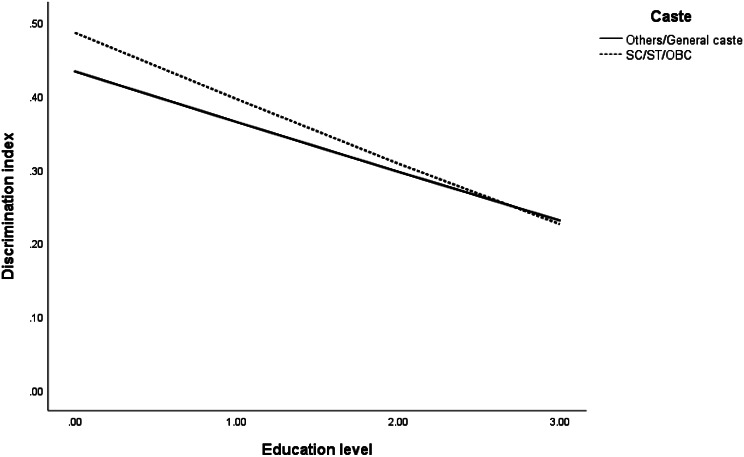
Discrimination is harmful action taken against individuals or groups to protect customary relations of power and privilege. Older adults are particularly vulnerable to experiences of discrimination that adversely affect their quality of life. We use data from the Longitudinal Ageing Study of India (LASI; Wave 1; 2017-2018) to examine different contextual forces that shape the experiences of discrimination in older adults in India, specifically gender, caste, and economic condition. We used the theory of intersectionality to hypothesize that economic condition, caste, and gender combine uniquely to engender perceived discrimination in older adults. We first used a concentration index to determine the sample's pre-existing inequality levels. The concentration curve evidenced a disproportionate concentration of discrimination among people with low income. Next, we used a three-way ANCOVA to examine the effects of caste, gender, and economic condition on individuals' experiences of discrimination. A significant interaction effect of caste, gender, and economic condition [F(1, 30,394) = 8.91 p = 0.003] evidenced the compounding effects of inequalities on experiences of discrimination. Finally, we ran a moderation model to test the ameliorating effects of education on experiences of discrimination experienced by marginalized castes. The model was significant (β= -0.192; p < 0.001), thereby supporting the proposition that increased education level can lead to an increased sense of belonging and perceptions of equal treatment, which relate negatively to perceived discrimination. Results are discussed considering intersectionality in peoples' struggles and resilience in India.
歧视是针对个人或群体采取的有害行动,旨在保护权力和特权的习惯性关系。老年人特别容易受到歧视的影响,这些歧视会对他们的生活质量产生不利影响。我们使用印度纵向老龄化研究(LASI;第 1 波;2017-2018 年)的数据,研究了不同的背景力量如何塑造印度老年人的歧视经历,特别是性别、种姓和经济状况。我们利用交叉性理论假设,经济状况、种姓和性别结合在一起,会导致老年人感受到歧视。我们首先使用集中指数来确定样本中已经存在的不平等水平。集中曲线证明了收入低的人之间存在歧视的不成比例的集中。接下来,我们使用三向 ANCOVA 来检验种姓、性别和经济状况对个体歧视经历的影响。种姓、性别和经济状况的显著交互效应[F(1, 30,394)=8.91,p=0.003]证明了不平等对歧视经历的累积影响。最后,我们运行了一个调节模型,测试教育对边缘化种姓经历的歧视的缓解作用。该模型具有显著性(β=-0.192;p<0.001),从而支持这样一种观点,即教育水平的提高可以导致归属感的增强和对平等待遇的认知,这与感知到的歧视呈负相关。结果在考虑到印度人民的交叉性斗争和适应能力的情况下进行了讨论。