Gomard Yann, Hafsia Sarah, Lebon Cyrille, Rabarison Patrick, Idaroussi Ambdoul-Bar, Yssouf Amina, Boussès Philippe, Mavingui Patrick, Atyame Célestine
Université de La Réunion, UMR PIMIT (Processus Infectieux en Milieu Insulaire Tropical) CNRS 9192, INSERM 1187, IRD 249, Saint-Denis, île de La Réunion, France.
Service de lutte antivectorielle, ARS Mayotte, Kawéni, France.
Front Microbiol. 2024 Mar 27;15:1343917. doi: 10.3389/fmicb.2024.1343917. eCollection 2024.
The influence of on mosquito reproduction and vector competence has led to renewed interest in studying the genetic diversity of these bacteria and the phenotypes they induced in mosquito vectors. In this study, we focused on two species of , namely and , from three islands in the Comoros archipelago (in the Southwestern Indian Ocean).
Using the gene, we examined the mitochondrial genetic diversity of 879 individuals from 54 sites. Additionally, we investigated the presence and genetic diversity of using the marker and the diversity of five housekeeping genes commonly used for genotyping through Multiple Locus Sequence Typing (MLST).
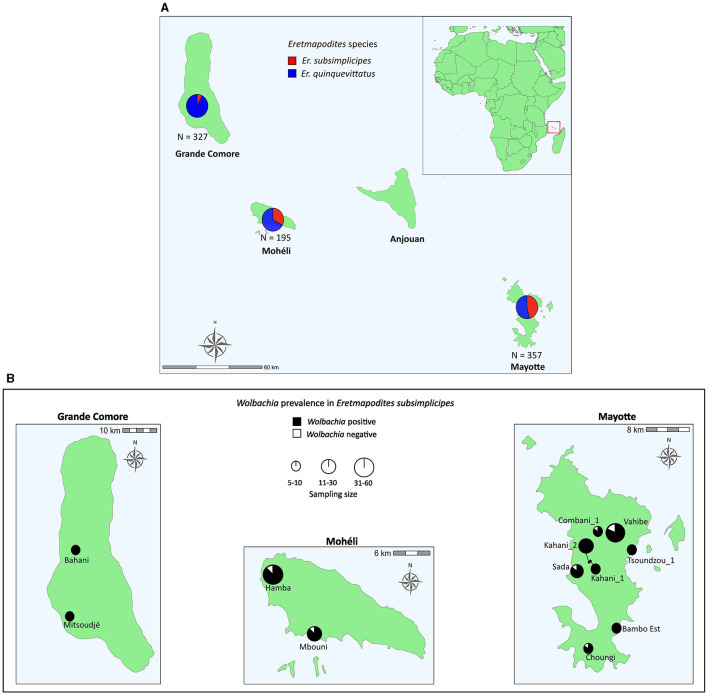
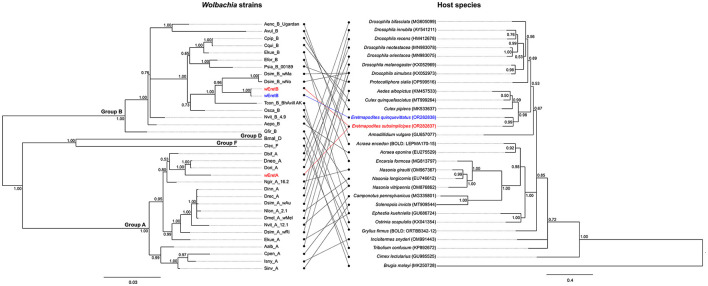
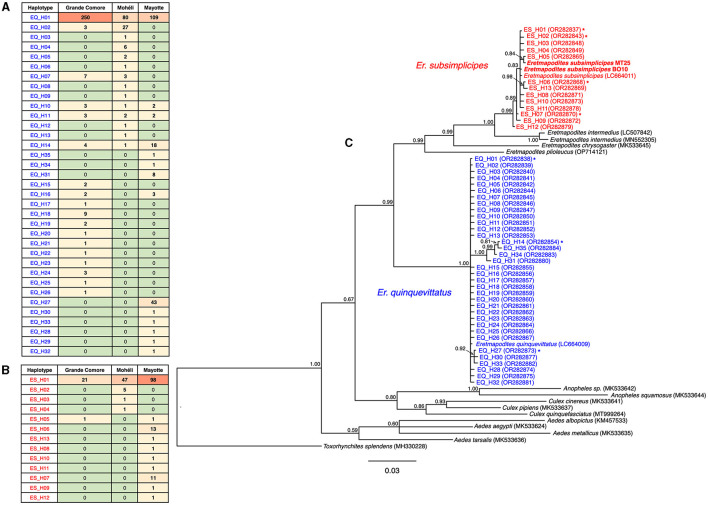
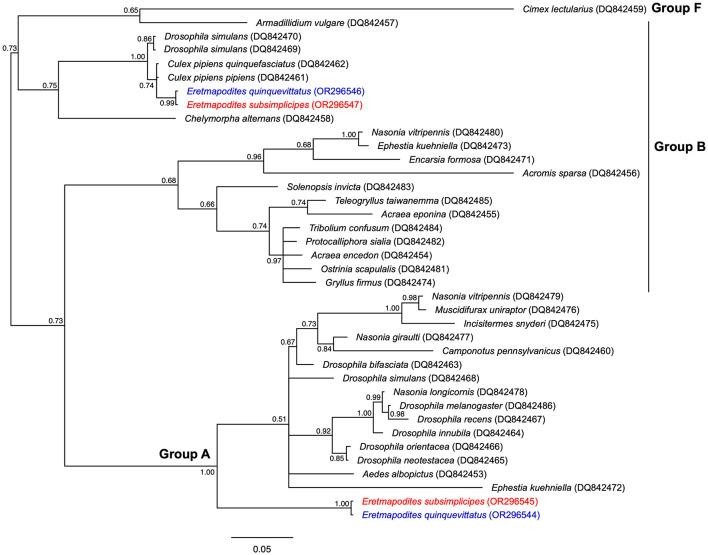
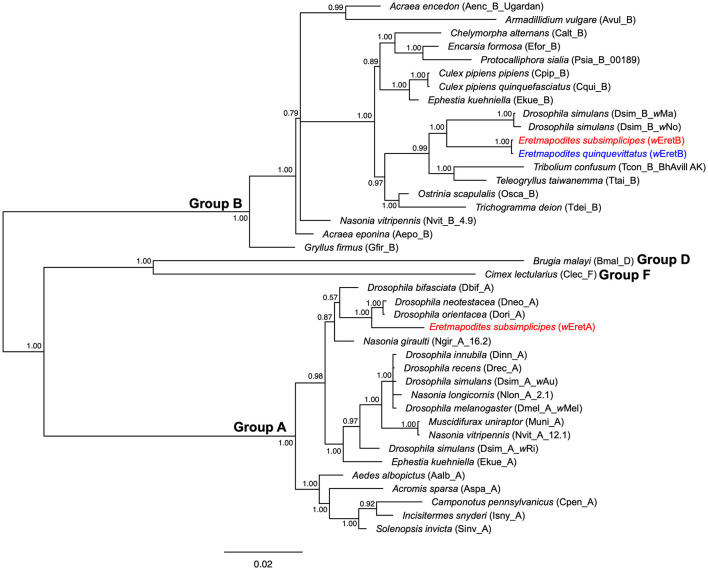
Overall, was the most abundant species in the three surveyed islands and both mosquito species occurred in sympatry in most of the investigated sites. We detected a higher mitochondrial genetic diversity in with 35 reported haplotypes ( = 615 specimens, = 0.481 and π = 0.002) while 13 haplotypes were found in ( = 205 specimens, = 0.338 and π = 0.001), this difference is likely due to the bias in sampling size between the two species. We report for the first time the presence of in these two species. The prevalence of infection varied significantly between species, with a low prevalence recorded in (0.8%, = 5/627) while infection was close to fixation in (87.7%, = 221/252). Both male and female individuals of the two mosquito species appeared to be infected. The analysis of MLST genes revealed the presence of two strains corresponding to two new strain types (STs) within the supergroups A and B, which have been named EretA and EretB. These strains were found as mono-infections and are closely related, phylogenetically, to strains previously reported in species. Finally, we demonstrate that maternal transmission of is imperfect in , which could explain the presence of a minority of uninfected individuals in the field.
[细菌名称]对蚊子繁殖和媒介能力的影响,引发了人们对研究这些细菌的遗传多样性及其在蚊子媒介中诱导的表型的新兴趣。在本研究中,我们聚焦于来自科摩罗群岛(位于印度洋西南部)三个岛屿的两种[细菌名称],即[细菌名称1]和[细菌名称2]。
我们使用[基因名称]基因,检测了来自54个地点的879只[蚊子名称]个体的线粒体遗传多样性。此外,我们使用[标记名称]标记研究了[细菌名称]的存在及其遗传多样性,并通过多位点序列分型(MLST)对常用于基因分型的五个管家基因的多样性进行了研究。
总体而言,[细菌名称1]是三个被调查岛屿中最丰富的物种,并且在大多数调查地点,这两种蚊子物种共存。我们在[蚊子名称1]中检测到更高的线粒体遗传多样性,报告了35种单倍型(n = 615个标本,Hd = 0.481,π = 0.002),而在[蚊子名称2]中发现了13种单倍型(n = 205个标本),Hd = = 0.338,π = 0.001),这种差异可能是由于两个物种采样量的偏差所致。我们首次报告了这两种[蚊子名称]物种中存在[细菌名称2]。[细菌名称2]感染的流行率在不同物种之间差异显著,在[蚊子名称1]中记录的流行率较低(0.8%,n = 5/627),而在[蚊子名称2]中感染接近固定状态(87.7%,n = 221/252)。两种蚊子物种的雄性和雌性个体似乎都被感染。MLST基因分析揭示了在超群A和B中存在两种[细菌名称2]菌株,对应于两种新的菌株类型(STs),分别命名为EretA和EretB。这些菌株被发现为单一感染,并且在系统发育上与先前在[蚊子名称]物种中报道的[细菌名称2]菌株密切相关。最后,我们证明了[细菌名称2]在[蚊子名称2]中的母系传播并不完美,这可以解释在野外存在少数未感染个体的现象。