Pang Fei, Li Qing, Solanki Manoj Kumar, Wang Zhen, Xing Yong-Xiu, Dong Deng-Feng
College of Agriculture, Guangxi University, Nanning, China.
Guangxi Key Laboratory of Agricultural Resources Chemistry and Biotechnology, Smart Agricultural College, Yulin Normal University, Yulin, China.
Front Microbiol. 2024 Mar 27;15:1383813. doi: 10.3389/fmicb.2024.1383813. eCollection 2024.
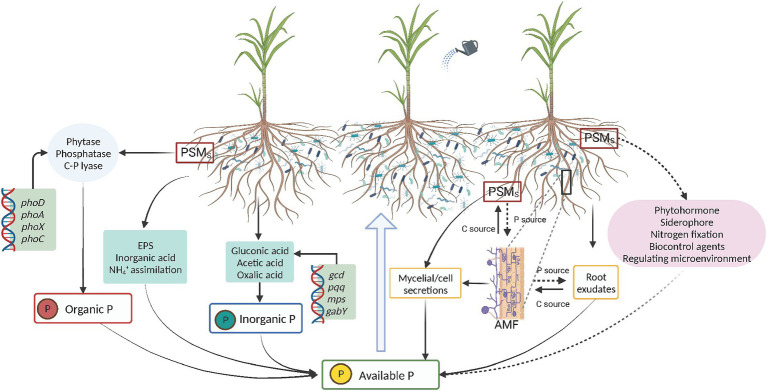
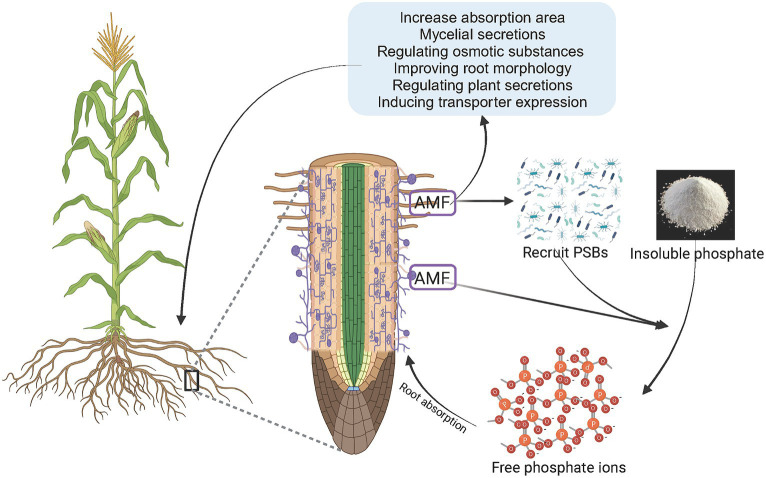
Phosphorus (P) is an important nutrient for plants, and a lack of available P greatly limits plant growth and development. Phosphate-solubilizing microorganisms (PSMs) significantly enhance the ability of plants to absorb and utilize P, which is important for improving plant nutrient turnover and yield. This article summarizes and analyzes how PSMs promote the absorption and utilization of P nutrients by plants from four perspectives: the types and functions of PSMs, phosphate-solubilizing mechanisms, main functional genes, and the impact of complex inoculation of PSMs on plant P acquisition. This article reviews the physiological and molecular mechanisms of phosphorus solubilization and growth promotion by PSMs, with a focus on analyzing the impact of PSMs on soil microbial communities and its interaction with root exudates. In order to better understand the ability of PSMs and their role in soil P transformation and to provide prospects for research on PSMs promoting plant P absorption. PSMs mainly activate insoluble P through the secretion of organic acids, phosphatase production, and mycorrhizal symbiosis, mycorrhizal symbiosis indirectly activates P via carbon exchange. PSMs can secrete organic acids and produce phosphatase, which plays a crucial role in soil P cycling, and related genes are involved in regulating the P-solubilization ability. This article reviews the mechanisms by which microorganisms promote plant uptake of soil P, which is of great significance for a deeper understanding of PSM-mediated soil P cycling, plant P uptake and utilization, and for improving the efficiency of P utilization in agriculture.
磷(P)是植物重要的养分,有效磷缺乏极大地限制了植物的生长发育。解磷微生物(PSMs)显著增强植物吸收和利用磷的能力,这对于改善植物养分周转和产量至关重要。本文从解磷微生物的种类与功能、解磷机制、主要功能基因以及解磷微生物复合接种对植物磷吸收的影响四个方面,对解磷微生物促进植物吸收和利用磷养分的方式进行了总结与分析。本文综述了解磷微生物解磷及促进生长的生理和分子机制,重点分析了解磷微生物对土壤微生物群落的影响及其与根系分泌物的相互作用。以便更好地了解解磷微生物的能力及其在土壤磷转化中的作用,并为解磷微生物促进植物磷吸收的研究提供展望。解磷微生物主要通过分泌有机酸、产生磷酸酶以及菌根共生来活化难溶性磷,菌根共生通过碳交换间接活化磷。解磷微生物能够分泌有机酸并产生磷酸酶,这在土壤磷循环中起着关键作用,相关基因参与调节解磷能力。本文综述了微生物促进植物吸收土壤磷的机制,这对于更深入理解解磷微生物介导的土壤磷循环、植物磷吸收与利用以及提高农业中磷的利用效率具有重要意义。