Institute of Medicine, University of Tsukuba, 1-1-1 Tennodai, Tsukuba, Ibaraki, 305-8575, Japan.
Health Services Research and Development Center, University of Tsukuba, 1-1-1 Tennodai, Tsukuba, Ibaraki, 305-8575, Japan.
BMC Health Serv Res. 2024 Apr 13;24(1):464. doi: 10.1186/s12913-024-10832-4.
The COVID-19 pandemic has impacted peoples' health-related behaviors, especially those of older adults, who have restricted their activities in order to avoid contact with others. Moreover, the pandemic has caused concerns in long-term care insurance (LTCI) providers regarding management and financial issues. This study aimed to examine the changes in revenues among LTCI service providers in Japan during the pandemic and analyze its impact on different types of services.
In this study, we used anonymized data from "Kaipoke," a management support platform for older adult care operators provided by SMS Co., Ltd. Kaipoke provides management support services to more than 27,400 care service offices nationwide and has been introduced in many home-care support offices. The data used in this study were extracted from care plans created by care managers on the Kaipoke platform. To examine the impact of the pandemic, an interrupted time-series analysis was conducted in which the date of the beginning of the pandemic was set as the prior independent variable.
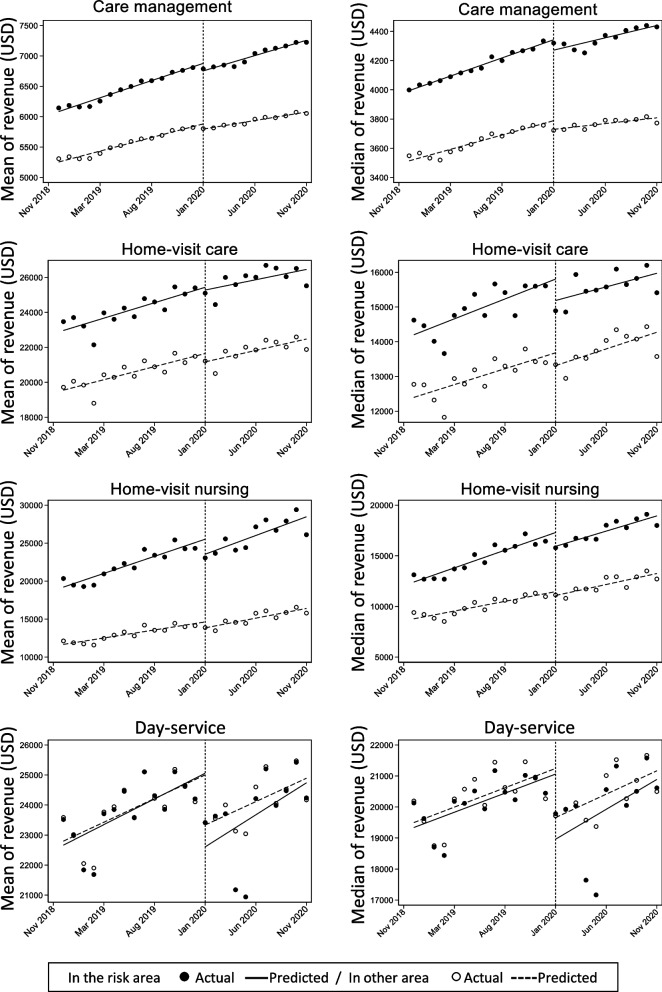
The participating providers were care management providers (n = 5,767), home-visit care providers (n = 3,506), home-visit nursing providers (n = 971), and adult day care providers (n = 4,650). The results revealed that LTCI revenues decreased significantly for care management providers, home-visit nursing providers, and adult day care providers after the COVID-19 pandemic began. The largest decrease was an average base of USD - 1668.8 in adult day care.
The decrease in revenue among adult day care providers was particularly concerning in terms of the sustainability of their business. This decrease in revenue may have made it difficult to retain personnel, and staff may have needed to be laid off as a result. Although this study has limitations, it may provide useful suggestions for countermeasures in such scenarios, in addition to support conducted measures.
COVID-19 大流行影响了人们与健康相关的行为,尤其是老年人,他们为了避免与他人接触而限制了自己的活动。此外,大流行引起了长期护理保险(LTCI)提供商对管理和财务问题的关注。本研究旨在检查日本 LTCI 服务提供商在大流行期间收入的变化,并分析其对不同类型服务的影响。
在这项研究中,我们使用了由 SMS 公司提供的老年人护理运营商管理支持平台“Kaipoke”的匿名数据。Kaipoke 为全国 27400 多个护理服务办公室提供管理支持服务,并已在许多家庭护理支持办公室中推出。本研究使用的数据分析从 Kaipoke 平台上的护理经理创建的护理计划中提取。为了检查大流行的影响,我们进行了中断时间序列分析,将大流行开始的日期作为先前的独立变量。
参与的提供者包括护理管理提供者(n=5767)、上门护理提供者(n=3506)、上门护理护士提供者(n=971)和成人日托提供者(n=4650)。结果表明,COVID-19 大流行开始后,LTCI 收入对护理管理提供者、上门护理护士提供者和成人日托提供者显著下降。成人日托的降幅最大,平均基数为-1668.8 美元。
成人日托提供者收入的减少尤其令人关注,因为这可能会影响其业务的可持续性。收入的减少可能使他们难以留住人员,因此可能需要裁员。尽管本研究存在局限性,但它可能为这种情况下的对策提供有用的建议,除了支持已采取的措施。