Sekar Akila, Panouillères Muriel T N, Kaski Diego
SENSE Research Unit, Department of Clinical and Movement Neurosciences, UCL Queen Square Institute of Neurology, London, UK.
NeuroClues, Ottignies-Louvain-la-Neuve, Belgium.
Eye Brain. 2024 Apr 9;16:3-16. doi: 10.2147/EB.S384769. eCollection 2024.
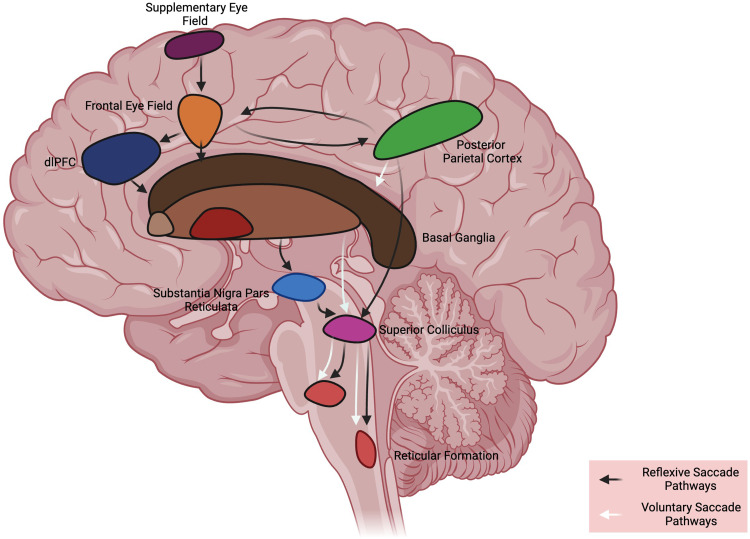
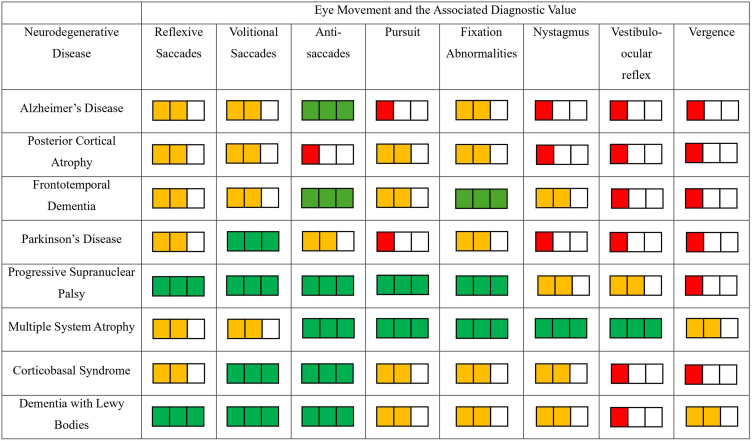
This review delineates the ocular motor disturbances across a spectrum of neurodegenerative disorders, including Alzheimer's Disease (AD) and related disorders (ADRD), Parkinson's Disease (PD), atypical parkinsonism, and others, leveraging advancements in eye-tracking technology for enhanced diagnostic precision. We delve into the different classes of eye movements, their clinical assessment, and specific abnormalities manifesting in these diseases, highlighting the nuanced differences and shared patterns. For instance, AD and ADRD are characterized by increased saccadic latencies and instability in fixation, while PD features saccadic hypometria and mild smooth pursuit impairments. Atypical parkinsonism, notably Progressive Supranuclear Palsy (PSP) and Corticobasal Syndrome (CBS), presents with distinct ocular motor signatures such as vertical supranuclear gaze palsy and saccadic apraxia, respectively. Our review underscores the diagnostic value of eye movement analysis in differentiating between these disorders and also posits the existence of underlying common pathological mechanisms. We discuss how eye movements have potential as biomarkers for neurodegenerative diseases but also some of the existing limitations.
本综述阐述了一系列神经退行性疾病中的眼球运动障碍,包括阿尔茨海默病(AD)及相关疾病(ADRD)、帕金森病(PD)、非典型帕金森综合征等,利用眼动追踪技术的进展来提高诊断精度。我们深入探讨了不同类型的眼球运动、它们的临床评估以及这些疾病中出现的特定异常情况,突出了细微差别和共同模式。例如,AD和ADRD的特点是扫视潜伏期延长和注视不稳定,而PD的特征是扫视幅度减小和轻度平稳跟踪受损。非典型帕金森综合征,特别是进行性核上性麻痹(PSP)和皮质基底节综合征(CBS),分别表现出独特的眼球运动特征,如垂直核上性凝视麻痹和扫视失用。我们的综述强调了眼球运动分析在区分这些疾病中的诊断价值,并提出存在潜在的共同病理机制。我们讨论了眼球运动作为神经退行性疾病生物标志物的潜力以及一些现有的局限性。