Zhang Bao Gen, Qian Xiao Fang
School of Physical Education, Guangzhou Sport University, Guangzhou, People's Republic of China.
Department of Physical Education, School of Humanities, Zhao Qing Medical College, Zhao Qing, People's Republic of China.
Psychol Res Behav Manag. 2024 Apr 8;17:1561-1571. doi: 10.2147/PRBM.S452606. eCollection 2024.
Physical exercise is an important predictor of deviant behavior in adolescents; however, the paths and mechanisms underlying this relationship remain understudied.
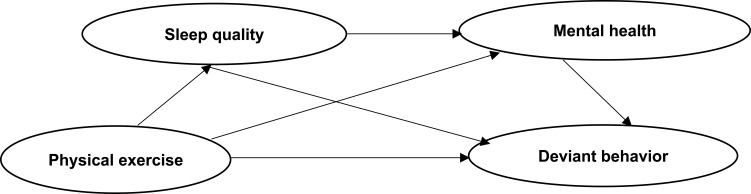
This cross-sectional study used education tracking data of 8725 Chinese adolescents (4453 males, 4240 females, average age 14 ± 0.73) to construct a chain mediation model to explore whether sleep quality and mental health mediated the relationship between physical exercise and adolescent deviant behavior.
The results show that physical exercise cannot directly predict adolescent deviant behavior; however, it can indirectly affect deviant behavior through the mediating effect of sleep quality and mental health as well as the chain mediating benefit of "sleep quality-mental health".
Sleep quality and mental health are important internal factors of physical exercise that inhibit deviant adolescent behavior. The lack of physical activity and poor sleep quality should be prioritized in interventions regarding deviant behavior among Chinese adolescents.
体育锻炼是青少年偏差行为的重要预测因素;然而,这种关系背后的途径和机制仍未得到充分研究。
这项横断面研究使用了8725名中国青少年(4453名男性,4240名女性,平均年龄14±0.73岁)的教育跟踪数据,构建了一个链式中介模型,以探讨睡眠质量和心理健康是否介导了体育锻炼与青少年偏差行为之间的关系。
结果表明,体育锻炼不能直接预测青少年偏差行为;然而,它可以通过睡眠质量和心理健康的中介作用以及“睡眠质量 - 心理健康”的链式中介效应间接影响偏差行为。
睡眠质量和心理健康是体育锻炼抑制青少年偏差行为的重要内在因素。在中国青少年偏差行为的干预中,应优先考虑缺乏体育活动和睡眠质量差的问题。