Lu Ruixia, Lin Wenyong, Jin Qipeng, Wang Dongyuan, Zhang Chunling, Wang Huiying, Chen Tiejun, Gao Junjie, Wang Xiaolong
Branch of National Clinical Research Center for Chinese Medicine Cardiology, Shuguang Hospital Affiliated to Shanghai University of Traditional Chinese Medicine, Shanghai 201203, China.
Cardiovascular Research Institute of Traditional Chinese Medicine, Shuguang Hospital Affiliated to Shanghai University of Traditional Chinese Medicine, Shanghai 201203, China.
ACS Omega. 2024 Mar 26;9(14):16322-16333. doi: 10.1021/acsomega.3c10474. eCollection 2024 Apr 9.
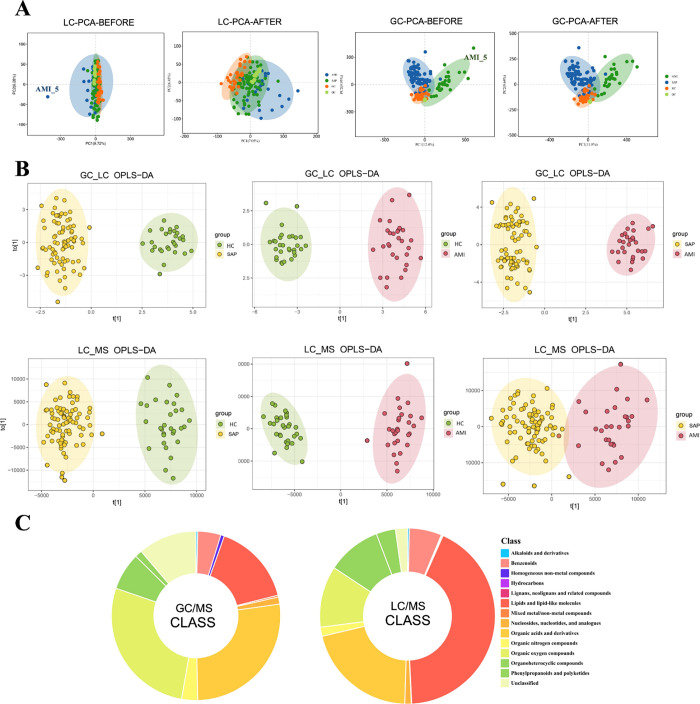
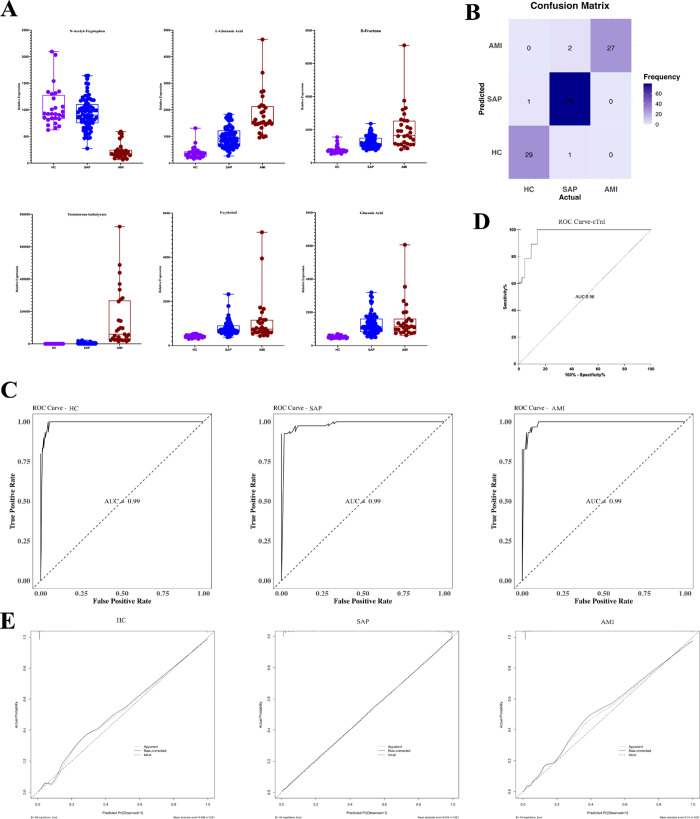
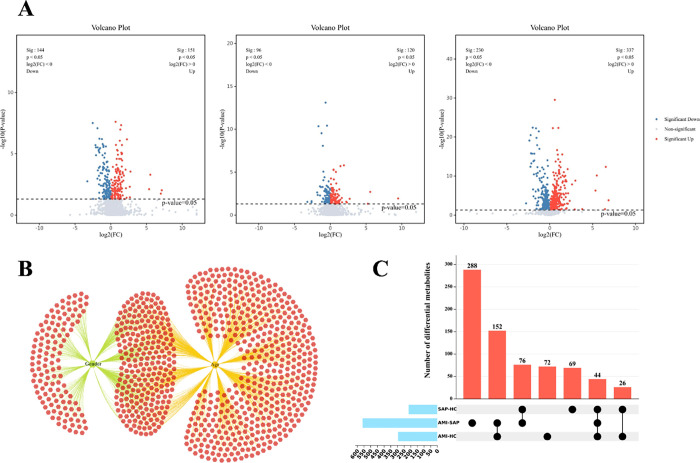
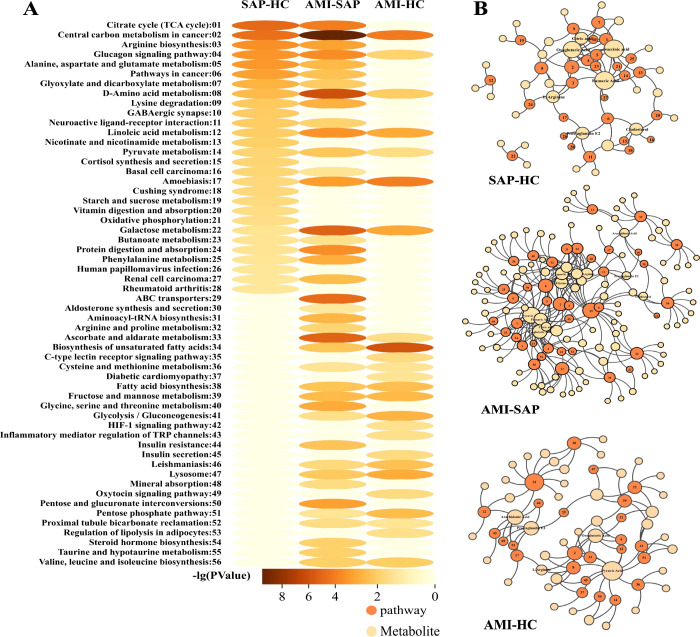
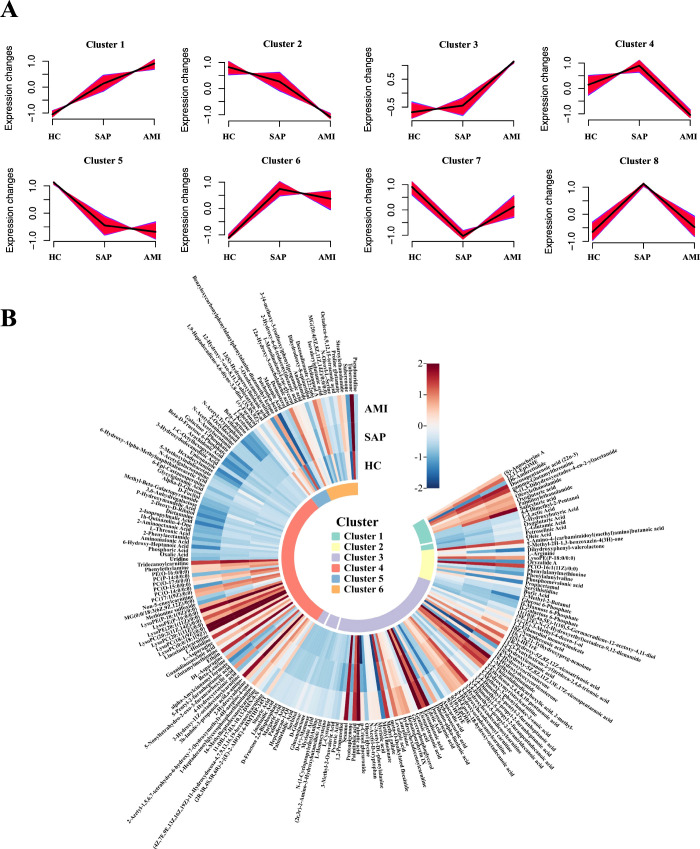
Coronary heart disease remains a major global health challenge, with a clear need for enhanced early risk assessment. This study aimed to elucidate metabolic signatures across various stages of coronary heart disease and develop an effective multiclass diagnostic model. Using metabolomic approaches, gas chromatography-mass and liquid chromatography-tandem mass spectrometry were used to analyze plasma samples from healthy controls, patients with stable angina pectoris, and those with acute myocardial infarction. Pathway enrichment analysis was conducted on metabolites exhibiting significant differences. The key metabolites were identified using Random Forest and Recursive Feature Elimination strategies to construct a multiclass diagnostic model. The performance of the model was validated through 10-fold cross-validation and evaluated using confusion matrices, receiver operating characteristic curves, and calibration curves. Metabolomics was used to identify 1491 metabolites, with 216, 567, and 295 distinctly present among the healthy controls, patients with stable angina pectoris, and those with acute myocardial infarction, respectively. This implicated pathways such as the glucagon signaling pathway, d-amino acid metabolism, pyruvate metabolism, and amoebiasis across various stages of coronary heart disease. After selection, testosterone isobutyrate, -acetyl-tryptophan, d-fructose, l-glutamic acid, erythritol, and gluconic acid were identified as core metabolites in the multiclass diagnostic model. Evaluating the diagnostic model demonstrated its high discriminative ability and accuracy. This study revealed metabolic pathway perturbations at different stages of coronary heart disease, and a precise multiclass diagnostic model was established based on these findings. This study provides new insights and tools for the early diagnosis and treatment of coronary heart disease.
冠心病仍然是一项重大的全球健康挑战,显然需要加强早期风险评估。本研究旨在阐明冠心病各个阶段的代谢特征,并开发一种有效的多类诊断模型。采用代谢组学方法,运用气相色谱-质谱联用和液相色谱-串联质谱分析法,对健康对照者、稳定型心绞痛患者和急性心肌梗死患者的血浆样本进行分析。对表现出显著差异的代谢物进行通路富集分析。使用随机森林和递归特征消除策略识别关键代谢物,以构建多类诊断模型。通过10倍交叉验证对模型性能进行验证,并使用混淆矩阵、受试者工作特征曲线和校准曲线进行评估。代谢组学共鉴定出1491种代谢物,其中216种、567种和295种分别在健康对照者组、稳定型心绞痛患者组和急性心肌梗死患者组中显著存在。这表明在冠心病的各个阶段涉及到如胰高血糖素信号通路、d-氨基酸代谢、丙酮酸代谢和阿米巴病等通路。经过筛选,异丁酸睾酮、N-乙酰色氨酸、d-果糖、L-谷氨酸、赤藓糖醇和葡萄糖酸被确定为多类诊断模型中的核心代谢物。对诊断模型的评估显示出其具有较高的判别能力和准确性。本研究揭示了冠心病不同阶段的代谢通路扰动,并基于这些发现建立了精确的多类诊断模型。该研究为冠心病的早期诊断和治疗提供了新的见解和工具。