Domingues Rafael Barnabé, von Rautenfeld Marita, Kavalco Caroline Mayara, Caliari Carolina, Dellagiustina Celso, da Fonseca Lucas Furtado, Costa Fabio Ramos, da Cruz Silva Reis Andreza, Santos Gabriel Silva, Azzini Gabriel, de Faria André Pinto Lemos, Santos Napoliane, Pires Luyddy, Huber Stephany Cares, Mahmood Ansar, Dallo Ignacio, Everts Peter, Lana José Fábio
Clinical Research, Anna Vitória Lana Institute (IAVL), SP, Brazil.
Regenerative Medicine, Orthoregen International Course, Indaiatuba, SP, Brazil.
Int Wound J. 2024 Apr;21(4):e14854. doi: 10.1111/iwj.14854.
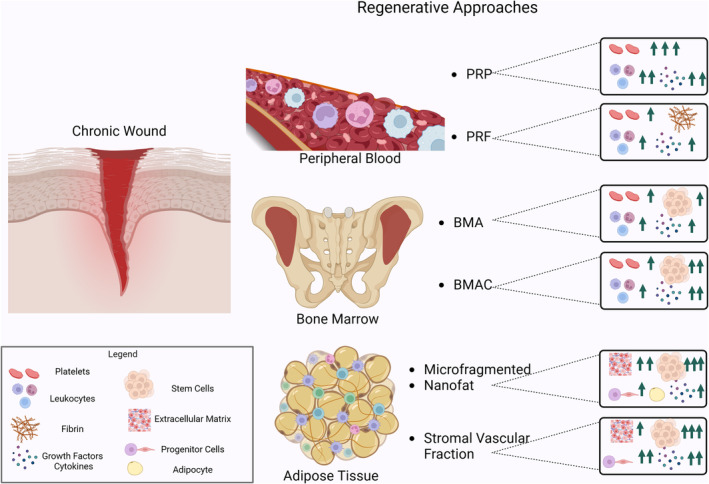
Chronic wounds, characterized by prolonged healing processes, pose a significant medical challenge with multifaceted aetiologies, including local and systemic factors. Here, it explores the complex pathogenesis of chronic wounds, emphasizing the disruption in the normal phases of wound healing, particularly the inflammatory phase, leading to an imbalance in extracellular matrix (ECM) dynamics and persistent inflammation. Senescent cell populations further contribute to impaired wound healing in chronic lesions. Traditional medical management focuses on addressing underlying causes, but many chronic wounds resist to conventional treatments, necessitating innovative approaches. Recent attention has turned to autologous orthobiologics, such as platelet-rich plasma (PRP), platelet-rich fibrin (PRF) and mesenchymal stem cells (MSCs), as potential regenerative interventions. These biologically derived materials, including bone marrow aspirate/concentrate (BMA/BMAC) and adipose tissue-derived stem cells (ADSCs), exhibit promising cytokine content and regenerative potential. MSCs, in particular, have emerged as key players in wound healing, influencing inflammation and promoting tissue regeneration. This paper reviews relevant scientific literature regarding basic science and brings real-world evidence regarding the use of orthobiologics in the treatment of chronic wounds, irrespective of aetiology. The discussion highlights the regenerative properties of PRP, PRF, BMA, BMAC and SVF, showcasing their potential to enhance wound healing. Despite advancements, further research is essential to elucidate the specific roles of each orthobiologic and determine optimal applications for different wound types. The conclusion underscores the evolving landscape in chronic wound management, with a call for more comprehensive studies to refine treatment strategies and maximize the benefits of regenerative medicine.
慢性伤口以愈合过程延长为特征,其病因多方面,包括局部和全身因素,给医学带来了重大挑战。本文探讨了慢性伤口的复杂发病机制,强调了伤口愈合正常阶段,特别是炎症阶段的破坏,导致细胞外基质(ECM)动态失衡和持续炎症。衰老细胞群体进一步导致慢性伤口愈合受损。传统医学管理侧重于解决根本原因,但许多慢性伤口对传统治疗有抵抗性,需要创新方法。最近的注意力转向了自体组织生物制剂,如富含血小板血浆(PRP)、富含血小板纤维蛋白(PRF)和间充质干细胞(MSCs),作为潜在的再生干预措施。这些生物来源的材料,包括骨髓抽吸物/浓缩物(BMA/BMAC)和脂肪组织来源的干细胞(ADSCs),具有有前景的细胞因子含量和再生潜力。特别是MSCs已成为伤口愈合的关键因素,影响炎症并促进组织再生。本文综述了有关基础科学的相关科学文献,并提供了关于使用组织生物制剂治疗慢性伤口的实际证据,无论其病因如何。讨论强调了PRP、PRF、BMA、BMAC和SVF的再生特性,展示了它们增强伤口愈合的潜力。尽管取得了进展,但进一步的研究对于阐明每种组织生物制剂的具体作用以及确定不同伤口类型的最佳应用至关重要。结论强调了慢性伤口管理中不断变化的形势,呼吁进行更全面的研究以完善治疗策略并最大限度地提高再生医学的益处。