Department of Clinical Research in Tumor Immunology, Graduate School of Medicine, Osaka University, Osaka, Japan.
Department of Respiratory Medicine and Clinical Immunology, Graduate School of Medicine, Osaka University, Osaka, Japan.
J Immunother Cancer. 2024 Apr 15;12(4):e008334. doi: 10.1136/jitc-2023-008334.
Cancer immunotherapy including immune checkpoint inhibitors is only effective for a limited population of patients with cancer. Therefore, the development of novel cancer immunotherapy is anticipated. In preliminary studies, we demonstrated that tetracyclines enhanced T-cell responses. Therefore, we herein investigated the efficacy of tetracyclines on antitumor T-cell responses by human peripheral T cells, murine models, and the lung tumor tissues of patients with non-small cell lung cancer (NSCLC), with a focus on signaling pathways in T cells.
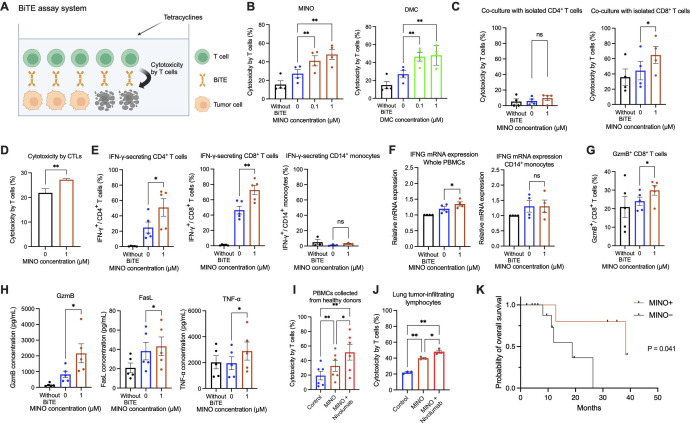
The cytotoxicity of peripheral and lung tumor-infiltrated human T cells against tumor cells was assessed by using bispecific T-cell engager (BiTE) technology (BiTE-assay system). The effects of tetracyclines on T cells in the peripheral blood of healthy donors and the tumor tissues of patients with NSCLC were examined using the BiTE-assay system in comparison with anti-programmed cell death-1 (PD-1) antibody, nivolumab. T-cell signaling molecules were analyzed by flow cytometry, ELISA, and qRT-PCR. To investigate the in vivo antitumor effects of tetracyclines, tetracyclines were administered orally to BALB/c mice engrafted with murine tumor cell lines, either in the presence or absence of anti-mouse CD8 inhibitors.
The results obtained revealed that tetracyclines enhanced antitumor T-cell cytotoxicity with the upregulation of granzyme B and increased secretion of interferon-γ in human peripheral T cells and the lung tumor tissues of patients with NSCLC. The analysis of T-cell signaling showed that CD69 in both CD4 and CD8 T cells was upregulated by minocycline. Downstream of T-cell receptor signaling, Zap70 phosphorylation and Nur77 were also upregulated by minocycline in the early phase after T-cell activation. These changes were not observed in T cells treated with anti-PD-1 antibodies under the same conditions. The administration of tetracyclines exhibited antitumor efficacy with the upregulation of CD69 and increases in tumor antigen-specific T cells in murine tumor models. These changes were canceled by the administration of anti-mouse CD8 inhibitors.
In conclusion, tetracyclines enhanced antitumor T-cell immunity via Zap70 signaling. These results will contribute to the development of novel cancer immunotherapy.
癌症免疫疗法包括免疫检查点抑制剂,仅对有限的癌症患者群体有效。因此,人们期望开发新的癌症免疫疗法。在初步研究中,我们证明了四环素类药物可增强 T 细胞反应。因此,我们在此通过人外周 T 细胞、小鼠模型以及非小细胞肺癌 (NSCLC) 患者的肺肿瘤组织,研究了四环素类药物对抗肿瘤 T 细胞反应的疗效,重点关注 T 细胞中的信号通路。
使用双特异性 T 细胞衔接器(BiTE)技术(BiTE 检测系统)评估外周血和肺肿瘤浸润的人 T 细胞对肿瘤细胞的细胞毒性。与抗程序性细胞死亡蛋白 1 (PD-1) 抗体纳武利尤单抗相比,使用 BiTE 检测系统检测四环素类药物对健康供体外周血和 NSCLC 患者肿瘤组织中 T 细胞的影响。通过流式细胞术、ELISA 和 qRT-PCR 分析 T 细胞信号分子。为了研究四环素类药物的体内抗肿瘤作用,我们给荷瘤的 BALB/c 小鼠口服四环素类药物,同时或不给予抗小鼠 CD8 抑制剂。
结果表明,四环素类药物可增强人外周血 T 细胞和 NSCLC 患者肺肿瘤组织中的抗肿瘤 T 细胞细胞毒性,上调颗粒酶 B 的表达并增加干扰素-γ的分泌。T 细胞信号分析表明,米诺环素可上调 CD4 和 CD8 T 细胞中的 CD69。T 细胞激活后早期,Zap70 磷酸化和 Nur77 也被米诺环素上调,而在相同条件下用抗 PD-1 抗体处理的 T 细胞中未观察到这些变化。在小鼠肿瘤模型中,四环素类药物的给药表现出抗肿瘤疗效,同时上调 CD69 和增加肿瘤抗原特异性 T 细胞。这些变化可通过给予抗小鼠 CD8 抑制剂而被取消。
总之,四环素类药物通过 Zap70 信号增强抗肿瘤 T 细胞免疫。这些结果将有助于开发新的癌症免疫疗法。