College of Medicine and Health Sciences, Khalifa University, PO Box 127788, Abu Dhabi, United Arab Emirates.
Research Methodology and Biostatistics Core, Morsani College of Medicine, University of South Florida, Tampa, FL, USA.
Sci Rep. 2024 Apr 16;14(1):8809. doi: 10.1038/s41598-024-59390-z.
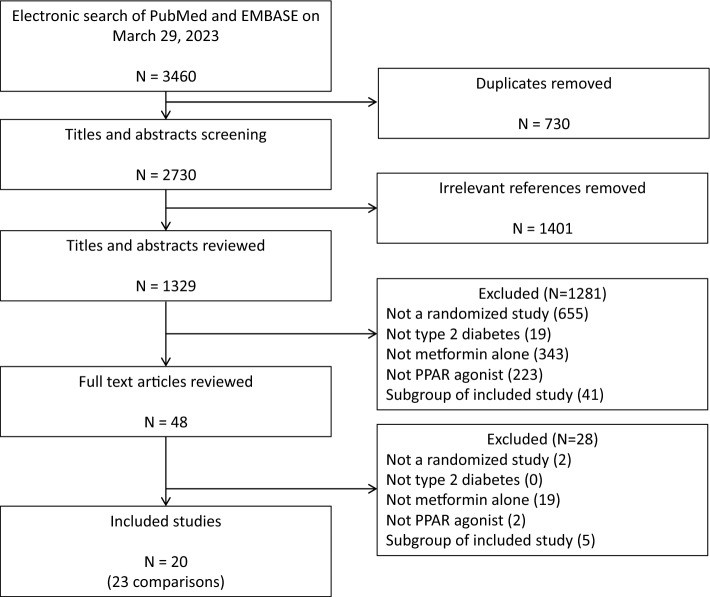
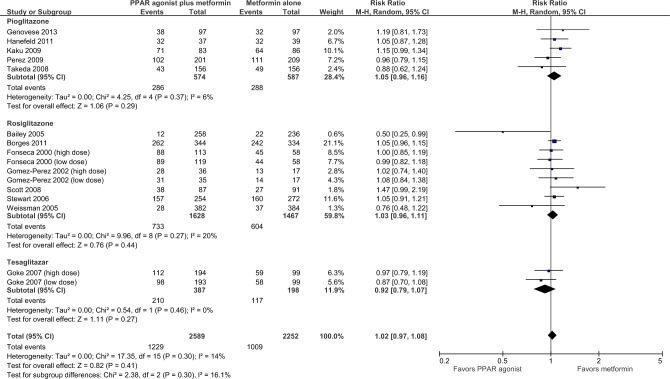
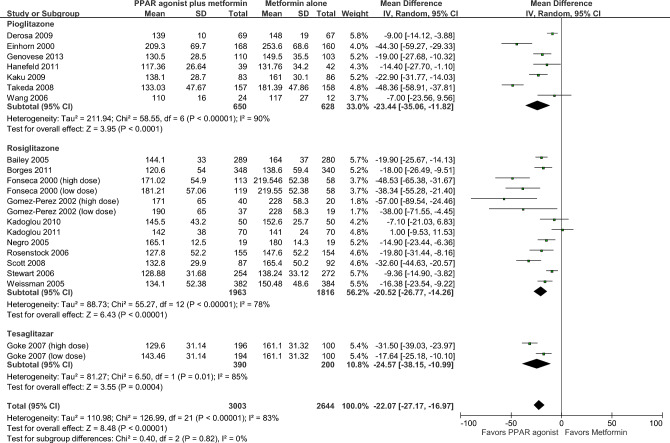
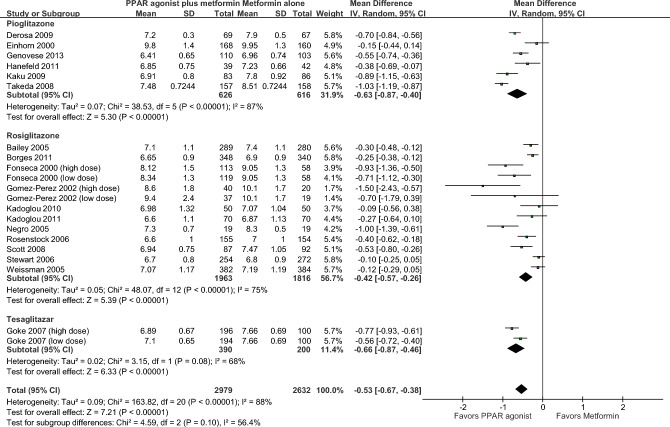
The combination of metformin and the peroxisome proliferator-activated receptors (PPAR) agonists offers a promising avenue for managing type 2 diabetes (T2D) through their potential complementary mechanisms of action. The results from randomized controlled trials (RCT) assessing the efficacy of PPAR agonists plus metformin versus metformin alone in T2D are inconsistent, which prompted the conduct of the systematic review and meta-analysis. We searched MEDLINE and EMBASE from inception (1966) to March 2023 to identify all RCTs comparing any PPAR agonists plus metformin versus metformin alone in T2D. Categorical variables were summarized as relative risk along with 95% confidence interval (CI). Twenty RCTs enrolling a total of 6058 patients met the inclusion criteria. The certainty of evidence ranged from moderate to very low. Pooled results show that using PPAR agonist plus metformin, as compared to metformin alone, results in lower concentrations of fasting glucose [MD = - 22.07 mg/dl (95% CI - 27.17, - 16.97), HbA1c [MD = - 0.53% (95% CI - 0.67, - 0.38)], HOMA-IR [MD = - 1.26 (95% CI - 2.16, - 0.37)], and fasting insulin [MD = - 19.83 pmol/L (95% CI - 29.54, - 10.13)] without significant increase in any adverse events. Thus, synthesized evidence from RCTs demonstrates the beneficial effects of PPAR agonist add-on treatment versus metformin alone in T2D patients. In particular, novel dual PPARα/γ agonist (tesaglitazar) demonstrate efficacy in improving glycaemic and lipid concentrations, so further RCTs should be performed to elucidate the long-term outcomes and safety profile of these novel combined and personalized therapeutic strategies in the management of T2D.PROSPERO registration no. CRD42023412603.
二甲双胍与过氧化物酶体增殖物激活受体 (PPAR) 激动剂的联合治疗为 2 型糖尿病 (T2D) 的管理提供了一种有前途的途径,因为它们具有潜在的互补作用机制。评估 PPAR 激动剂加二甲双胍与单独使用二甲双胍治疗 T2D 的疗效的随机对照试验 (RCT) 的结果不一致,这促使我们进行了系统评价和荟萃分析。我们检索了 MEDLINE 和 EMBASE 从建库开始(1966 年)到 2023 年 3 月,以确定所有比较任何 PPAR 激动剂加二甲双胍与单独使用二甲双胍治疗 T2D 的 RCT。分类变量以相对风险(RR)和 95%置信区间(CI)表示。20 项 RCT 共纳入 6058 名患者符合纳入标准。证据的确定性从中等到极低不等。汇总结果显示,与单独使用二甲双胍相比,使用 PPAR 激动剂加二甲双胍可降低空腹血糖浓度[MD = -22.07 mg/dl (95% CI -27.17, -16.97),糖化血红蛋白 [MD = -0.53% (95% CI -0.67, -0.38)],HOMA-IR [MD = -1.26 (95% CI -2.16, -0.37)]和空腹胰岛素[MD = -19.83 pmol/L (95% CI -29.54, -10.13)],而不良事件发生率无显著增加。因此,来自 RCT 的综合证据表明,PPAR 激动剂联合治疗与单独使用二甲双胍相比,在 T2D 患者中具有有益的效果。特别是新型双重 PPARα/γ激动剂(tesaglitazar)在改善血糖和血脂浓度方面显示出疗效,因此应该进行进一步的 RCT 来阐明这些新型联合和个性化治疗策略在 T2D 管理中的长期结果和安全性特征。PROSPERO 注册号 CRD42023412603。