Ogata Masatomo, Kato Masaki, Miyauchi Takamasa, Murata-Hasegawa Marie, Sakurai Yuko, Shinoda Kazunobu, Yamazaki Hajime, Shibagaki Yugo, Yazawa Masahiko
Division of Nephrology and Hypertension, Department of Internal Medicine, St. Marianna University School of Medicine, Kawasaki, Japan.
Division of Gastroenterology and Hepatology, Department of Internal Medicine, St. Marianna University School of Medicine, Kawasaki, Japan.
Inflamm Intest Dis. 2024 Mar 18;9(1):96-102. doi: 10.1159/000538334. eCollection 2024 Jan-Dec.
Gastrointestinal complications are common after solid organ transplantation. New-onset inflammatory bowel disease (IBD) after transplantation (de novo) is a major differential diagnosis of diarrhea after liver transplantation (LT) because of its high incidence in the field. However, the incidence of IBD after kidney transplantation (KT) remains unknown.
This case series comprised six de novo IBD patients who had undergone KT at our hospital from April 1998 to December 2020. In this period, 232 KT recipients were identified. Participants were analyzed based on their colonoscopy diagnoses. Detailed clinical information regarding both KT- and IBD-related symptoms or outcomes was obtained, and we calculated the incidence of de novo IBD from the date of KT.
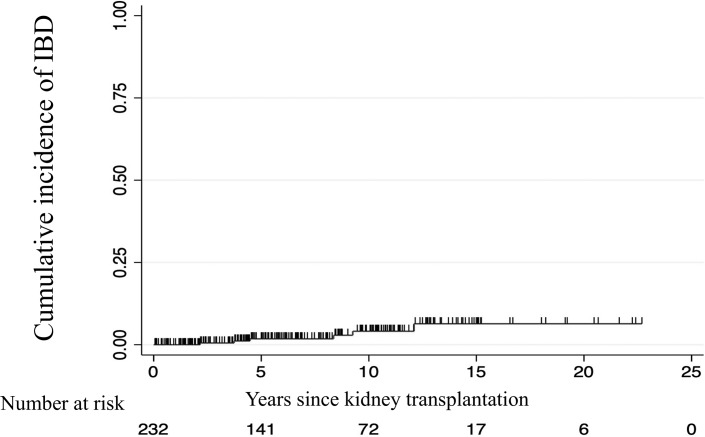
Of the 232 recipients in the median observation period of 6.1 (interquartile range: 2.6, 10.8) years, six recipients (one with Crohn's disease and five with ulcerative colitis) were diagnosed with de novo IBD. The incidence of de novo IBD after KT was 355.8/100,000 person-years (95% confidence interval, 159.8-791.9 per 100,000 person-years). Bloody stools and diarrhea did not always occur, with bloody stools occurring in three and diarrhea in 2 patients at the time of diagnosis. No recipient developed graft failure or extraintestinal complications (e.g., IBD-related nephritis or arthritis).
Despite a small sample size, this study's results indicate that the incidence of de novo IBD after KT may be similar to that after LT and higher than that in the general population. Larger studies are required to validate these preliminary findings.
实体器官移植后胃肠道并发症很常见。移植后新发炎症性肠病(IBD)(即原发性)是肝移植(LT)后腹泻的主要鉴别诊断,因为该领域其发病率较高。然而,肾移植(KT)后IBD的发病率仍不清楚。
本病例系列包括1998年4月至2020年12月在我院接受KT的6例原发性IBD患者。在此期间,共确定了232例KT受者。根据结肠镜检查诊断对参与者进行分析。获取了与KT和IBD相关症状或结局的详细临床信息,并计算了自KT之日起原发性IBD的发病率。
在232例受者中,中位观察期为6.1年(四分位间距:2.6,10.8),6例受者(1例克罗恩病,5例溃疡性结肠炎)被诊断为原发性IBD。KT后原发性IBD的发病率为355.8/100,000人年(95%置信区间,每100,000人年159.8 - 791.9)。诊断时便血和腹泻并非总是出现,3例出现便血,2例出现腹泻。没有受者发生移植失败或肠外并发症(如IBD相关的肾炎或关节炎)。
尽管样本量较小,但本研究结果表明,KT后原发性IBD的发病率可能与LT后相似,且高于一般人群。需要更大规模的研究来验证这些初步发现。