Kargar Niloofar, Zeinali Ahad, Molazadeh Mikaeil
Department of Medical Physics, Faculty of Medicine, Urmia University of Medical Sciences, Urmia, Iran.
Department of Medical Physics, Faculty of Medicine, Tabriz University of Medical Sciences, Tabriz, Iran.
J Biomed Phys Eng. 2024 Apr 1;14(2):129-140. doi: 10.31661/jbpe.v0i0.2305-1616. eCollection 2024 Apr.
Breast cancer requires evaluating treatment plans using dosimetric and biological parameters. Considering radiation dose distribution and tissue response, healthcare professionals can optimize treatment plans for better outcomes.
This study aimed to evaluate the effects of the different Dose Calculation Algorithms (DCAs) and Biologically Model-Related Parameters (BMRPs) on the prediction of cardiopulmonary complications due to left breast radiotherapy.
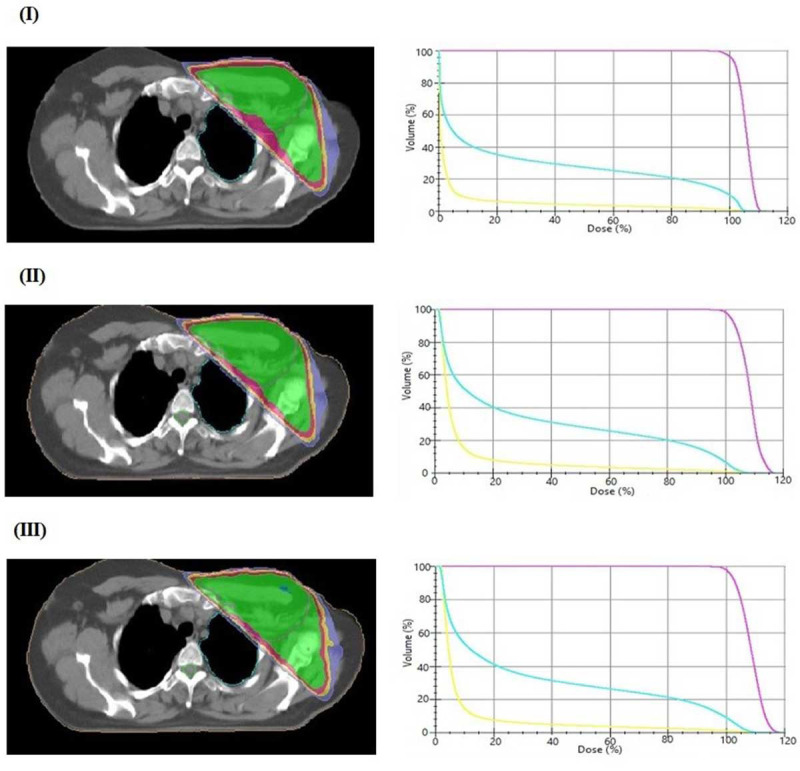
In this practical study, the treatment plans of 21 female patients were simulated in the Monaco Treatment Planning System (TPS) with a prescribed dose of 50 Gy in 25 fractions. Dose distribution was extracted using the three DCAs [Pencil Beam (PB), Collapsed Cone (CC), and Monte Carlo (MC)]. Cardiopulmonary complications were predicted by Normal Tissue Complication Probability (NTCP) calculations using different dosimetric and biological parameters. The Lyman-Kutcher-Burman (LKB) and Relative-Seriality (RS) models were used to calculate NTCP. The endpoint for NTCP calculation was pneumonitis, pericarditis, and late cardiac mortality. The ANOVA test was used for statistical analysis.
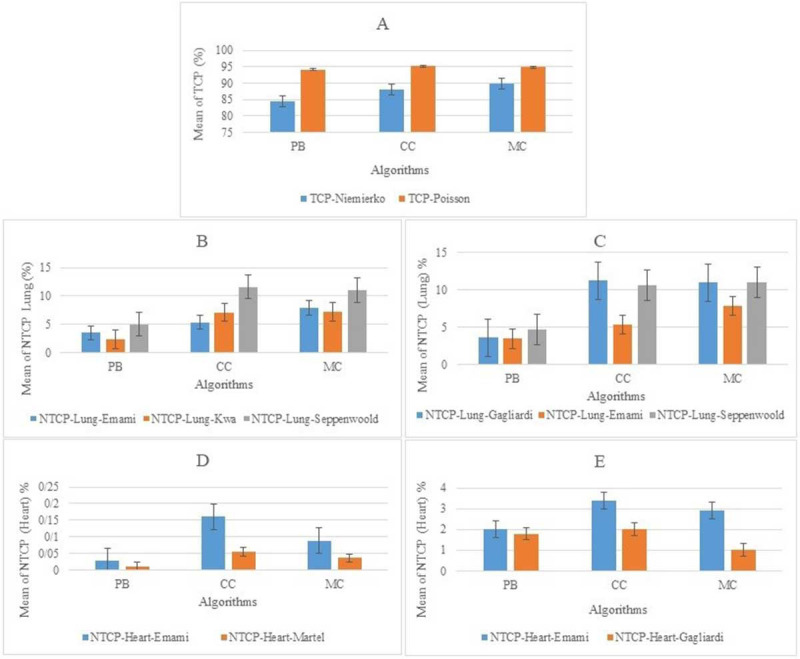
In calculating Tumor Control Probability (TCP), a statistically significant difference was observed between the results of DCAs in the Poisson model. The PB algorithm estimated NTCP as less than others for all Pneumonia BMRPs.
The impact of DCAs and BMRPs differs in the estimation of TCP and NTCP. DCAs have a stronger influence on TCP calculation, providing more effective results. On the other hand, BMRPs are more effective in estimating NTCP. Consequently, parameters for radiobiological indices should be cautiously used s to ensure the appropriate consideration of both DCAs and BMRPs.
乳腺癌需要使用剂量学和生物学参数来评估治疗方案。考虑到辐射剂量分布和组织反应,医疗保健专业人员可以优化治疗方案以获得更好的治疗效果。
本研究旨在评估不同剂量计算算法(DCA)和生物模型相关参数(BMRP)对左乳放疗引起的心肺并发症预测的影响。
在本实践研究中,在Monaco治疗计划系统(TPS)中模拟了21名女性患者的治疗方案,处方剂量为50 Gy,分25次给予。使用三种DCA [铅笔束(PB)、卷积锥(CC)和蒙特卡罗(MC)]提取剂量分布。通过使用不同的剂量学和生物学参数进行正常组织并发症概率(NTCP)计算来预测心肺并发症。使用Lyman-Kutcher-Burman(LKB)和相对串行性(RS)模型计算NTCP。NTCP计算的终点是肺炎、心包炎和晚期心脏死亡率。使用方差分析进行统计分析。
在计算肿瘤控制概率(TCP)时,泊松模型中DCA的结果之间存在统计学上的显著差异。对于所有肺炎BMRP,PB算法估计的NTCP低于其他算法。
DCA和BMRP在TCP和NTCP估计中的影响不同。DCA对TCP计算的影响更大,提供了更有效的结果。另一方面,BMRP在估计NTCP方面更有效。因此,应谨慎使用放射生物学指标参数,以确保同时适当考虑DCA和BMRP。