Center for Care Delivery and Outcomes Research, Minneapolis VA Health Care System, Minneapolis, Minnesota.
Department of Medicine, University of Minnesota, Minneapolis.
JAMA Netw Open. 2024 Apr 1;7(4):e246858. doi: 10.1001/jamanetworkopen.2024.6858.
Clinician burnout has been associated with clinician outcomes, but the association with patient outcomes remains unclear.
To evaluate the association between clinician burnout and the outcomes of patients receiving of guideline-recommended trauma-focused psychotherapies for posttraumatic stress disorder (PTSD).
DESIGN, SETTING, AND PARTICIPANTS: This cohort study was set at the US Veterans Affairs Health Care System and included licensed therapists who provided trauma-focused psychotherapies and responded to an online survey between May 2 and October 8, 2019, and their patients who initiated a trauma-focused therapy during the following year. Patient data were collected through December 31, 2020. Data were analyzed from May to September 2023.
Therapists completing the survey reported burnout with a 5-point validated measure taken from the Physician Worklife Study. Burnout was defined as scores of 3 or more.
The primary outcome was patients' clinically meaningful improvement in PTSD symptoms according to the PTSD Checklist for the Diagnostic and Statistical Manual of Mental Disorders (Fifth Edition). Patient dropout, therapist adherence, and session spacing was assessed through electronic health records. Multivariable random-effects logistic regression examined the association of therapist burnout and clinically meaningful improvement, adjusted for case-mix.
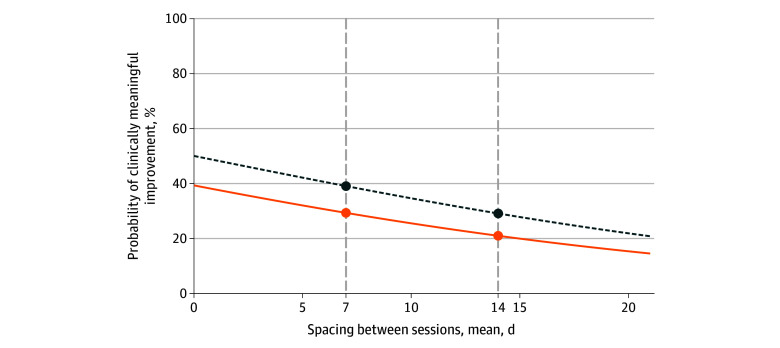
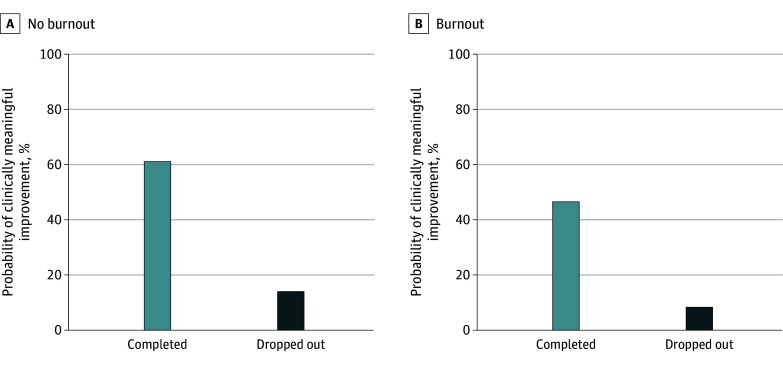
In this study, 165 of 180 (91.7%) therapists (89 [53.9%] female) completed the burnout measure and provided trauma-focused psychotherapies to 1268 patients (961 [75.8%] male) with outcome data. Fifty-eight (35.2%) therapists endorsed burnout. One third of patients (431 [34.0%]) met criterion for clinically meaningful improvement. Clinically meaningful improvement in PTSD symptoms was experienced by 120 (28.3%) of the 424 patients seen by therapists who reported burnout and 311 (36.8%) of the 844 patients seen by therapists without burnout. Burnout was associated with lower odds of clinically meaningful improvement (adjusted odds ratio [OR],0.63; 95% CI, 0.48-0.85). The odds of clinically meaningful improvement were reduced for patients who dropped out (OR, 0.15; 95% CI, 0.11-0.20) and had greater session spacing (OR, 0.80; 95% CI, 0.70-0.92). Therapist adherence was not associated with therapy effectiveness. Adjusting for dropout or session spacing did not meaningfully alter the magnitude of the association between burnout and clinically meaningful improvement.
In this prospective cohort study, therapist burnout was associated with reduced effectiveness of trauma-focused psychotherapies. Studying when and how burnout affects patient outcomes may inform workplace interventions.
临床医生倦怠与临床医生的结果有关,但与患者结果的关系仍不清楚。
评估临床医生倦怠与接受创伤聚焦心理治疗(创伤聚焦心理治疗)的 PTSD 患者的结果之间的关联。
设计、地点和参与者:本队列研究在美国退伍军人事务医疗保健系统进行,包括提供创伤聚焦心理治疗并于 2019 年 5 月 2 日至 10 月 8 日之间在线调查的持照治疗师以及在接下来的一年中开始创伤聚焦治疗的患者。通过电子健康记录收集患者数据,直至 2020 年 12 月 31 日。数据分析于 2023 年 5 月至 9 月进行。
完成调查的治疗师使用来自医生工作生活研究的经过验证的 5 点措施报告倦怠。倦怠定义为得分 3 或以上。
主要结果是 PTSD 症状根据精神障碍诊断和统计手册(第五版)的 PTSD 检查表有临床意义的改善。通过电子健康记录评估患者脱落、治疗师依从性和治疗间隔。多变量随机效应逻辑回归调整病例组合后,评估了治疗师倦怠与临床意义改善的关联。
在这项研究中,180 名治疗师中有 165 名(91.7%)(89 名[53.9%]女性)完成了倦怠测量,并为 1268 名(961 名[75.8%]男性)有结局数据的患者提供了创伤聚焦心理治疗。58 名(35.2%)治疗师表示存在倦怠。三分之一的患者(431 名[34.0%])符合临床意义改善的标准。在报告倦怠的 424 名患者中,有 120 名(28.3%)经历了 PTSD 症状的临床意义改善,而在没有倦怠的 844 名患者中,有 311 名(36.8%)经历了 PTSD 症状的临床意义改善。倦怠与临床意义改善的可能性降低有关(调整后的优势比[OR],0.63;95%CI,0.48-0.85)。脱落的患者(OR,0.15;95%CI,0.11-0.20)和治疗间隔较大的患者(OR,0.80;95%CI,0.70-0.92)临床意义改善的可能性降低。治疗师的依从性与治疗效果无关。调整脱落或治疗间隔并不会显著改变倦怠与临床意义改善之间关联的幅度。
在这项前瞻性队列研究中,治疗师倦怠与创伤聚焦心理治疗的效果降低有关。研究倦怠如何影响患者的结果可能有助于制定工作场所干预措施。