Department of Gynaecology and Obstetrics, Máxima MC, Veldhoven, The Netherlands.
Department of Electrical Engineering, Eindhoven University of Technology, Eindhoven, The Netherlands.
PLoS One. 2024 Apr 17;19(4):e0302123. doi: 10.1371/journal.pone.0302123. eCollection 2024.
Fetal two-dimensional speckle tracking echocardiography (2D-STE) is an emerging technique for assessing fetal cardiac function by measuring global longitudinal strain. Alterations in global longitudinal strain may serve as early indicator of pregnancy complications, making 2D-STE a potentially valuable tool for early detection. Early detection can facilitate timely interventions to reduce fetal and maternal morbidity and mortality. Therefore, the aim of this study was to investigate the feasibility of performing 2D-STE at 16 weeks gestational age.
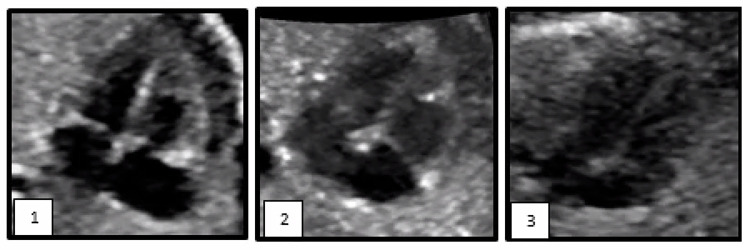
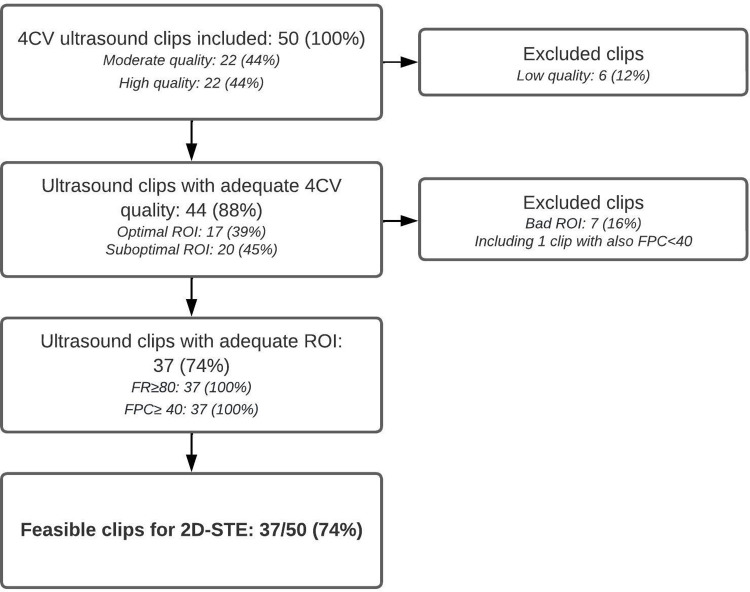
This pilot study utilized 50 ultrasound clips of the fetal four-chamber view recorded between 15+5 and 16+2 weeks gestational age from a prospective cohort study. A strict protocol assessed three parameters essential for 2D-STE analysis: fetal four-chamber view ultrasound clip quality, region of interest, and frame rates. Two independent researchers measured global longitudinal strain in all adequate fetal four-chamber view ultrasound clips to determine inter- and intra-operator reliability.
Out of the 50 ultrasound clips, 37 (74%) were feasible for 2D-STE analysis. The inter-operator reliability for global longitudinal strain measurements of the left and right ventricles was moderate (ICC of 0.64 and 0.74, respectively), while the intra-operator reliability was good (ICC of 0.76 and 0.79, respectively).
Our findings demonstrate that fetal 2D-STE analysis at 16 weeks gestational age is feasible when adhering to a strict protocol. However, further improvements are necessary to enhance the inter- and intra-operator reliability of 2D-STE at this gestational age.
胎儿二维斑点追踪超声心动图(2D-STE)是一种新兴的技术,通过测量整体纵向应变来评估胎儿心功能。整体纵向应变的改变可能是妊娠并发症的早期指标,因此 2D-STE 可能成为早期检测的有用工具。早期检测可以促进及时干预,降低胎儿和母亲的发病率和死亡率。因此,本研究旨在探讨在 16 孕周进行 2D-STE 的可行性。
这项前瞻性队列研究共纳入了 50 个 15+5 至 16+2 孕周胎儿四腔心切面的超声片段。一个严格的方案评估了 2D-STE 分析所需的三个基本参数:胎儿四腔心切面超声片段质量、感兴趣区和帧率。两名独立的研究人员测量了所有适当的胎儿四腔心切面超声片段的整体纵向应变,以确定观察者间和观察者内的可靠性。
在 50 个超声片段中,37 个(74%)可用于 2D-STE 分析。左、右心室整体纵向应变测量的观察者间可靠性为中度(ICC 分别为 0.64 和 0.74),观察者内可靠性良好(ICC 分别为 0.76 和 0.79)。
本研究结果表明,严格遵循方案,在 16 孕周进行胎儿 2D-STE 分析是可行的。然而,需要进一步改进以提高该孕周 2D-STE 的观察者间和观察者内可靠性。