Nutritional Epidemiology Group, School of Food Science and Nutrition, University of Leeds, Leeds, United Kingdom.
PLoS One. 2024 Apr 17;19(4):e0292561. doi: 10.1371/journal.pone.0292561. eCollection 2024.
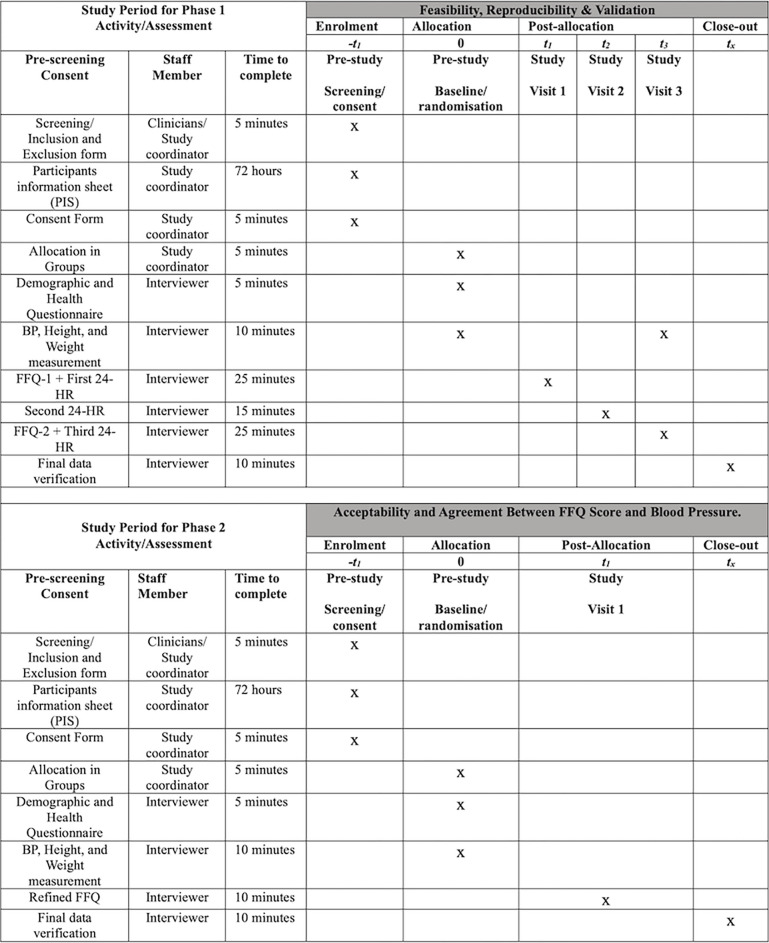
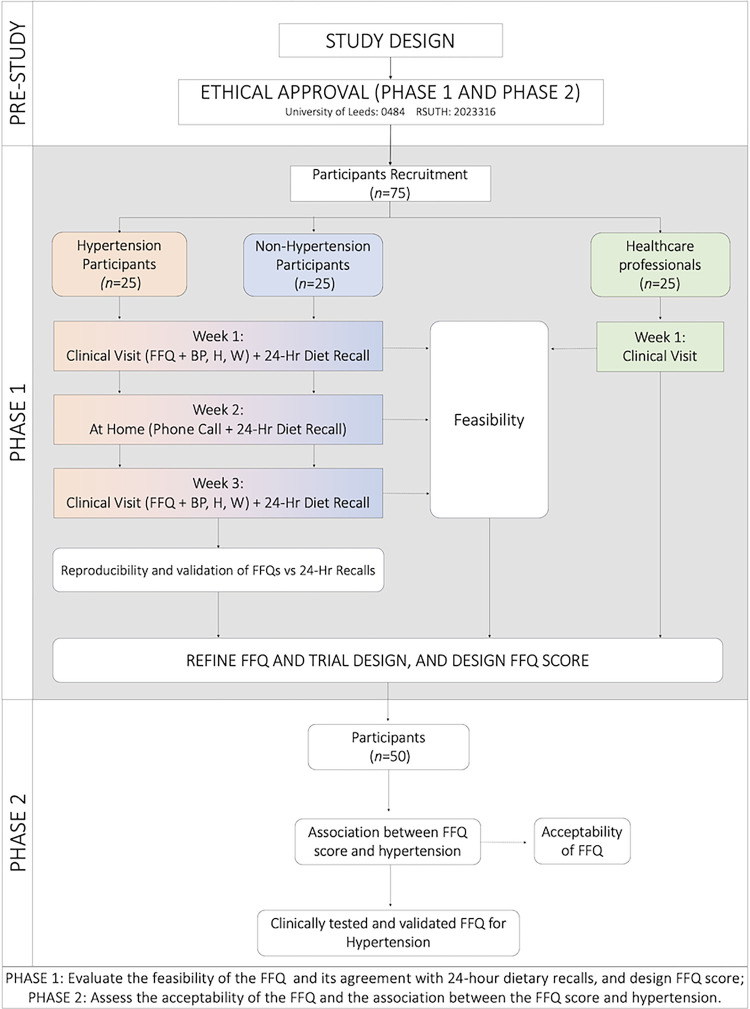
Contrary to North America and Europe, the prevalence of hypertension is rising in West Africa. With a transition from whole foods to processed foods in Nigeria, diet plays a key driver of hypertension. To combat this, the national nutritional guidelines in Nigeria were implemented, but their translation into actionable tools for clinicians remains a challenge. Currently, there are no simple dietary assessment tools that are concise and suitable to be incorporated into clinical care without requiring extensive data analysis while still providing personalised dietary support to their patients. This study aims to deliver a clinically tested and validated short dietary assessment tool for clinicians, patients, and researchers across Nigeria to provide personalised dietary advice for patients with hypertension. The study will be conducted in two phases: Phase 1 (n = 75) will investigate the feasibility of the short FFQ and its agreement with 24-hour dietary recalls (3x) in a clinical setting in Nigeria. During the analysis of Phase 1 data, a scoring system will be developed based on the associations between individual food items in the FFQ and measures of hypertension. Phase 2 (n = 50) will assess the acceptability of the FFQ and validate the association between the FFQ score and hypertension. Expected outcomes: The development of a clinically tested and validated short food frequency questionnaire that will be ready to use by clinicians, patients, and researchers across Nigeria to support the prevention and management of hypertension. This study will contribute to knowledge on dietary assessment and hypertension prevention by developing a validated and acceptable FFQ, which will be valuable for clinicians and researchers for personalised dietary recommendations to combat hypertension in Nigeria.
与北美和欧洲相反,高血压在西非的患病率正在上升。随着尼日利亚从全食向加工食品的转变,饮食成为高血压的主要驱动因素。为了应对这一问题,尼日利亚实施了国家营养指南,但将其转化为临床医生可操作的工具仍然是一个挑战。目前,没有简单的饮食评估工具,这些工具既简洁又适合纳入临床护理,而无需进行广泛的数据分析,同时仍能为患者提供个性化的饮食支持。本研究旨在为尼日利亚的临床医生、患者和研究人员提供一种经过临床测试和验证的简短饮食评估工具,为高血压患者提供个性化的饮食建议。该研究将分两个阶段进行:第 1 阶段(n = 75)将研究简短 FFQ 在尼日利亚临床环境中的可行性及其与 24 小时膳食回忆(3 次)的一致性。在分析第 1 阶段数据期间,将根据 FFQ 中各个食物项目与高血压测量值之间的关联,制定评分系统。第 2 阶段(n = 50)将评估 FFQ 的可接受性并验证 FFQ 得分与高血压之间的关联。预期结果:开发一种经过临床测试和验证的简短食物频率问卷,可供尼日利亚的临床医生、患者和研究人员使用,以支持高血压的预防和管理。本研究将通过开发一种经过验证和可接受的 FFQ 为饮食评估和高血压预防做出贡献,这对临床医生和研究人员来说,都是为了在尼日利亚进行个性化的饮食建议以对抗高血压的宝贵资源。