Technical University of Munich, TUM School of Natural Sciences, Bavarian NMR Center and Department of Bioscience, Lichtenbergstr. 4, 85747, Garching, Germany.
Helmholtz Munich, Molecular Targets and Therapeutics Center, Institute of Structural Biology, Ingolstädter Landstr. 1, 85764, Neuherberg, Germany.
Nat Commun. 2024 Apr 18;15(1):3317. doi: 10.1038/s41467-024-47605-w.
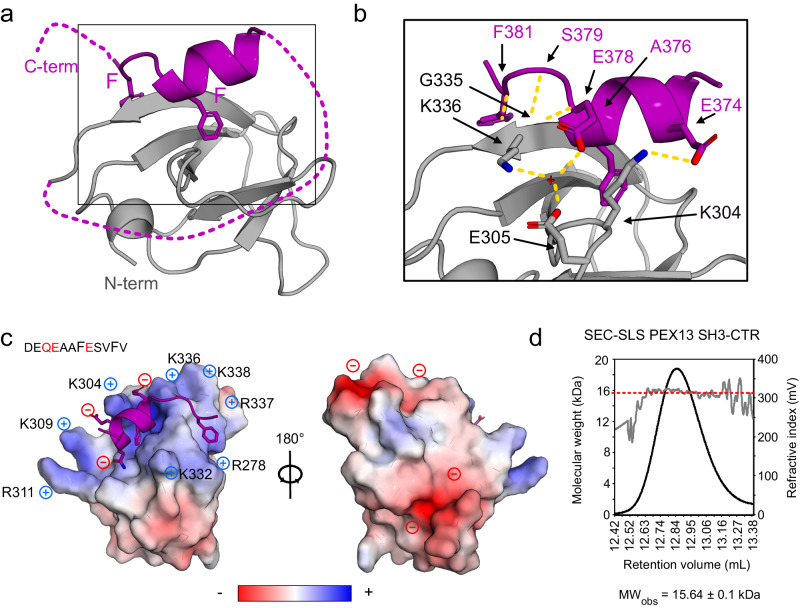
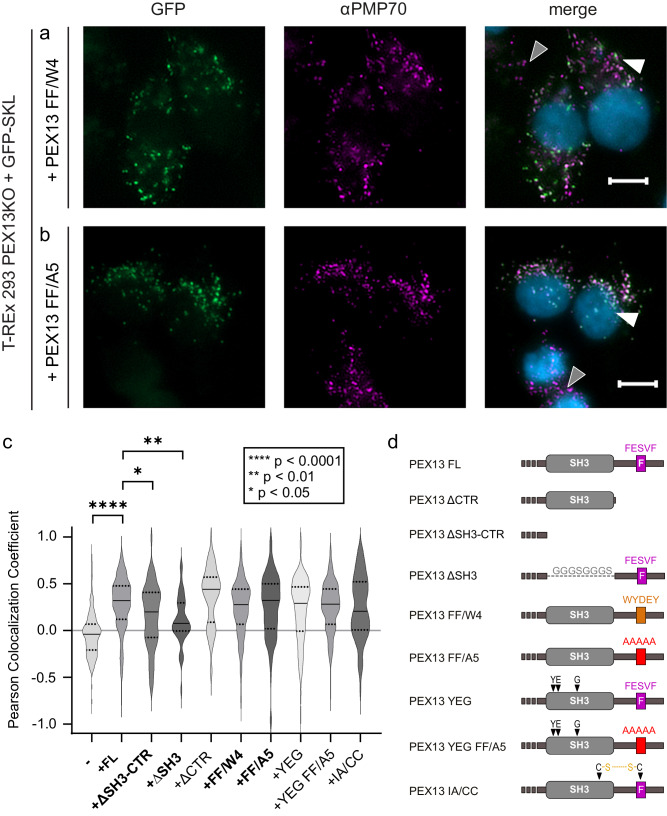
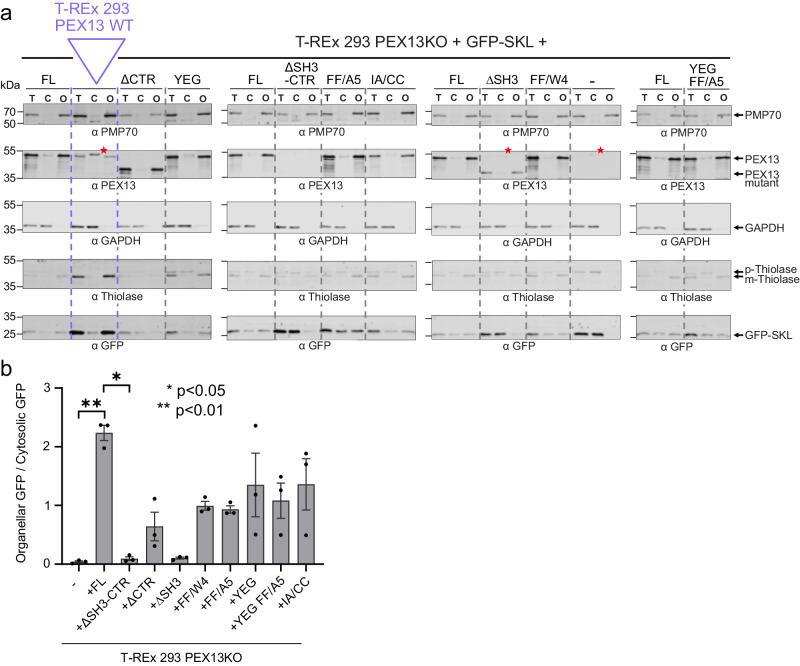
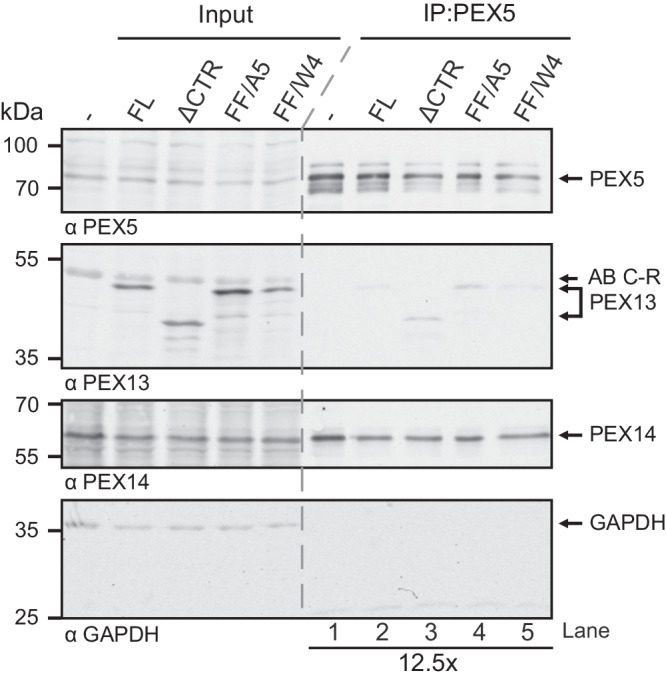
Import of proteins into peroxisomes depends on PEX5, PEX13 and PEX14. By combining biochemical methods and structural biology, we show that the C-terminal SH3 domain of PEX13 mediates intramolecular interactions with a proximal FxxxF motif. The SH3 domain also binds WxxxF peptide motifs in the import receptor PEX5, demonstrating evolutionary conservation of such interactions from yeast to human. Strikingly, intramolecular interaction of the PEX13 FxxxF motif regulates binding of PEX5 WxxxF/Y motifs to the PEX13 SH3 domain. Crystal structures reveal how FxxxF and WxxxF/Y motifs are recognized by a non-canonical surface on the SH3 domain. The PEX13 FxxxF motif also mediates binding to PEX14. Surprisingly, the potential PxxP binding surface of the SH3 domain does not recognize PEX14 PxxP motifs, distinct from its yeast ortholog. Our data show that the dynamic network of PEX13 interactions with PEX5 and PEX14, mediated by diaromatic peptide motifs, modulates peroxisomal matrix import.
蛋白质向过氧化物酶体的输入依赖于 PEX5、PEX13 和 PEX14。通过结合生化方法和结构生物学,我们表明 PEX13 的 C 端 SH3 结构域介导与近端 FxxxF 基序的分子内相互作用。SH3 结构域还结合了输入受体 PEX5 中的 WxxxF 肽基序,证明了这种相互作用从酵母到人具有进化上的保守性。引人注目的是,PEX13 FxxxF 基序的分子内相互作用调节了 PEX5 WxxxF/Y 基序与 PEX13 SH3 结构域的结合。晶体结构揭示了 FxxxF 和 WxxxF/Y 基序如何被 SH3 结构域上的非典型表面识别。PEX13 FxxxF 基序还介导与 PEX14 的结合。令人惊讶的是,SH3 结构域的潜在 PxxP 结合表面不识别 PEX14 的 PxxP 基序,与酵母同源物不同。我们的数据表明,PEX13 与 PEX5 和 PEX14 的相互作用网络通过二芳基肽基序介导,调节过氧化物酶体基质的输入。