Cape Coast Nursing and Midwifery Training College, Cape Coast, Ghana.
Department of Health, Physical Education, and Recreation, University of Cape Coast, Cape Coast, Ghana.
BMC Public Health. 2024 Apr 17;24(1):1070. doi: 10.1186/s12889-024-18516-8.
Suicide represents a major public health concern, affecting a significant portion of individuals. However, there remains a gap in understanding the age and sex disparities in the occurrence of suicide. Therefore, this study aimed to investigate the sex-related inequalities in suicide rates in Ghana from 2000 to 2019.
We utilized data from the WHO Health Equity Assessment Toolkit (HEAT) online software. We analysed sex differences in both crude and age-standardized suicide rates in Ghana spanning from 2000 to 2019. Crude and age-adjusted suicide rates were calculated based on the International Classification of Diseases (ICD) definition and coding of suicide mortality. We measured inequality in terms of sex. Two inequality indicators were used to examine the suicide rates: the difference (D) and the ratio (R).
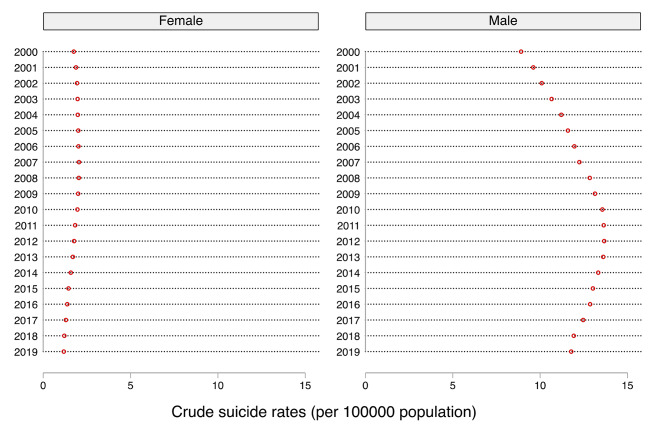
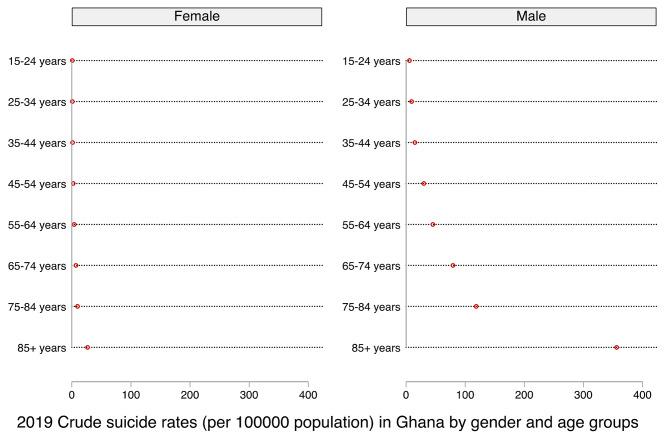
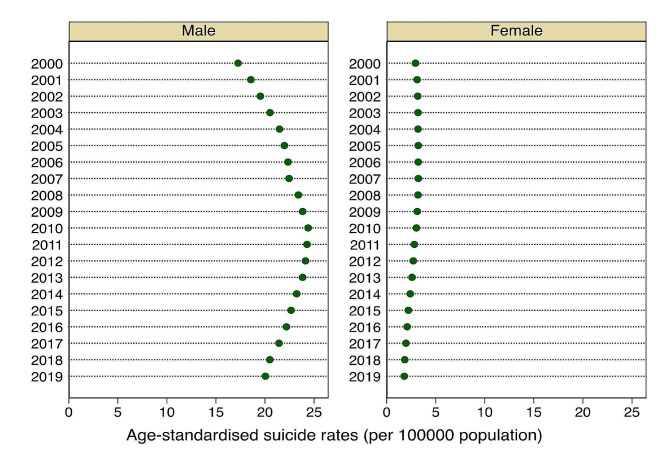
Age-standardized and crude suicide rates in Ghana were higher among men from 2000 to 2019. Between 2000 and 2007, the age-standardized suicide rate for women rose steadily and declined slightly between 2008 and 2019. Age-standardized suicide rates for men increased consistently from 2000 to 2010, then declined steadily from 2011 to 2019. The crude suicide rates among men and women followed similar patterns. The widest absolute inequality in crude suicide rates (D) was recorded in 2013 (D=-11.91), while the smallest difference was observed in 2000 (D=-7.16). We also found the greatest disparity in age-standardized rates in 2011 (D=-21.46) and the least in 2000 (D=-14.32). The crude suicide rates increased with age for both men and women aged 15-54 years and 55-85+ years respectively. However, the increased rate was higher in men than in women across all age groups surveyed. A similar pattern was observed for relative inequality in both crude and age-standardized rates of suicide.
The suicide rate in Ghana has declined over time. Suicide is more common among older men. Inequalities in suicide rates, in both absolute and relative terms, are similar. There is a need to monitor suicide trends in Ghana, especially among older men. Moreover, the findings could serve as a basis for future studies on suicide in Ghana.
自杀是一个严重的公共卫生问题,影响了相当一部分人群。然而,人们对于自杀发生率中的年龄和性别差异仍缺乏了解。因此,本研究旨在调查 2000 年至 2019 年期间加纳的性别与自杀率之间的关系。
我们利用世界卫生组织健康公平评估工具包(HEAT)在线软件中的数据。我们分析了 2000 年至 2019 年期间加纳的粗自杀率和年龄标准化自杀率中的性别差异。根据国际疾病分类(ICD)自杀死亡率的定义和编码计算了粗率和年龄调整后的自杀率。我们衡量了性别不平等程度。使用两个不平等指标来检查自杀率:差异(D)和比值(R)。
2000 年至 2019 年期间,加纳的标准化和粗自杀率在男性中更高。2000 年至 2007 年期间,女性的标准化自杀率稳步上升,2008 年至 2019 年期间略有下降。2000 年至 2010 年期间,男性的标准化自杀率持续上升,然后从 2011 年至 2019 年期间稳步下降。男性和女性的粗自杀率呈现出类似的模式。2013 年记录到的粗自杀率绝对不平等程度最大(D=-11.91),而 2000 年的差异最小(D=-7.16)。我们还发现,2011 年的标准化率差异最大(D=-21.46),而 2000 年的差异最小(D=-14.32)。15-54 岁和 55-85+岁的男性和女性的粗自杀率随年龄增长而增加。然而,在所有调查的年龄组中,男性的增长率均高于女性。在粗率和标准化率的相对不平等方面也观察到了类似的模式。
加纳的自杀率随时间呈下降趋势。自杀在年龄较大的男性中更为常见。绝对和相对自杀率的不平等程度相似。需要监测加纳的自杀趋势,特别是在年龄较大的男性中。此外,这些发现可以为加纳的未来自杀研究提供依据。