Department of Medical Imaging, Radboud University Medical Center, Geert Grooteplein Zuid 10, 6525 GA, Nijmegen, The Netherlands.
Jheronimus Academy of Data Science, Sint Janssingel 92, 5211 DA, 's-Hertogenbosch, The Netherlands.
Eur Radiol. 2024 Oct;34(10):6600-6613. doi: 10.1007/s00330-024-10744-1. Epub 2024 Apr 18.
To develop and validate an artificial intelligence (AI) system for measuring and detecting signs of carpal instability on conventional radiographs.
Two case-control datasets of hand and wrist radiographs were retrospectively acquired at three hospitals (hospitals A, B, and C). Dataset 1 (2178 radiographs from 1993 patients, hospitals A and B, 2018-2019) was used for developing an AI system for measuring scapholunate (SL) joint distances, SL and capitolunate (CL) angles, and carpal arc interruptions. Dataset 2 (481 radiographs from 217 patients, hospital C, 2017-2021) was used for testing, and with a subsample (174 radiographs from 87 patients), an observer study was conducted to compare its performance to five clinicians. Evaluation metrics included mean absolute error (MAE), sensitivity, and specificity.
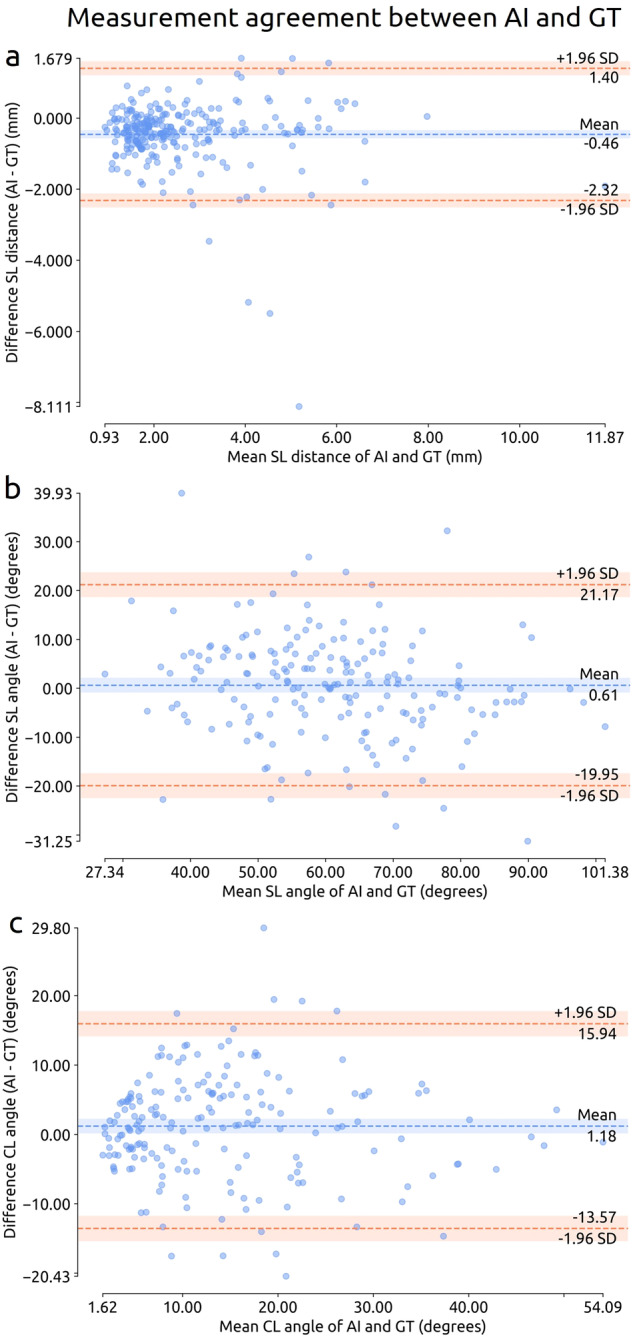
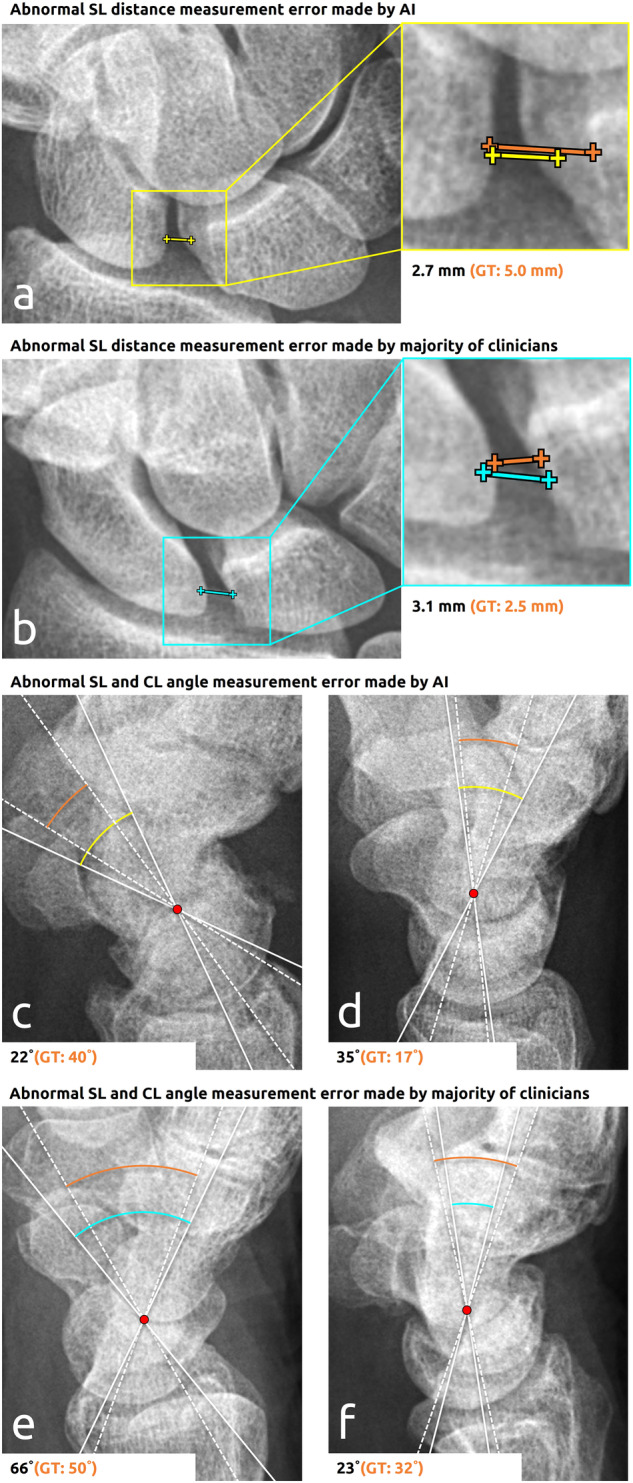
Dataset 2 included 258 SL distances, 189 SL angles, 191 CL angles, and 217 carpal arc labels obtained from 217 patients (mean age, 51 years ± 23 [standard deviation]; 133 women). The MAE in measuring SL distances, SL angles, and CL angles was respectively 0.65 mm (95%CI: 0.59, 0.72), 7.9 degrees (95%CI: 7.0, 8.9), and 5.9 degrees (95%CI: 5.2, 6.6). The sensitivity and specificity for detecting arc interruptions were 83% (95%CI: 74, 91) and 64% (95%CI: 56, 71). The measurements were largely comparable to those of the clinicians, while arc interruption detections were more accurate than those of most clinicians.
This study demonstrates that a newly developed automated AI system accurately measures and detects signs of carpal instability on conventional radiographs.
This system has the potential to improve detections of carpal arc interruptions and could be a promising tool for supporting clinicians in detecting carpal instability.
开发和验证一种用于在常规 X 光片上测量和检测腕骨不稳定迹象的人工智能(AI)系统。
在三家医院(医院 A、B 和 C)回顾性地获取了手部和腕部 X 光片的两个病例对照数据集。数据集 1(来自 1993 名患者的 2178 张 X 光片,医院 A 和 B,2018-2019 年)用于开发用于测量舟月(SL)关节距离、SL 和月骨(CL)角度以及腕骨弧中断的 AI 系统。数据集 2(来自 217 名患者的 481 张 X 光片,医院 C,2017-2021 年)用于测试,并且使用一个亚样本(来自 87 名患者的 174 张 X 光片)进行了观察者研究,以比较其性能与五名临床医生。评估指标包括平均绝对误差(MAE)、灵敏度和特异性。
数据集 2 包括来自 217 名患者(平均年龄 51 岁±23[标准差];133 名女性)的 258 个 SL 距离、189 个 SL 角度、191 个 CL 角度和 217 个腕骨弧标签。测量 SL 距离、SL 角度和 CL 角度的 MAE 分别为 0.65mm(95%CI:0.59,0.72)、7.9 度(95%CI:7.0,8.9)和 5.9 度(95%CI:5.2,6.6)。检测弧中断的灵敏度和特异性分别为 83%(95%CI:74,91)和 64%(95%CI:56,71)。测量结果与临床医生的结果基本一致,而弧中断的检测则比大多数临床医生更准确。
本研究表明,新开发的自动 AI 系统能够准确地在常规 X 光片上测量和检测腕骨不稳定的迹象。
该系统有可能提高对腕骨弧中断的检测能力,并且可能成为支持临床医生检测腕骨不稳定的有前途的工具。