Department of Public Health, Institute of Tropical Medicine, Antwerp, Belgium.
Department of Sociology, University of Antwerp, Antwerp, Belgium.
PLoS One. 2024 Apr 18;19(4):e0300220. doi: 10.1371/journal.pone.0300220. eCollection 2024.
Adolescents and young adults (AYA) face multiple barriers to accessing healthcare services, which can interact, creating complex needs that often impact health behaviours, leading to increased vulnerability to HIV. We aimed to identify distinct AYA subgroups based on patterns of barriers to HIV testing services and assess the association between these barrier patterns and sexual behaviour, socio-demographics, and HIV status.
Data were from Nigeria's AIDS Indicator and Impact Survey (NAIIS, 2018) and included 18,612 sexually active AYA aged 15-24 years who had never been tested for HIV and reported barriers to accessing HIV testing services. A Latent class analysis (LCA) model was built from 12 self-reported barrier types to identify distinct subgroups of AYA based on barrier patterns. Latent class regressions (LCR) were conducted to compare the socio-demographics, sexual behaviour, and HIV status across identified AYA subgroups. Sex behaviour characteristics include intergenerational sex, transactional sex, multiple sex partners, condom use, and knowledge of partner's HIV status.
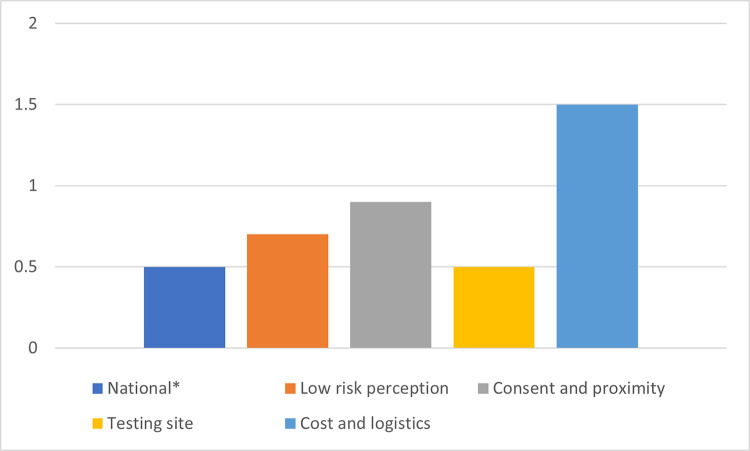
Our LCA model identified four distinct AYA subgroups termed 'low-risk perception' (n = 7,361; 39.5%), 'consent and proximity' (n = 5,163; 27.74%), 'testing site' (n = 4,996; 26.84%), and 'cost and logistics' (n = 1,092; 5.87%). Compared to adolescents and young adults (AYA) in the low-risk perception class, those in the consent and proximity class were more likely to report engaging in intergenerational sex (aOR 1.17, 95% CI 1.02-1.35), transactional sex (aOR 1.50, 95% CI 1.23-1.84), and have multiple sex partners (aOR 1.75, 95% CI 1.39-2.20), while being less likely to report condom use (aOR 0.79, 95% CI 0.63-0.99). AYA in the testing site class were more likely to report intergenerational sex (aOR 1.21, 95% CI 1.04-1.39) and transactional sex (aOR 1.53, 95% CI 1.26-1.85). AYA in the cost and logistics class were more likely to engage in transactional sex (aOR 2.12, 95% CI 1.58-2.84) and less likely to report condom use (aOR 0.58, 95% CI 0.34-0.98). There was no significant relationship between barrier subgroup membership and HIV status. However, being female, aged 15-24 years, married or cohabiting, residing in the Southsouth zone, and of Christian religion increased the likelihood of being HIV infected.
Patterns of barriers to HIV testing are linked with differences in sexual behaviour and sociodemographic profiles among AYA, with the latter driving differences in HIV status. Findings can improve combination healthcare packages aimed at simultaneously addressing multiple barriers and determinants of vulnerability to HIV among AYA.
青少年和年轻人(AYA)在获得医疗保健服务方面面临多种障碍,这些障碍可能相互作用,产生复杂的需求,这些需求往往会影响健康行为,导致他们更容易感染 HIV。我们旨在根据艾滋病病毒检测服务障碍的模式识别不同的 AYA 亚组,并评估这些障碍模式与性行为、社会人口统计学和 HIV 状况之间的关联。
数据来自尼日利亚艾滋病指标和影响调查(NAIIS,2018 年),包括 18612 名从未接受过 HIV 检测且报告过获得 HIV 检测服务障碍的 15-24 岁性活跃 AYA。从 12 种自我报告的障碍类型中构建了潜在类别分析(LCA)模型,根据障碍模式确定基于障碍模式的不同 AYA 亚组。进行潜在类别回归(LCR)以比较不同 AYA 亚组的社会人口统计学、性行为和 HIV 状况。性行为特征包括代际性行为、交易性行为、多个性伴侣、避孕套使用和对伴侣 HIV 状况的了解。
我们的 LCA 模型确定了四个不同的 AYA 亚组,分别称为“低风险感知”(n=7361;39.5%)、“同意和接近”(n=5163;27.74%)、“检测地点”(n=4996;26.84%)和“成本和物流”(n=1092;5.87%)。与低风险感知类别中的青少年和年轻人(AYA)相比,同意和接近类别中的 AYA 更有可能报告进行代际性行为(aOR 1.17,95%CI 1.02-1.35)、交易性行为(aOR 1.50,95%CI 1.23-1.84)和多个性伴侣(aOR 1.75,95%CI 1.39-2.20),而不太可能报告使用避孕套(aOR 0.79,95%CI 0.63-0.99)。检测地点类别的 AYA 更有可能报告代际性行为(aOR 1.21,95%CI 1.04-1.39)和交易性行为(aOR 1.53,95%CI 1.26-1.85)。成本和物流类别的 AYA 更有可能进行交易性行为(aOR 2.12,95%CI 1.58-2.84),而不太可能使用避孕套(aOR 0.58,95%CI 0.34-0.98)。障碍亚组成员与 HIV 状况之间没有显著关系。然而,女性、15-24 岁、已婚或同居、居住在南南地区和基督教信仰会增加感染 HIV 的可能性。
艾滋病病毒检测服务障碍的模式与 AYA 之间的性行为和社会人口统计学特征差异有关,而后者是造成 HIV 状况差异的原因。研究结果可以改善旨在同时解决 AYA 群体中艾滋病病毒脆弱性的多种障碍和决定因素的综合保健套餐。