
在尼日利亚,青少年和年轻成年人中 HIV 检测覆盖率较低:对实现艾滋病规划署第一个 95 目标的影响。
Low coverage of HIV testing among adolescents and young adults in Nigeria: Implication for achieving the UNAIDS first 95.
机构信息
Population Dynamics and Reproductive Health and Rights Unit, African Population and Health Research Center, Kitisuru, Nairobi, Kenya.
Economics and Business Policy Department, Junior Research Fellow, Nigerian Institute of Social and Economic Research, Ibadan, Nigeria.
出版信息
PLoS One. 2020 May 19;15(5):e0233368. doi: 10.1371/journal.pone.0233368. eCollection 2020.
BACKGROUND
Most studies on HIV testing among young people in Nigeria are not nationally representative. As such, recent nationally representative data, such as the Multiple Indicator Cluster Survey (MICS), could help assess the current level of HIV testing among young people, a key target population for HIV prevention in the country. In this study, we examined the coverage and factors associated with HIV testing among adolescents and young adults (AYA).
METHODS
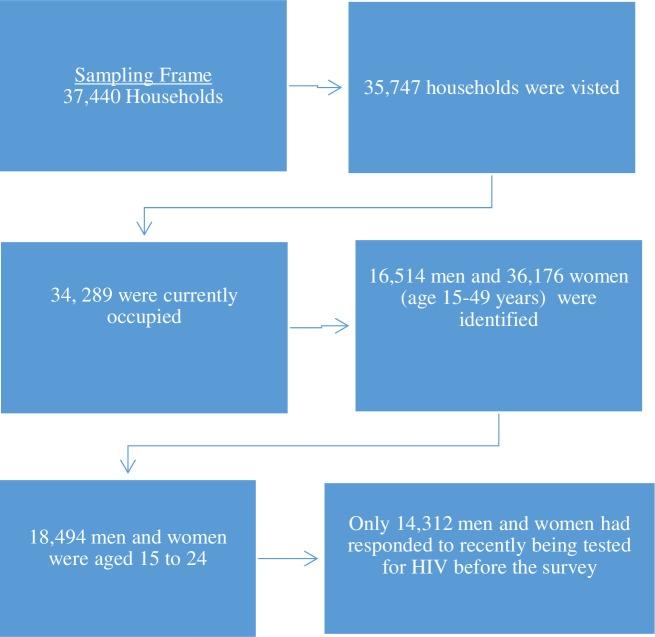
We used the data for 14,312 AYA that examined recent and lifetime HIV testing from the 2017 MCIS. Our outcomes of interest were ever tested for HIV and recently tested for HIV. We examined the association between socio-demographic factors (e.g., age, marital status, education attainment, wealth status), stigma belief, exposure to media and HIV knowledge, and uptake of HIV testing using adjusted and unadjusted logistic regression models.
RESULTS
Less than a quarter of the AYA (23.7%) had ever tested for HIV, and an even lower proportion (12.4%) tested in the year preceding the survey. More females (25.4%) compared to males (20.8%) had ever tested for HIV. Young people who were aged 20-24 years (AOR 1.52, 95% CI 1.34-1.72), married (AOR 2.42, 95% CI 1.98-2.97), had higher educational attainment (AOR 5.85, 95% CI 4.39-7.81), and belonged to the wealthiest quintile (AOR 1.99, 95% CI 1.53-2.60), had higher odds of having ever tested for HIV compared to those aged 15-19 years, never married, had no formal education and belonged to the poorest wealth quintile. Also, those who had positive stigma belief towards people living with HIV (AOR 2.93, 95% CI 2.47-3.49), had higher HIV knowledge (AOR 1.62, 95% CI 1.24-2.11), and higher media exposure (AOR 1.64, 95% CI 1.36-1.97), had higher odds of having ever tested compared to those who had more negative stigma belief, had low knowledge of HIV and low media exposure.
CONCLUSION
The HIV testing coverage among AYA in Nigeria is well below the national target of 95% indicated in the national HIV/AIDS strategic framework (2017-2021). Also, the low rate of HIV testing found in this study means realising the UNAIDS first 95 will require interventions targeting AYA. These interventions should focus on improving young people's knowledge of HIV, reducing negative stigma belief through media campaigns and increasing access to HIV testing through home-based testing and "opt-out" strategy at the point of care.
背景
大多数关于尼日利亚年轻人艾滋病毒检测的研究都不具有全国代表性。因此,最近的全国代表性数据,如多指标类集调查(MICS),可以帮助评估该国年轻人中艾滋病毒检测的当前水平,年轻人是该国艾滋病毒预防的关键目标人群。在这项研究中,我们研究了青少年和青年成年人(AYA)中艾滋病毒检测的覆盖范围和相关因素。
方法
我们使用了来自 2017 年 MICS 的 14312 名 AYA 中最近和终生艾滋病毒检测数据。我们感兴趣的结果是曾经接受过艾滋病毒检测和最近接受过艾滋病毒检测。我们使用调整和未调整的逻辑回归模型,研究了社会人口因素(例如年龄、婚姻状况、教育程度、财富状况)、污名信念、媒体接触和艾滋病毒知识与艾滋病毒检测采用之间的关联。
结果
不到四分之一的 AYA(23.7%)曾经接受过艾滋病毒检测,甚至更低的比例(12.4%)在调查前一年接受过检测。与男性(20.8%)相比,更多的女性(25.4%)曾经接受过艾滋病毒检测。年龄在 20-24 岁的年轻人(AOR 1.52,95%CI 1.34-1.72)、已婚(AOR 2.42,95%CI 1.98-2.97)、接受过更高教育(AOR 5.85,95%CI 4.39-7.81),并属于最富有五分位数(AOR 1.99,95%CI 1.53-2.60)的年轻人,与 15-19 岁、未婚、没有正规教育且属于最贫穷五分位数的年轻人相比,他们更有可能曾经接受过艾滋病毒检测。此外,对艾滋病毒感染者持积极污名信念的人(AOR 2.93,95%CI 2.47-3.49)、具有更高的艾滋病毒知识(AOR 1.62,95%CI 1.24-2.11)和更高的媒体接触率(AOR 1.64,95%CI 1.36-1.97),与那些对艾滋病毒具有更多负面污名信念、艾滋病毒知识水平较低和媒体接触率较低的人相比,更有可能曾经接受过艾滋病毒检测。
结论
尼日利亚 AYA 的艾滋病毒检测覆盖率远低于国家艾滋病毒/艾滋病战略框架(2017-2021 年)规定的 95%的国家目标。此外,本研究中发现的艾滋病毒检测率低意味着要实现艾滋病署的第一个 95%,需要针对 AYA 开展干预措施。这些干预措施应侧重于提高年轻人对艾滋病毒的认识,通过媒体运动减少负面污名信念,并通过家庭检测和护理点的“选择退出”战略增加艾滋病毒检测的机会。
 Zotero 插件