European Molecular Biology Laboratory, European Bioinformatics Institute (EMBL-EBI), Wellcome Genome Campus, Cambridgeshire, United Kingdom.
European Molecular Biology Laboratory, European Bioinformatics Institute (EMBL-EBI), Wellcome Genome Campus, Cambridgeshire, United Kingdom.
Mol Cell Proteomics. 2024 Jun;23(6):100771. doi: 10.1016/j.mcpro.2024.100771. Epub 2024 Apr 19.
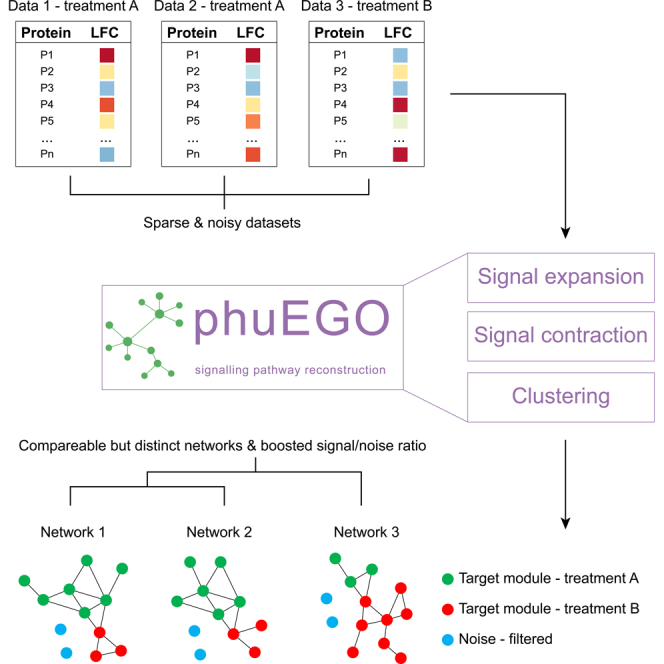
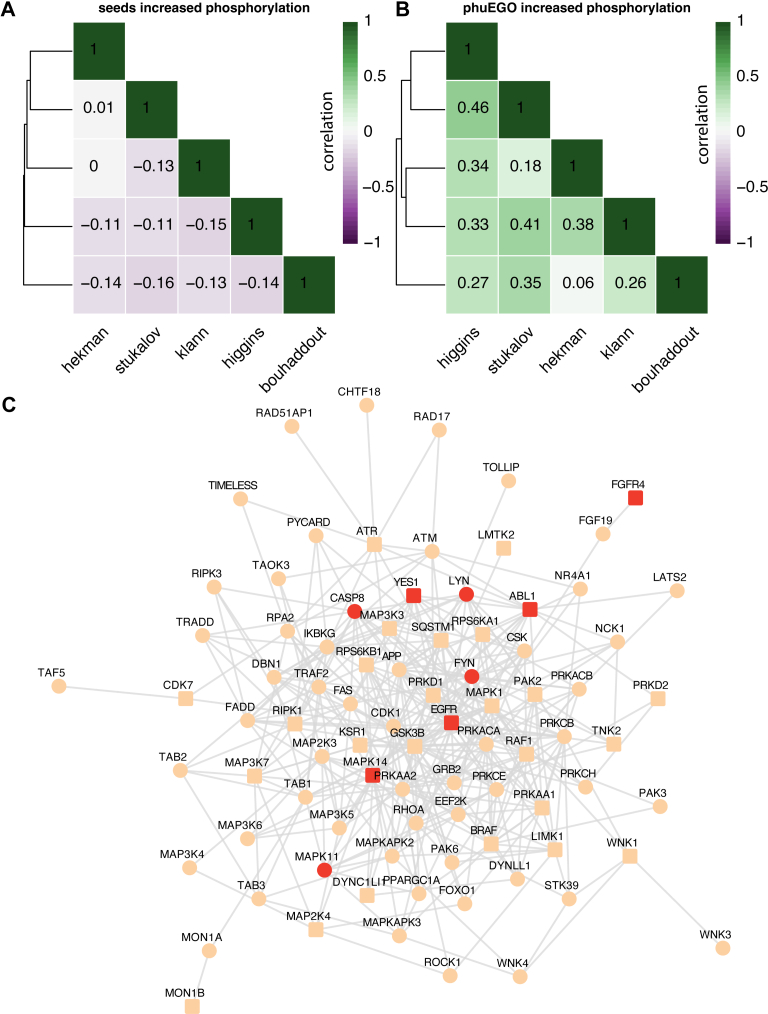
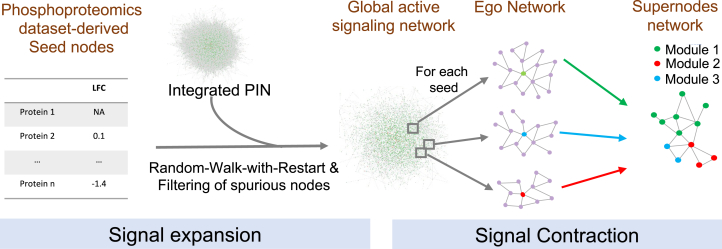
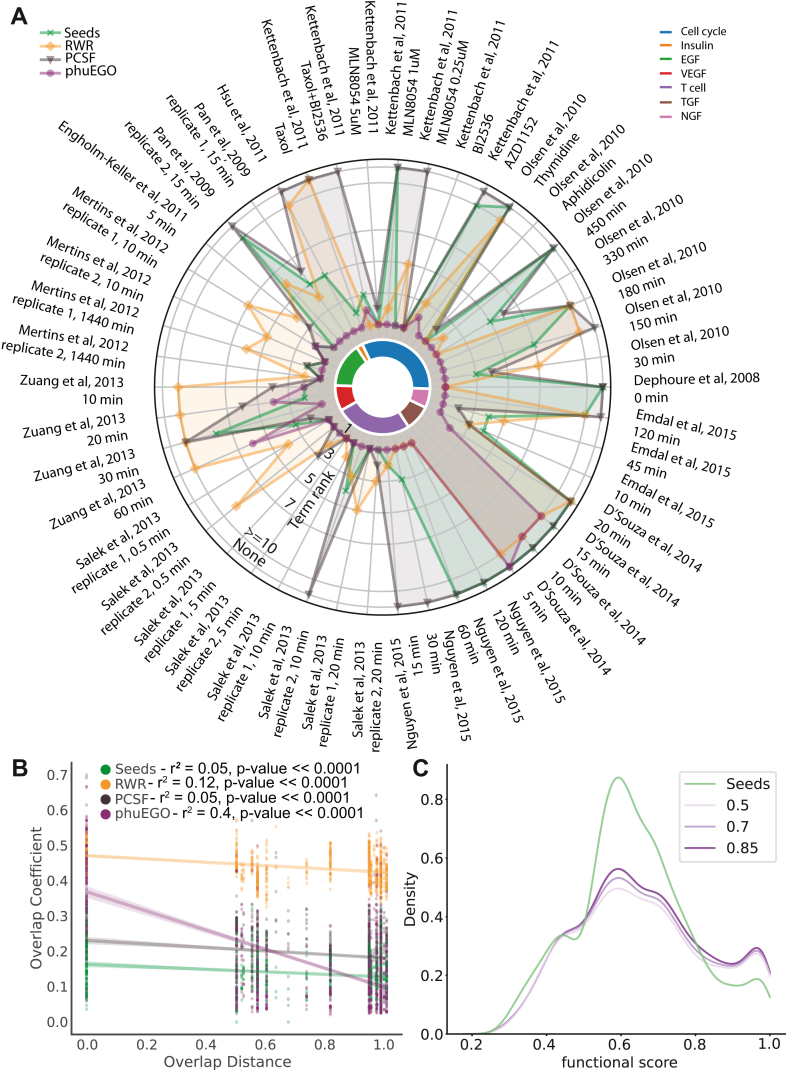
Signaling networks are critical for virtually all cell functions. Our current knowledge of cell signaling has been summarized in signaling pathway databases, which, while useful, are highly biased toward well-studied processes, and do not capture context specific network wiring or pathway cross-talk. Mass spectrometry-based phosphoproteomics data can provide a more unbiased view of active cell signaling processes in a given context, however, it suffers from low signal-to-noise ratio and poor reproducibility across experiments. While progress in methods to extract active signaling signatures from such data has been made, there are still limitations with respect to balancing bias and interpretability. Here we present phuEGO, which combines up-to-three-layer network propagation with ego network decomposition to provide small networks comprising active functional signaling modules. PhuEGO boosts the signal-to-noise ratio from global phosphoproteomics datasets, enriches the resulting networks for functional phosphosites and allows the improved comparison and integration across datasets. We applied phuEGO to five phosphoproteomics data sets from cell lines collected upon infection with SARS CoV2. PhuEGO was better able to identify common active functions across datasets and to point to a subnetwork enriched for known COVID-19 targets. Overall, phuEGO provides a flexible tool to the community for the improved functional interpretation of global phosphoproteomics datasets.
信号通路对于几乎所有的细胞功能都至关重要。我们目前对细胞信号转导的了解已经总结在信号通路数据库中,这些数据库虽然有用,但高度偏向于研究充分的过程,并且无法捕捉特定于上下文的网络布线或途径串扰。基于质谱的磷酸化蛋白质组学数据可以提供更全面的视角来了解特定背景下细胞信号转导的活跃过程,但是,它存在信噪比低和实验间重现性差的问题。虽然已经取得了从这些数据中提取活跃信号特征的方法方面的进展,但在平衡偏差和可解释性方面仍然存在局限性。这里我们提出了 phuEGO,它结合了三层网络传播和自我网络分解,提供了由活跃功能信号模块组成的小网络。phuEGO 提高了来自全局磷酸蛋白质组数据集的信噪比,丰富了功能磷酸化位点的网络,并且可以改善不同数据集之间的比较和整合。我们将 phuEGO 应用于五个源自 SARS CoV2 感染的细胞系磷酸蛋白质组数据集。phuEGO 能够更好地识别数据集之间共同的活跃功能,并指出富含已知 COVID-19 靶点的子网络。总的来说,phuEGO 为社区提供了一个灵活的工具,用于改善全局磷酸蛋白质组数据集的功能解释。