Department of Cardiology, The Fourth Affiliated Hospital, Zhejiang University School of Medicine, Shangcheng Avenue N1#, Yiwu, Zhejiang, China.
The Second Hospital of Jiaxing, The Second Affiliated Hospital of Jiaxing University, Jiaxing, China.
Sci Rep. 2024 Apr 20;14(1):9093. doi: 10.1038/s41598-024-59789-8.
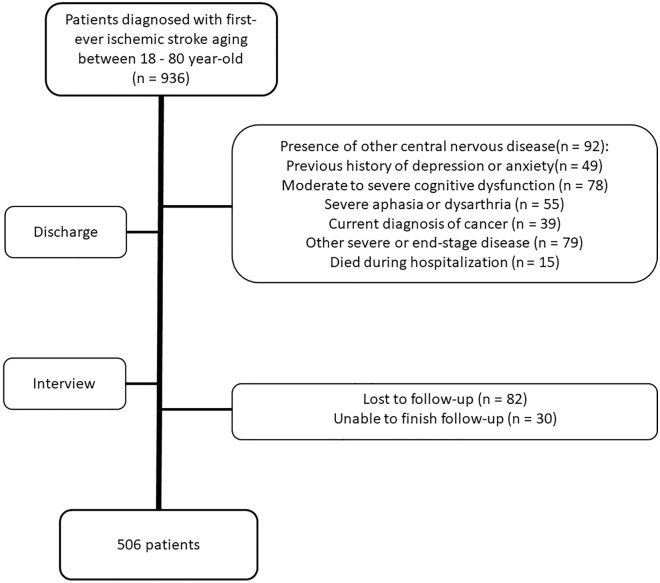
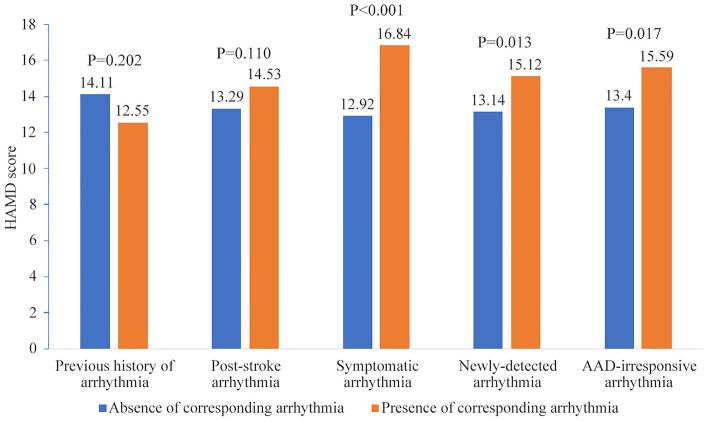
Post-stroke depression (PSD) is regarded as the consequence of multiple contributors involving the process of cognition, mood and autonomic system, with the specific mechanism unclear yet. As a common type of stroke-heart syndromes, post-stroke arrhythmia shared some common pathogenesis with PSD. We presumed that post-stroke arrhythmia might be an early distinguishable marker for the presence of PSD and aimed to verity their association in this study. Patients with first-ever ischemic stroke were enrolled. The presence of post-stroke ectopic arrhythmia and the symptoms of arrhythmia were recorded with anti-arrhythmia drugs prescribed when necessary. Patients were followed up 3 months later to identify their presence and severity of PSD using Hamilton Depression Scale (HAMD) and also presence and severity of arrhythmia. Characteristics including the prevalence of various types of arrhythmias were compared between PSD and non-PSD groups. The HAMD scores were compared between patients with and without arrhythmia in PSD group. Logistic regression was used to identify the independent predictor of PSD. Patients with PSD had higher prevalence of post-stroke arrhythmia especially newly-detected arrhythmia, symptomatic arrhythmia and poor-controlled arrhythmia. In PSD group, patients of post-stroke arrhythmia had higher scores of HAMD than those without arrhythmia. Presence of newly-detected, symptomatic and poor-controlled arrhythmias were independent predictor of PSD. post-stroke arrhythmia especially newly-detected arrhythmia and symptomatic arrhythmia could be an early predictor of PSD. Successful control of arrhythmia was associated with reduced prevalence and severity of PSD.
脑卒中后抑郁(PSD)被认为是涉及认知、情绪和自主神经系统过程的多种因素的结果,其具体机制尚不清楚。作为一种常见的中风-心脏综合征,脑卒中后心律失常与 PSD 具有一些共同的发病机制。我们推测脑卒中后心律失常可能是 PSD 存在的早期可识别标志物,并旨在在本研究中验证它们之间的关联。入选首次发生缺血性脑卒中的患者。记录脑卒中后异位心律失常的存在和心律失常的症状,并在必要时开具抗心律失常药物。3 个月后对患者进行随访,使用汉密尔顿抑郁量表(HAMD)评估 PSD 的存在和严重程度,同时评估心律失常的存在和严重程度。比较 PSD 和非 PSD 组之间各种类型心律失常的患病率特征。比较 PSD 组中伴或不伴心律失常患者的 HAMD 评分。采用 Logistic 回归分析识别 PSD 的独立预测因素。PSD 患者脑卒中后心律失常的患病率较高,尤其是新发心律失常、有症状的心律失常和控制不佳的心律失常。在 PSD 组中,有脑卒中后心律失常的患者 HAMD 评分高于无心律失常的患者。新发、有症状和控制不佳的心律失常的存在是 PSD 的独立预测因素。脑卒中后心律失常,尤其是新发心律失常和有症状的心律失常,可能是 PSD 的早期预测指标。心律失常的成功控制与 PSD 的患病率和严重程度降低相关。