von Preetzmann Nils, Zipplies Daniel, Span Roland, Richter Markus
Thermodynamics, Ruhr University Bochum, 44780 Bochum, Germany.
Applied Thermodynamics, Chemnitz University of Technology, 09107 Chemnitz, Germany.
Int J Thermophys. 2024;45(5):72. doi: 10.1007/s10765-024-03357-9. Epub 2024 Apr 19.
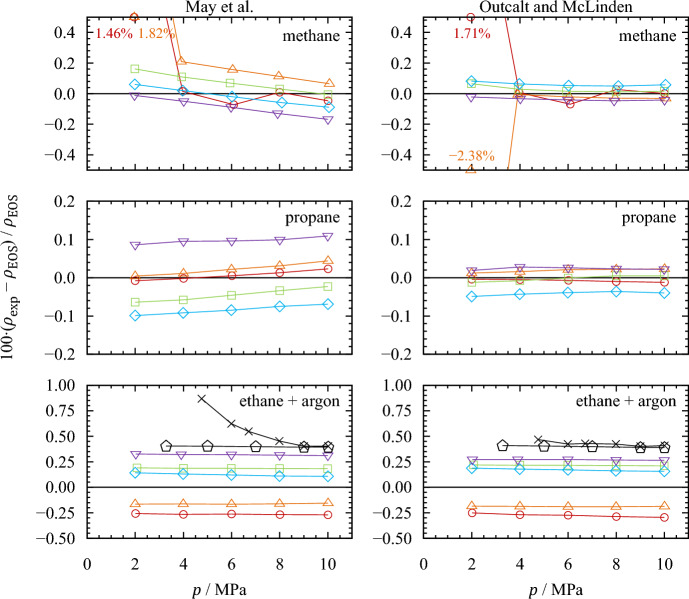
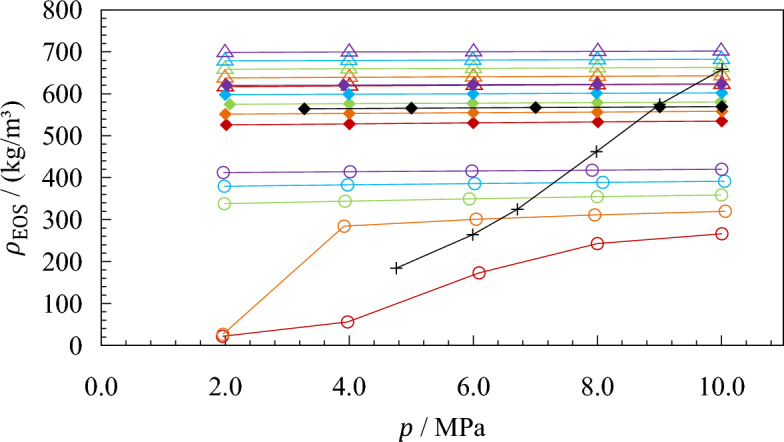
A high-pressure vibrating tube densimeter, specified by the manufacturer for temperatures from (263 to 473) K at pressures up to 140 MPa, was tested at temperatures down to 100 K and from vacuum to pressures up to 10 MPa. To verify the functionality and overall performance under these conditions, the densimeter was calibrated with measurements under vacuum as well as methane and propane as reference fluids. The calibration range is = (120 to 200) K at pressures from (2.0 to 10.0) MPa. To evaluate the recorded data, two established calibration models were used to describe the dependence of the densimeter's oscillation period on the investigated reference fluids' temperature, pressure, and density. The experiments showed that the vibrating tube densimeter is operational even at temperatures down to 100 K, but exhibits a shift of its vacuum resonance when subjected to thermal cycling at temperatures below 180 K. Accordingly, the calibration models were modified with respect to how the vacuum resonance is considered. Then, the determined calibration parameters reproduce the densities of the reference fluids within ± 0.10 kg·m for the calibration model that performed better for the present study. Measurements on pure ethane and argon validate the calibration of the densimeter. Here, the densities are within (- 0.47 to 0.16) kg·m of values calculated with the respective reference equation of state. The estimated combined expanded uncertainty ( = 2) in density for the validation measurements ranges from (0.52 to 1.13) kg·m or is less than 0.1 % for liquid densities.
The online version of this article (10.1007/s10765-024-03357-9) contains supplementary material, which is available to authorized users.
一种由制造商指定用于温度范围为(263至473)K、压力高达140 MPa的高压振动管密度计,在低至100 K的温度以及从真空到高达10 MPa的压力下进行了测试。为了验证在这些条件下的功能和整体性能,该密度计通过在真空以及以甲烷和丙烷作为参考流体的测量进行校准。校准范围是在压力为(2.0至10.0)MPa时温度为(120至200)K。为了评估记录的数据,使用了两个既定的校准模型来描述密度计振荡周期与所研究参考流体的温度、压力和密度之间的关系。实验表明,振动管密度计即使在低至100 K的温度下也能运行,但在低于180 K的温度下进行热循环时,其真空共振会发生偏移。因此,在校准模型中对如何考虑真空共振进行了修改。然后,对于在本研究中表现更好的校准模型,所确定的校准参数能够在±0.10 kg·m的范围内重现参考流体的密度。对纯乙烷和氩气的测量验证了密度计的校准。在此,密度与使用各自参考状态方程计算的值相差在(-0.47至0.16)kg·m之内。验证测量中密度的估计合成扩展不确定度( = 2)范围为(0.52至1.13)kg·m,对于液体密度而言小于0.1%。
本文的在线版本(10.1007/s10765 - 024 - 03357 - 9)包含补充材料,可供授权用户使用。