Zheng Fang, Dahlmanns Marc, Kessler Philipp, Alzheimer Christian
Institute of Physiology and Pathophysiology, Friedrich-Alexander-Universität Erlangen-Nürnberg, Erlangen, Germany.
Front Aging Neurosci. 2024 Apr 5;16:1382492. doi: 10.3389/fnagi.2024.1382492. eCollection 2024.
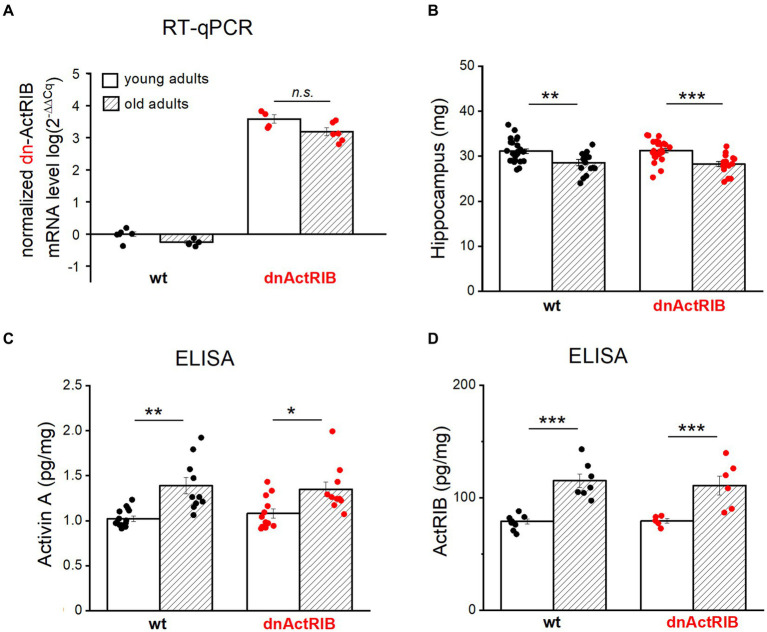
Activin A, a member of the transforming growth factor β (TGF-β) family, is widely recognized for its neurotrophic and neuroprotective function in the developing and injured brain, respectively. Moreover, in the healthy adult brain, activin A has been shown to tune signal processing at excitatory synapses in a fashion that improves cognitive performance. Because its level in human cerebrospinal fluid rises with age, we wondered whether activin A has a role in mitigating the gradual cognitive decline that healthy individuals experience in late-life. To interrogate the role of activin A in synaptic plasticity in the aging brain, we used an established transgenic mouse line, in which expression of a dominant-negative mutant of activin receptor IB (dnActRIB) serves to disrupt activin receptor signaling in a forebrain-specific fashion. In brain slices of young adult dnActRIB mice (2-4 months old), the NMDA receptor-dependent and -independent forms of long-term potentiation (LTP) at the Schaffer collateral-CA1 pyramidal cell synapse of the hippocampus were equally impaired relative to the extent of LTP measured in the wild-type preparation. Unexpectedly, the difference between the genotypes disappeared when the two forms of LTP were re-examined in slices from middle-aged mice (13-16 months old). Since the level of activin A and endogenous ActRIB both displayed a significant elevation in middle-aged hippocampus, we reasoned that with such a rise, the dominant-negative effect of the mutant receptors could be overcome. Substantiating this idea, we found that administration of recombinant activin A was indeed capable of restoring full-blown LTP in slices from young dnActRIB mice. Our data suggest that, beginning in the middle-aged brain, endogenous activin receptor signaling appears to become strengthened in an attempt to stave off cognitive decline. If further corroborated, this concept would also hold promise for new therapeutic venues to preserve cognitive functions in the aged brain.
激活素A是转化生长因子β(TGF-β)家族的成员之一,分别因其在发育中的大脑和受损大脑中的神经营养和神经保护功能而广为人知。此外,在健康的成年大脑中,激活素A已被证明以一种改善认知表现的方式调节兴奋性突触处的信号处理。由于其在人类脑脊液中的水平随年龄增长而升高,我们想知道激活素A是否在减轻健康个体在晚年经历的逐渐认知衰退中发挥作用。为了探究激活素A在衰老大脑突触可塑性中的作用,我们使用了一种已建立的转基因小鼠品系,其中激活素受体IB(dnActRIB)的显性负性突变体的表达以前脑特异性方式破坏激活素受体信号传导。在年轻成年dnActRIB小鼠(2 - 4个月大)的脑片中,相对于在野生型标本中测量的长时程增强(LTP)程度,海马体的沙费尔侧支 - CA1锥体细胞突触处依赖NMDA受体和不依赖NMDA受体的LTP形式均受到同等程度的损害。出乎意料的是,当在中年小鼠(13 - 16个月大)的脑片中重新检查这两种LTP形式时,基因型之间的差异消失了。由于激活素A和内源性ActRIB的水平在中年海马体中均显著升高,我们推断随着这种升高,突变受体的显性负性作用可能会被克服。证实这一想法的是,我们发现给予重组激活素A确实能够恢复年轻dnActRIB小鼠脑片的完全成熟的LTP。我们的数据表明,从中年大脑开始,内源性激活素受体信号传导似乎会增强,以试图避免认知衰退。如果进一步得到证实,这一概念也将为保护老年大脑认知功能的新治疗途径带来希望。