Xia Ying, Lin Xinda
Key Laboratory of Bioorganic Synthesis of Zhejiang Province, College of Biotechnology and Bioengineering, Zhejiang University of Technology, Hangzhou, 310014, People's Republic of China.
Bioresour Bioprocess. 2022 Aug 29;9(1):91. doi: 10.1186/s40643-022-00581-9.
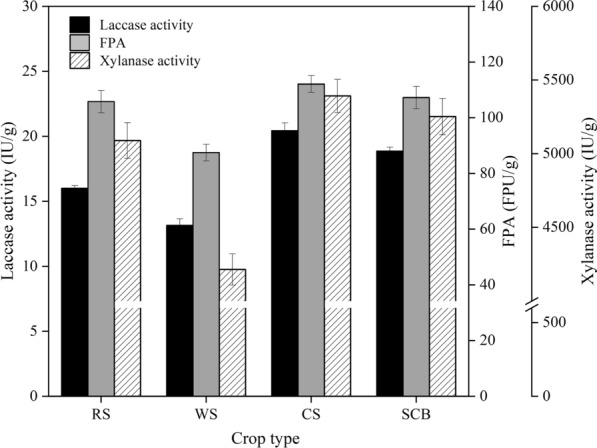
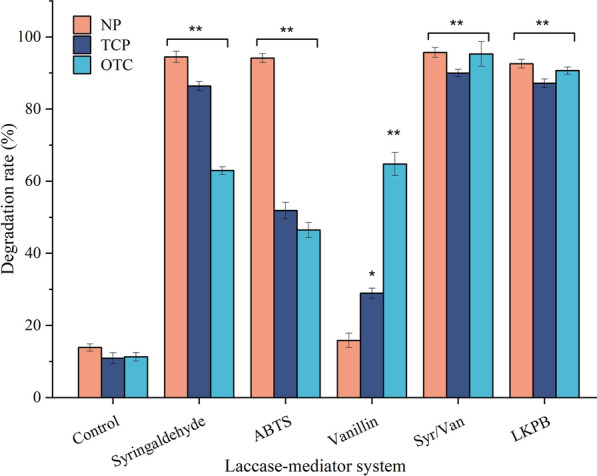
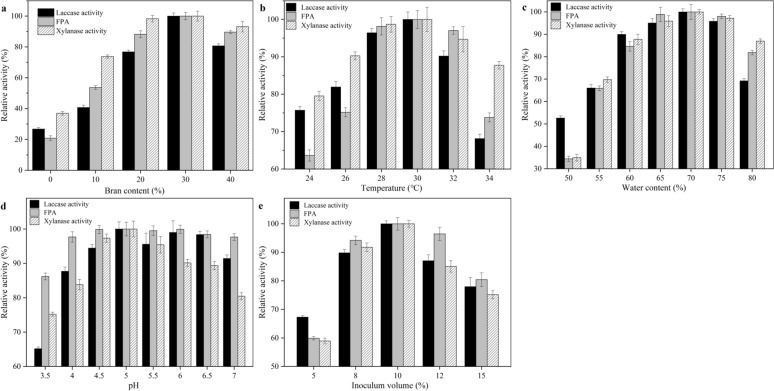
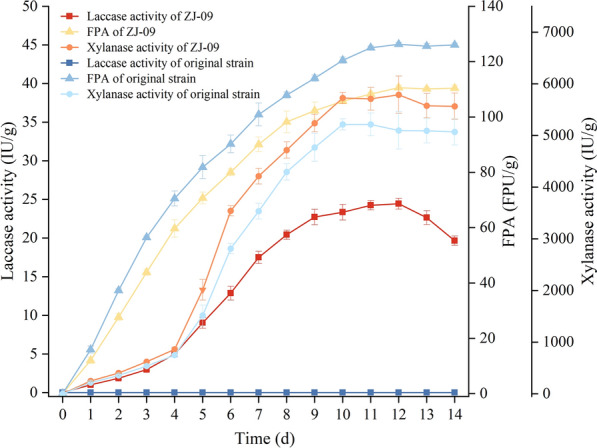
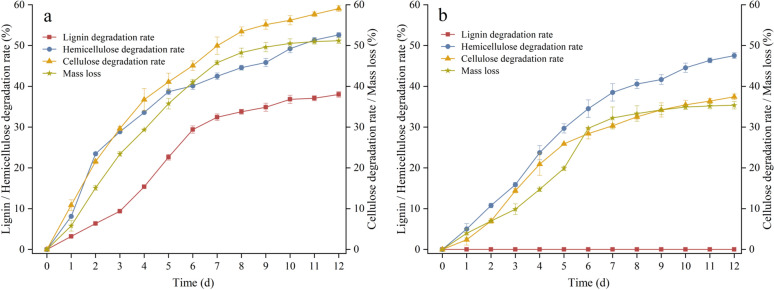
Efficient biodegradation of lignocellulosic biomass needs a battery of enzymes targeting cellulose, hemicellulose, and lignin. In this study, recombinant Trichoderma reesei ZJ-09 with Pycnoporus sanguineus laccase gene was used to degrade rice straw by in situ production of laccase, xylanase, and cellulases under solid-state fermentation (SSF). Effects of parameters on key enzymes (cellulase, xylanase, and laccase) in biodegradation during SSF were investigated. Under the optimized SSF conditions, the FPA, xylanase activity, and laccase activity reached 110.47 FPU/g, 5787.59 IU/g, and 24.45 IU/g, respectively, on day 12. The obtained recombinant T. reesei SSF system achieved efficient degradation of rice straw with the final mass loss up to 51.16% which was 1.4-fold higher than the host strain. Further, bioconversion of rice straw into a novel laccase-enriched koji for persistent organic pollutants bioremediation (LKPB) was conducted by the optimized SSF system. LKPB was found to degrade persistent organic pollutants (POPs) effectively without the addition of mediators. 4-h removal rates of three POPs mediated by LKPB (87.21% for 2,4,5-trichlorophenol, 92.45% for nonylphenol, and 90.73% for oxytetracycline) were comparable to those achieved by laccase-co-mediator system. The newly established recombinant T. reesei SSF system could be potential to effectively degrade lignocellulosic wastes as well as organic pollutants.
木质纤维素生物质的高效生物降解需要一系列针对纤维素、半纤维素和木质素的酶。在本研究中,携带血红密孔菌漆酶基因的重组里氏木霉ZJ-09用于在固态发酵(SSF)条件下原位产生漆酶、木聚糖酶和纤维素酶来降解稻草。研究了固态发酵过程中各参数对生物降解关键酶(纤维素酶、木聚糖酶和漆酶)的影响。在优化的固态发酵条件下,第12天时滤纸酶活(FPA)、木聚糖酶活性和漆酶活性分别达到110.47 FPU/g、5787.59 IU/g和24.45 IU/g。所获得的重组里氏木霉固态发酵系统实现了稻草的高效降解,最终质量损失高达51.16%,比宿主菌株高1.4倍。此外,通过优化的固态发酵系统将稻草生物转化为一种用于持久性有机污染物生物修复的新型富含漆酶的曲(LKPB)。发现LKPB在不添加介体的情况下能有效降解持久性有机污染物(POPs)。LKPB介导的三种POPs的4小时去除率(2,4,5-三氯苯酚为87.21%,壬基酚为92.45%,土霉素为90.73%)与漆酶-共介体系统的去除率相当。新建立的重组里氏木霉固态发酵系统有可能有效降解木质纤维素废物以及有机污染物。