Sánchez-García J, Asensio-Grau A, García-Hernández J, Heredia A, Andrés A
Instituto Universitario de Ingeniería de Alimentos Para el Desarrollo (IIAD), Universitat Politècnica de València, Camino de Vera s/n, 46022, Valencia, Spain.
Centro Avanzado de Microbiología de Alimentos (CAMA), Universitat Politècnica de València, Camino de Vera s/n, 46022, Valencia, Spain.
Bioresour Bioprocess. 2022 May 11;9(1):51. doi: 10.1186/s40643-022-00542-2.
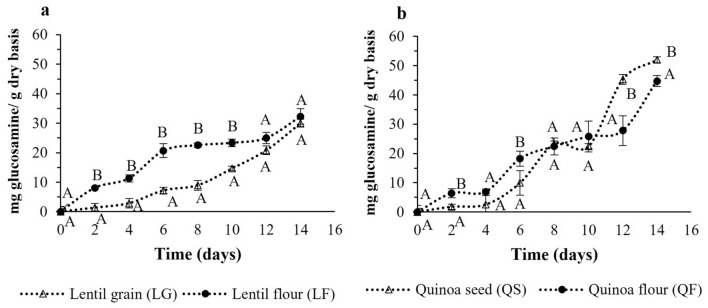
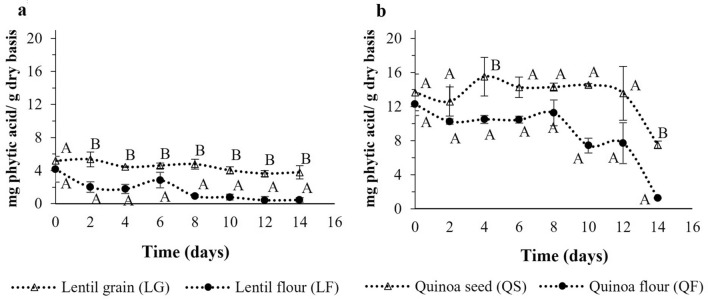
Solid-state fermentation (SSF) may be a suitable bioprocess to produce protein-vegetal ingredients with increased nutritional and functional value. This study assessed changes in phenol content, antinutrient content, biomass production and protein production resulting from the metabolic activity of Pleurotus ostreatus, an edible fungus, in lentils and quinoa over 14 days of SSF. The impact of particle size on these parameters was also assessed because the process was conducted in both seeds and flours. Fungus biomass increased during fermentation, reaching 30.0 ± 1.4 mg/g dry basis and 32 ± 3 mg/g dry basis in lentil grain and flour and 52.01 ± 1.08 mg/g dry basis and 45 ± 2 mg/g dry basis in quinoa seeds and flour after 14 days of SSF. Total protein content also increased by 20% to 25% during fermentation, in all cases except lentil flour. However, the soluble protein fraction remained constant. Regarding phytic acid, SSF had a positive impact, with a progressive decrease being higher in flours than in seeds. Regarding antioxidant properties, autoclaving of the substrates promoted the release of polyphenols, together with antioxidant activity (ABTS, DPPH and FRAP), in all substrates. However, these parameters drastically decreased as fermentation progressed. These results provide scientific knowledge for producing lentil- or quinoa-based ingredients with low antinutrient content enriched with protein fungal biomass.
固态发酵(SSF)可能是一种合适的生物工艺,用于生产具有更高营养价值和功能价值的植物蛋白成分。本研究评估了在14天的固态发酵过程中,食用菌平菇在扁豆和藜麦中的代谢活动所导致的酚类含量、抗营养成分含量、生物量生产和蛋白质生产的变化。由于该过程在种子和面粉中均进行,因此还评估了颗粒大小对这些参数的影响。发酵过程中真菌生物量增加,固态发酵14天后,扁豆籽粒和面粉中的真菌生物量分别达到30.0±1.4毫克/克干重和32±3毫克/克干重,藜麦种子和面粉中的真菌生物量分别达到52.01±1.08毫克/克干重和45±2毫克/克干重。除扁豆面粉外,在所有情况下,发酵过程中总蛋白质含量也增加了20%至25%。然而,可溶性蛋白质部分保持不变。关于植酸,固态发酵有积极影响,面粉中的植酸含量逐渐下降的幅度高于种子。关于抗氧化特性,底物的高压灭菌促进了所有底物中多酚的释放以及抗氧化活性(ABTS、DPPH和FRAP)。然而,随着发酵的进行,这些参数急剧下降。这些结果为生产低抗营养成分、富含蛋白质真菌生物量的扁豆或藜麦基成分提供了科学知识。