Laboratory of Environmental Chemistry, School of Architecture, Civil and Environmental Engineering, École Polytechnique Fédérale de Lausanne (EPFL), Vaud, Lausanne, Switzerland.
Departament of Biology, Healthcare and Environment, Faculty of Pharmacy and Food Sciences, University of Barcelona (UB), Barcelona, Catalunya, Spain.
Food Environ Virol. 2024 Sep;16(3):1-22. doi: 10.1007/s12560-024-09594-3. Epub 2024 Apr 22.
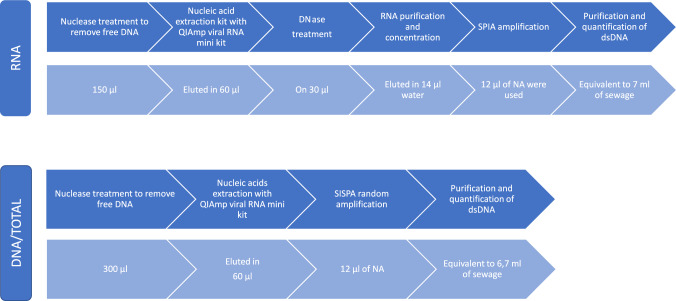
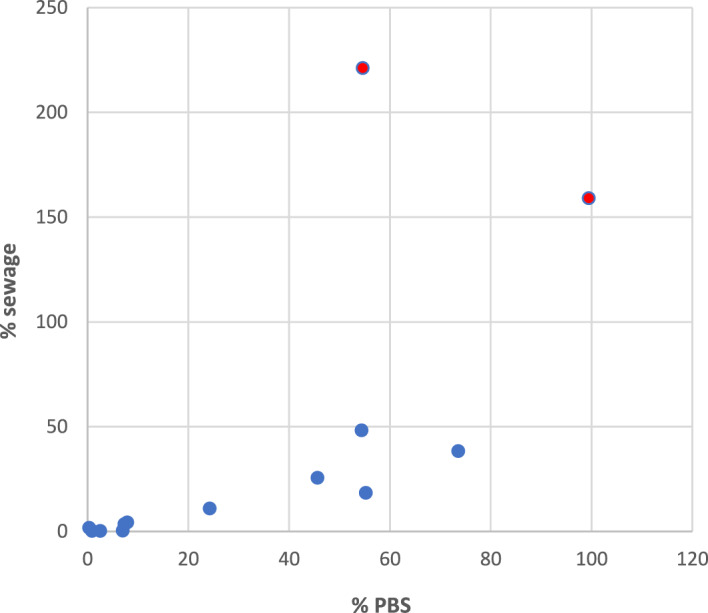
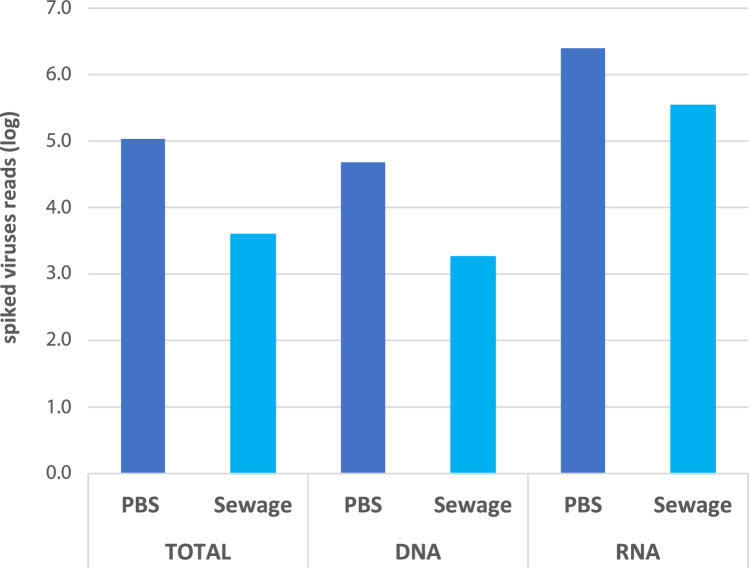
Viral metagenomics is a useful tool for detecting multiple human viruses in urban sewage. However, more refined protocols are required for its effective use in disease surveillance. In this study, we investigated the performance of three different preamplification pipelines (specific to RNA viruses, DNA viruses or both) for viral genome sequencing using spiked-in Phosphate Buffered Saline and sewage samples containing known concentrations of viruses. We found that compared to the pipeline targeting all genome types, the RNA pipeline performed better in detecting RNA viruses in both spiked and unspiked sewage samples, allowing the detection of various mammalian viruses including members from the Reoviridae, Picornaviridae, Astroviridae and Caliciviridae. However, the DNA-specific pipeline did not improve the detection of mammalian DNA viruses. We also measured viral recovery by quantitative reverse transcription polymerase chain reaction and assessed the impact of genetic background (non-viral genetic material) on viral coverage. Our results indicate that viral recoveries were generally lower in sewage (average of 11.0%) and higher in Phosphate Buffered Saline (average of 23.4%) for most viruses. Additionally, spiked-in viruses showed lower genome coverage in sewage, demonstrating the negative effect of genetic background on sequencing. Finally, correlation analysis revealed a relationship between virus concentration and genome normalized reads per million, indicating that viral metagenomic sequencing can be semiquantitative.
病毒宏基因组学是一种用于检测城市污水中多种人类病毒的有用工具。然而,为了在疾病监测中有效使用它,需要更精细的协议。在这项研究中,我们研究了三种不同的扩增前处理管道(针对 RNA 病毒、DNA 病毒或两者)在使用含已知浓度病毒的磷酸盐缓冲盐水和污水样品进行病毒基因组测序时的性能。我们发现,与针对所有基因组类型的管道相比,RNA 管道在检测污水中 RNA 病毒方面表现更好,能够检测到各种哺乳动物病毒,包括呼肠孤病毒科、小 RNA 病毒科、星状病毒科和杯状病毒科的成员。然而,DNA 特异性管道并没有提高哺乳动物 DNA 病毒的检测能力。我们还通过定量逆转录聚合酶链反应测量了病毒回收率,并评估了遗传背景(非病毒遗传物质)对病毒覆盖度的影响。我们的结果表明,大多数病毒在污水中的回收率普遍较低(平均为 11.0%),在磷酸盐缓冲盐水中较高(平均为 23.4%)。此外,污水中添加的病毒基因组覆盖度较低,表明遗传背景对测序有负面影响。最后,相关性分析显示病毒浓度与每百万基因组标准化读取数之间存在关系,表明病毒宏基因组测序具有半定量能力。