Division of Micro and Nanosystems, KTH Royal Institute of Technology, Malvinas väg 10, Stockholm, 100 44, Sweden.
Division of Nanobiotechnology, Science for Life Laboratory, KTH Royal Institute of Technology, Tomtebodavägen 23a, Solna, 171 65, Sweden.
Adv Sci (Weinh). 2024 Jul;11(25):e2401859. doi: 10.1002/advs.202401859. Epub 2024 Apr 24.
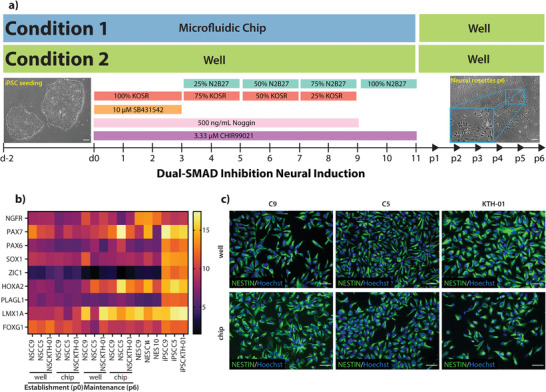
The clinical translation of induced pluripotent stem cells (iPSCs) holds great potential for personalized therapeutics. However, one of the main obstacles is that the current workflow to generate iPSCs is expensive, time-consuming, and requires standardization. A simplified and cost-effective microfluidic approach is presented for reprogramming fibroblasts into iPSCs and their subsequent differentiation into neural stem cells (NSCs). This method exploits microphysiological technology, providing a 100-fold reduction in reagents for reprogramming and a ninefold reduction in number of input cells. The iPSCs generated from microfluidic reprogramming of fibroblasts show upregulation of pluripotency markers and downregulation of fibroblast markers, on par with those reprogrammed in standard well-conditions. The NSCs differentiated in microfluidic chips show upregulation of neuroectodermal markers (ZIC1, PAX6, SOX1), highlighting their propensity for nervous system development. Cells obtained on conventional well plates and microfluidic chips are compared for reprogramming and neural induction by bulk RNA sequencing. Pathway enrichment analysis of NSCs from chip showed neural stem cell development enrichment and boosted commitment to neural stem cell lineage in initial phases of neural induction, attributed to a confined environment in a microfluidic chip. This method provides a cost-effective pipeline to reprogram and differentiate iPSCs for therapeutics compliant with current good manufacturing practices.
诱导多能干细胞(iPSCs)的临床转化在个性化治疗方面具有巨大潜力。然而,目前面临的主要障碍之一是,生成 iPSCs 的现行工作流程既昂贵又耗时,且需要标准化。本文提出了一种简化且具有成本效益的微流控方法,用于将成纤维细胞重编程为 iPSCs,并进一步分化为神经干细胞(NSCs)。该方法利用微生理技术,将重编程所需试剂减少了 100 倍,输入细胞数量减少了 9 倍。通过微流控重编程生成的 iPSCs 表现出多能性标记物的上调和成纤维细胞标记物的下调,与在标准培养条件下重编程的 iPSCs 相当。在微流控芯片中分化的 NSCs 表现出神经上皮标记物(ZIC1、PAX6、SOX1)的上调,突出了其神经系统发育的倾向。在传统的微孔板和微流控芯片上获得的细胞通过批量 RNA 测序进行重编程和神经诱导比较。芯片上的 NSCs 的通路富集分析显示神经干细胞发育的富集,并在神经诱导的初始阶段促进向神经干细胞谱系的分化,这归因于微流控芯片中的受限环境。该方法提供了一种符合现行良好生产规范的成本效益型 iPSCs 重编程和分化治疗方法。